


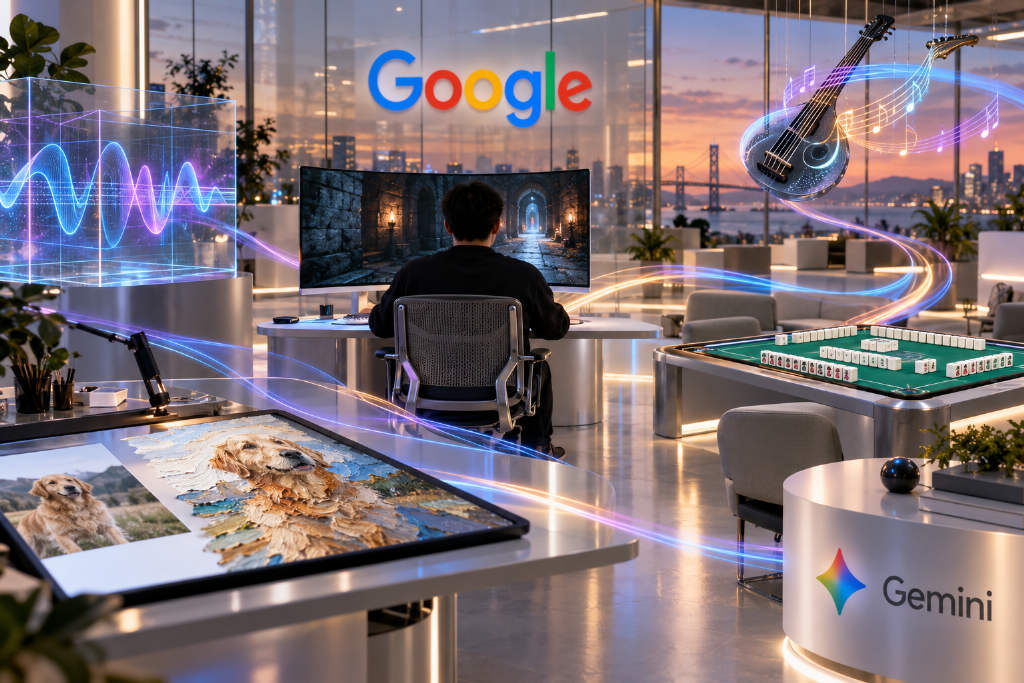
Google’s official X account said at 2:38 a.m. Taipei time on Oct. 15 that 「Gemini 4 Argon is here」, then followed up with a thread showing five team-built examples for the newly rolled-out flagship model. The posts came after Google’s official blog announced broader availability for Argon.
According to the source material, Argon had previously been limited to cybersecurity partners. It is now available to developers, enterprises, and paid subscribers.
Five examples span animation, games, painting, and music
The five demos were presented as a cross-section of what Argon can produce across graphics, code, and multimodal generation.
The first example used the mathematics of Fourier epicycles to create an animation of a pelican riding a bicycle. Google said Argon handled the physics, motion, and video rendering, while the background music was generated and synchronized with Lyria 3.5. In the post, Google wrote: 「Use complex mathematical principles like Fourier epicycles to animate a pelican riding a bicycle. Argon takes care of the physics, motion, and video render with background music generated and synced using Lyria 3.5.」
The second example showed Argon generating a stylized playable game with 3D rendering in Three.js, including jump-scare elements, in a single shot. Google described it this way: 「Build playable, stylized games with 3D renderings in Three.js with Argon (complete with jump scares), all in one shot.」 The build was credited to @ammaar.
The third example turned standard photos into digital oil paintings. Google said the prompt generated a custom multi-pass canvas renderer in Python through Argon. The post read: 「Go from standard photos to digital oil paintings. This prompt in Argon generates a custom multi-pass canvas renderer in Python.」 It was credited to @_philschmid.
The fourth example was an interactive WebGL Mahjong game built in the agent-development platform Antigravity, with responsive spring physics and sound effects. Google wrote: 「Play an interactive WebGL Mahjong game built in @Antigravity featuring responsive, realistic spring physics and sound effects.」 The example was credited to @soumyadesigm.
The fifth example combined WebMIDI and Three.js to make playable 3D musical instruments. Google’s post said: 「Make 3D musical instruments using Argon, WebMIDI, and Three.js.」 The build was credited to @alexanderchen.
Model specs and temporary pricing
Google’s Gemini API documentation lists the model ID as gemini-4-argon. It has a shared context window of 1,048,576 tokens across input and output and accepts text, images, video, audio, and PDF files.
Promotional pricing lasts through Nov. 30. During that period, input costs $2 per million tokens and output costs $10 per million tokens. From Dec. 1, those rates rise to $4 and $20.
For consumer access, the source says users need a Google AI Pro or Ultra subscription to use Argon in the Gemini app and in AI Mode in Search. The free plan does not include access.
Google cites internal engineering use
Google also pointed to internal adoption data. The company said engineering teams using Argon inside Antigravity saw agent-submitted code volume increase by more than 35%, while code rollbacks fell by nearly one-third.
Benchmark results show strengths, but not across every test
A Google DeepMind model card cited in the source says Argon scored 68.9% on the Vals Index, a benchmark for economically relevant tasks. That put it above OpenAI GPT-6 Astra at 63.1% and Anthropic Claude Opus 5.5 at 67.0%.
On the long-horizon software engineering benchmark DeepSWE v1.1, Argon posted 77.9%, also leading the comparison referenced in the article.
The same table showed weaker results elsewhere. On Terminal-bench 4.0, Argon scored 57.4%, behind Claude Opus 5.5 at 66.4%. The source also mentioned FrontierSWE v... but did not provide the rest of the line or additional figures.
Taken together, the showcase thread, API details, pricing, internal usage data, and benchmark comparisons outline how Google is positioning Argon after its broader release.