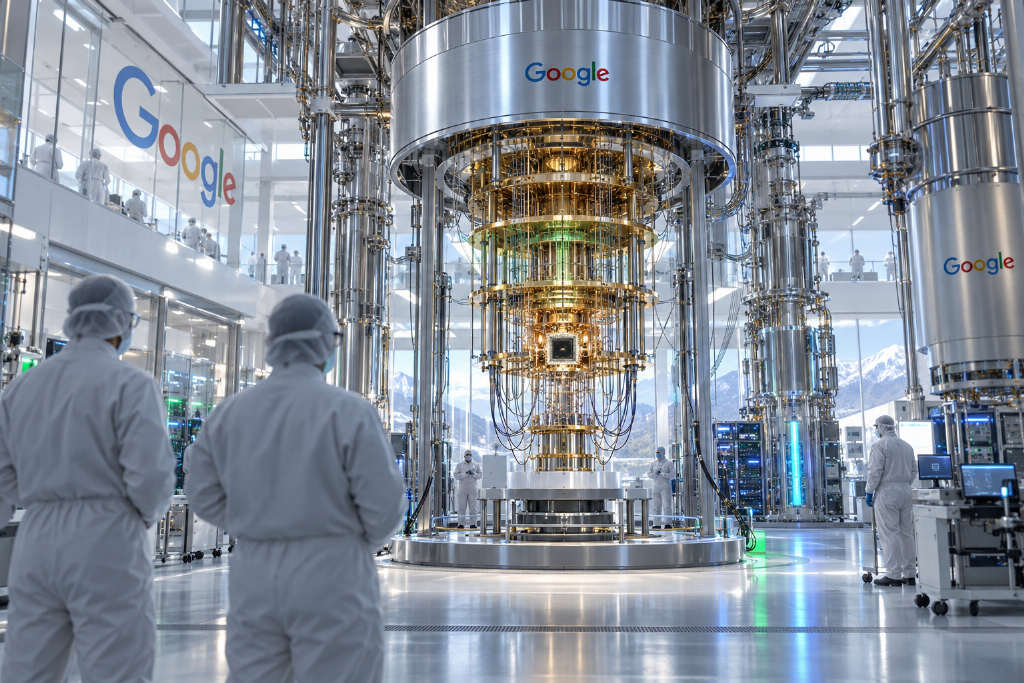
Google Quantum AI said in a paper published in Science that its "magic state cultivation" technique reduced errors by about 40 times on the Willow processor and produced T states with 99.99% logical fidelity. Magic states are single-use resources required to run useful quantum programs, and Google cited estimates showing that producing them can consume as much as 95% of a quantum computer’s total capacity, leaving limited room for actual computation. The standard method before this was magic-state distillation, proposed in 2004 by physicists Sergei Bravyi and Alexei Kitaev, which relies on large qubit factories dedicated to that task. Google researchers proposed a lower-cost cultivation route in 2024, describing it as more like a filter: rough magic states are injected into a small region of the chip, subjected to a sequence of checks, defective attempts are discarded, and the successful ones are gradually amplified. In the reported experiment, only about 8% of attempts passed all checks. The work used as many as 54 of Willow’s 105 qubits. The paper also said that factoring an RSA-2048 key would require magic states with an error rate of roughly one in ten billion, about a million times cleaner than the result achieved in this experiment.
Google Quantum AI published a paper in Science saying its "magic state cultivation" technique reduced errors by about 40x on the Willow processor and produced T states with 99.99% logical fidelity.
Magic states are one-shot resources needed to run useful quantum programs. Each use consumes the state. Google cited estimates showing that the cost of producing magic states can take up as much as 95% of a quantum computer’s total capacity, leaving limited space for actual computation.
From distillation to cultivation
The standard approach before this was magic-state distillation, proposed in 2004 by physicists Sergei Bravyi and Alexei Kitaev. That method requires large qubit factories devoted to this single task.
Google researchers proposed a cheaper cultivation route in 2024. The process was described as acting more like a filter: rough magic states are injected into a small region of the chip, put through a sequence of checks, defective attempts are rejected, and the ones that pass are gradually amplified.
What the experiment showed
According to the paper, only about 8% of attempts passed all checks in the experiment. Put another way, more than 90% of attempts were discarded to keep one clean state.
The experiment used up to 54 of Willow’s 105 qubits. The paper also said that factoring an RSA-2048 key would require magic states with an error rate of about one in ten billion, roughly a million times cleaner than what was achieved here.
Link to RSA-2048 estimates
The report added that cultivation is one of the factors behind Gidney’s 2025 estimate that RSA-2048 encryption could be broken with fewer than one million noisy qubits. That compares with his 2019 estimate of 20 million, a 20x drop.
This article was originally published by Bit.Fan. For more cryptocurrency news and market insights, visit www.bit.fan. Disclaimer:
The market information, project data, and third-party content displayed on this platform are for industry information sharing only and do not constitute any form of investment advice or return commitment.
Cryptocurrency trading carries high risks. Users should fully assess their risk tolerance and make independent decisions. All profits, losses, and legal responsibilities are borne by the users themselves.