
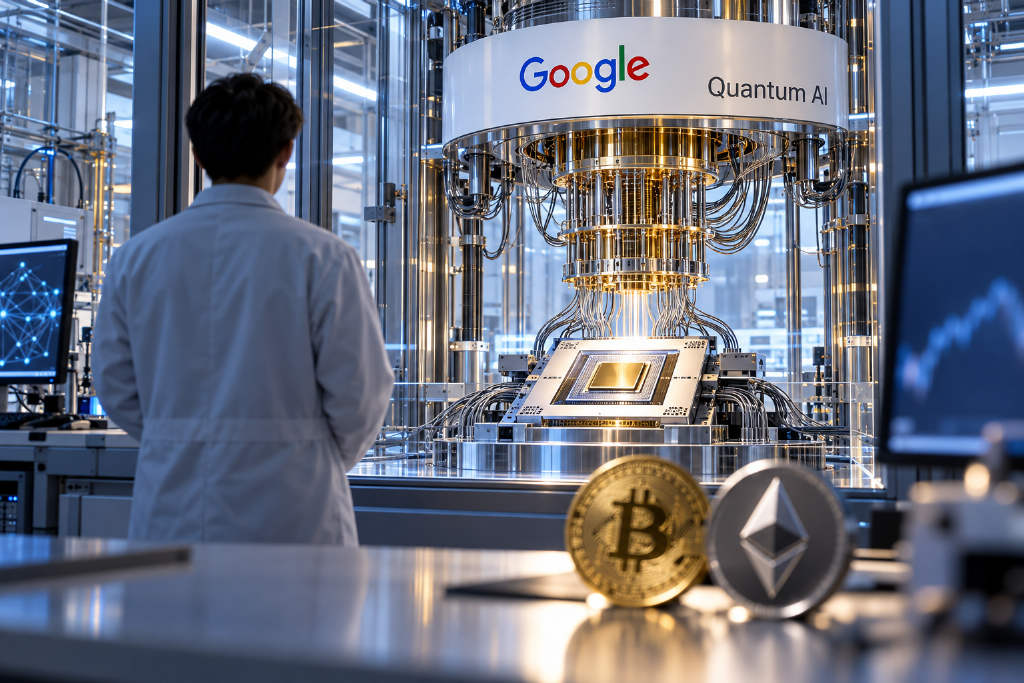
Google’s latest quantum computing result led Decrypt’s newest Morning Minute, with the newsletter arguing that the breakthrough makes the long-term debate around crypto security more concrete while leaving Bitcoin safe for now.
The daily newsletter is written by Tyler Warner, and the piece notes that the analysis and opinions are his own and do not necessarily reflect those of Decrypt.
Google cuts a major class of quantum errors, but not nearly enough to threaten Bitcoin today
The report says an Ethereum researcher told large holders eight days ago to move their coins. Google’s newly published result now makes that warning look less like paranoia and more like an early response to a real technological trajectory.
According to a new paper in Science, Google Quantum AI reduced a critical class of quantum errors by roughly 40-fold on its Willow chip. The technique targets what the article describes as one of quantum computing’s biggest bottlenecks: generating the clean, single-use resources needed for certain operations. By some estimates cited in the piece, that process can consume as much as 95% of a machine’s capacity.
Rather than relying on dedicated qubit factories to purify those resources, Google filters them. It injects a rough state, runs it through a sequence of checks, and discards the 92% that fail. The states that remain reach 99.99% fidelity.
That still does not put wallets at immediate risk. The article says breaking an RSA-2048 key would require error rates around one in 10 billion, roughly a million times cleaner than what Google has just demonstrated.
Research is moving fast, and the qubit estimates keep falling
The newsletter argues that the larger point is the pace of progress. It highlights a set of estimates showing how quickly the target has moved:
- In 2019, cracking RSA-2048 was estimated to require 20 million noisy qubits.
- By 2025, that figure had fallen to under 1 million.
- In a March 2026 white paper, Google put Bitcoin’s elliptic curve cryptography below 500,000 physical qubits.
Willow, by comparison, has 105 qubits.
The article also references another report headlined Google Says It Just Cracked One of Quantum Computing's Biggest Bottlenecks, framing the latest result as a major engineering advance rather than evidence that practical attacks on crypto systems are already here.
Justin Drake’s immediate concern is AI-led math, not quantum hardware
One of the sharper points in the piece is that Ethereum researcher Justin Drake is not mainly worried about quantum computing. The article says he believes AI-driven mathematics could break elliptic curves first, and do so on ordinary hardware, in “months not years.”
That is why his advice to large holders was to move funds to fresh addresses that have never signed a transaction. Once an address signs, its public key is exposed. In the newsletter’s framing, crypto is now being pressured along two tracks at once: quantum progress and AI progress.
Exchanges, chains, and protocols are already preparing for migration
The newsletter says some of the sector’s biggest players are already moving. Coinbase spent the week arguing that migration needs to begin now. Sui is already running quantum-safe transactions on a test network. Ethereum, Zcash, and Near all have plans aimed at becoming quantum-resistant.
The piece ends that section with a simple conclusion: crypto leaders are likely to prepare, but Google’s result was a reminder that the clock is ticking.
Macro, crypto, and market moves
Major crypto assets were green and rebounding after a Thursday morning selloff. Decrypt listed the following levels:
- BTC +1% at $82.7k
- ETH +4% at $2,480
- SOL +4% at $107
- HYPE +2% at $82
- ZEC +12% at $1,240
Top altcoin movers included TIA (+27%), INJ (+27%), ZRO (+22%), and NEAR (+15%).
In commodities, oil was up 2% at $97.5 and gold gained 0.8% to $4,200. Stock futures were slightly green despite hot CPI and PPI prints this week, with the Dow up 0.4% and the Nasdaq down 0.05%.
Policy, institutional, and corporate developments
MSCI finalized new index rules for non-operating companies, putting Strategy at risk of being removed from its global indexes. The final list of affected companies is due November 11. The newsletter also noted MSTR was down 3%.
The White House no longer has a crypto lead after adviser Patrick Witt announced his departure for the private sector, marking the first time since Trump took office that the role has gone unfilled, according to the piece.
A report from Castle Labs said Solana increased its RWA market share from 4.5% to 26% over the past year.
Chainalysis reported that the U.S. became a net importer of Bitcoin for the first time since 2022, pointing to institutions buying more than retail investors are selling.
Bitwise CIO Matt Hougan argued that Bitcoin benefits whether the AI trade booms or breaks down. As summarized in the newsletter, his case is that AI-driven abundance bids up scarce assets, an AI-led recession triggers the kind of money printing Bitcoin “was built for,” and even a muddle-through still brings ETF and treasury inflows.
Russia is banning peer-to-peer crypto trading from July 1, 2027 under updated Bank of Russia guidance, forcing all trades through licensed brokers or registered exchanges.
Mastercard launched its Global Money Platform on BVNK, the crypto firm it bought for roughly $1.8 billion in August. The platform gives banks and fintechs a single account that can hold fiat and stablecoins, with API-based conversion between the two.
Ledger introduced Atom, a touchscreen Android device it calls a signer rather than a wallet. It runs Ledger OS on a secure chip isolated from Android and includes a hardware switch that physically cuts the camera and microphone.
Binance US is trying to raise up to $100 million at a $1 billion valuation. The article says that is down 78% from the $4.5 billion valuation it held in 2022, before its parent company’s settlement with U.S. authorities damaged its market share.
Corporate treasuries and ETF flows
Spot Bitcoin ETFs recorded $5 million in net inflows on Thursday, while spot Ethereum ETFs saw $60 million in net outflows.
Meme coin and on-chain token tracker
Meme coin leaders were mostly green, up 2% to 5%. DOGE rose 3%, SHIB 4%, PEPE 4%, PENGU 4%, TRUMP 4%, SPX fell 1%, and BONK gained 4%.
On Robinhood chain, leaders were up 10% to 20%. PONS rose 9% to $226 million, AI climbed 20% to $107 million, and Cashcat added 15% to $115 million. HOOKR (+30%), Orbio (+25%), and MEME (+30%) were among the top movers.
On Solana, the biggest movers listed were FTR (+2000%), 1 (+3000%), Dacity (+1200%), and Bubble (+1800%).
Tokens, airdrops, and protocol revenue
Papertrade led on-chain protocols in revenue on Thursday with $5.98 million, followed by Hyperliquid at $3.46 million and Pump.fun at $2.08 million.
The newsletter says Pump.fun’s Custom Pairs feature has quietly pulled roughly 5.9 million PUMP out of circulation since launching last month, equal to about 0.33% of the float.
Jupiter rolled out its own Papertrade-like product offering 1000x leverage on major crypto assets and posted $1 billion in volume on its first day.
NFTs
NFT leaders were mostly flat. CryptoPunks were unchanged at 31 ETH, BAYC slipped 1% to 5.4 ETH, and Pudgy was unchanged at 2.42 ETH.
Yield Field Deeds (+14%), Argonauts (+12%), and OTC Desks (+75%) led the top movers.