


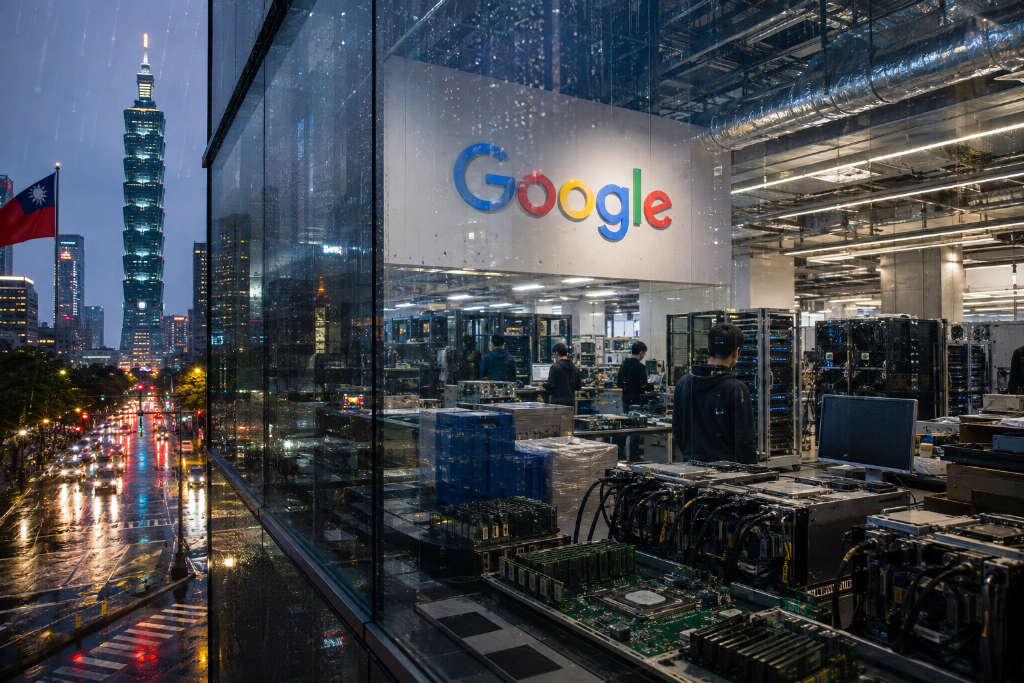
Google will expand its AI infrastructure research and development center in Taipei’s Shilin district, increasing office space by 60%, Chief Technology Officer and Vice President of AI Infrastructure Amin Vahdat said on Sept. 2 at SEMICON Taiwan 2026. The company has not disclosed the investment amount, planned hiring, or the completion timeline.
Shilin AI center set for expansion
According to Central News Agency, Vahdat announced the expansion during the event’s opening keynote. The AI infrastructure R&D center in Taipei’s Shilin district will add 60% more office space.
The center opened at the end of 2025. It has more than 10 laboratories and employs hundreds of staff. Speaking to reporters after the event, Vahdat said Google’s operations in Taiwan are expected to keep growing, but he did not provide figures for capital spending, additional headcount, or the project schedule.
This year marks Google’s 20th anniversary in Taiwan. Taiwan is currently Google’s largest hardware engineering R&D base outside the United States, according to the report. The company opened its Changhua data center in 2013 and has invested in several submarine cable projects connected to Taiwan.
Taiwan’s role now covers co-design of AI systems
Vahdat said Taiwan is a key engineering hub linking the broader AI hardware ecosystem. Its role goes beyond chips and extends to advanced packaging, liquid cooling, and high-power delivery systems.
He said a significant share of Google’s hardware design and manufacturing work is completed in Taiwan together with local companies, with Google engineering teams working side by side with Taiwanese partners. After Google’s in-house chips come off Taiwan Semiconductor Manufacturing Co. production lines, Taiwan-based teams handle bring-up, testing, and performance and functional validation before the chips are handed to software teams.
Vahdat also said Google is discussing next-generation hardware with multiple Taiwan partners. Topics include rack-level architecture, design for manufacturability, and system reliability. He said current computing platforms would be difficult to build without this level of deep co-design.
Computing demand rising about 10x annually
As AI models and services improve, demand for computing is growing at about 10x per year, Vahdat said, adding that the scale is beyond anything he had seen before.
Asked what the most severe constraint could be over the next 18 months, he said the bottleneck may shift quickly between power supply, chip availability, memory, cooling, rack lead times, and networking. No single link in that chain can be neglected, he said.
Vahdat also said energy is a constraint for both Google and Taiwan. Google will continue investing in renewable energy, batteries, and geothermal power as it works toward its round-the-clock carbon-free energy goal. For Taiwan, he said the focus should be on improving manufacturing automation and energy efficiency while strengthening coordination across the supply chain.