
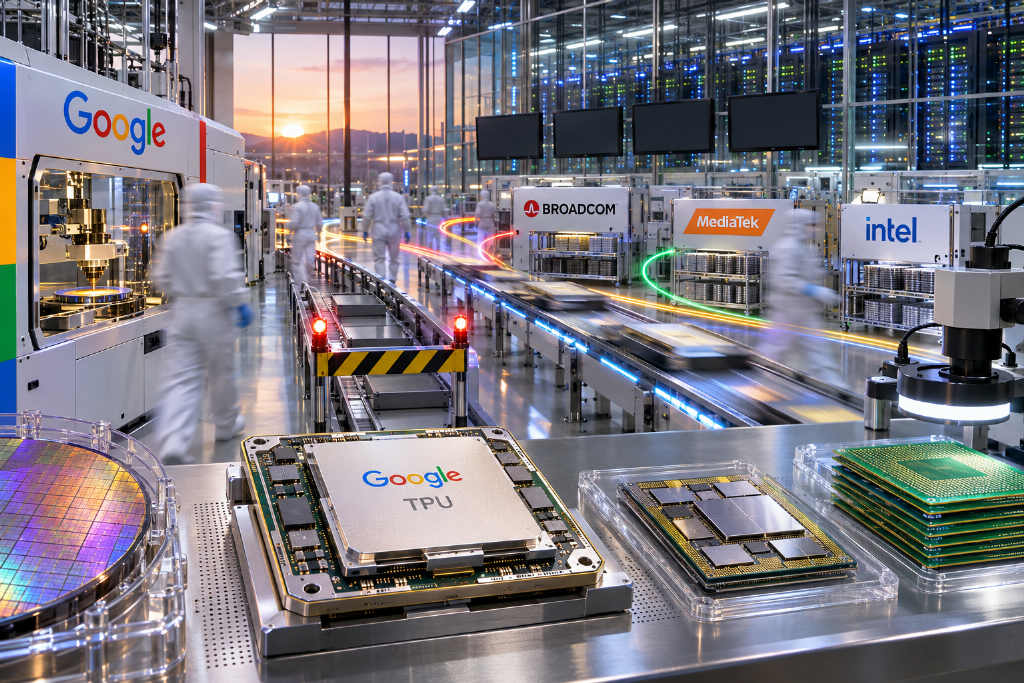
Google’s transition to a new generation of in-house AI accelerators is facing a new source of uncertainty. StatementDog, a stock fundamentals analysis platform, said in a recent note that if TPU v9 is delayed again, its mass-production ramp could be squeezed before v10 arrives. That, in turn, could alter the shipment outlook for Google’s custom compute chips and affect the timing and scale of orders tied to Broadcom (AVGO), MediaTek (2454), and Intel (INTC).
StatementDog puts 2028 TPU v9 shipments at about 2.3 million units
According to StatementDog’s estimates, the TPU v9 generation could ship about 1.9 million Humufish units and about 400,000 Triggerfish units in 2028, for a combined total of roughly 2.3 million. At the same time, it raised its 2028 forecast for the previous-generation Zebrafish, or v8t.
The revision reflects a scenario outlined by StatementDog in which the new chip generation ramps more slowly, forcing Google to rely on older products for longer. In its view, the mix between generations matters as much as total TPU shipments. A larger contribution from older chips could still support growth in compute capacity, but it would leave the timing of the next performance upgrade less certain.
Core A design changes are seen as the main reason for the delay
Pressure around MediaTek’s target of mass-producing TPU v9 in the first quarter of 2028 is not new. Chain News previously reported that Google had delayed development by about three weeks after modifying the Core A design for TPU v9. Because the Core B and I/O work handled by MediaTek must align with Core A, that schedule was also affected.
That report said the sampling target for November 2026 remained unchanged, while the first tape-out was expected to move to January 2027. The production tape-out version was projected for the second quarter, and shipments could slip to the first quarter of 2028.
StatementDog’s latest analysis points in the same direction. It said MediaTek is still targeting first-quarter 2028 mass production for its second-generation data center ASIC, leaving little room for another delay. The design issue involves the complexity of Core A, and the changes also affect the associated compute die and I/O die.
Packaging and substrate yield remain key variables
On the packaging side, TrendForce has also said that v9 is expected to use Intel’s EMIB-T packaging technology. Substrate yield, it said, remains a key challenge for production scale and cost competitiveness.
Different assumptions for Broadcom, Intel, and MediaTek
StatementDog’s model lays out separate assumptions for how Broadcom, MediaTek, and Intel could be affected. It also made clear that these allocation scenarios are part of its own model and are not official information.
Broadcom
The model assumes the entire v9 generation is supplied by MediaTek, while v10 would assign Merope to Broadcom and Icefish to MediaTek. StatementDog said that if the v9 ramp window is shortened, any shift in supplier structure could move closer to the point when v9 capacity is actually established.
Intel
StatementDog said chip design execution is a separate constraint on packaging demand. Its model cuts the v9 shipment forecast while describing EMIB substrate yield progress as being in line with expectations. Under that framework, an improvement in packaging yield alone may not be enough to drive the chip volumes previously expected if the design schedule slips.
MediaTek
As the design partner for v9, MediaTek sits at the center of the project timeline. Whether it can hold the first-quarter 2028 mass-production target is the clearest checkpoint for the market.
Broadcom’s role is still debated
Views in the market are not aligned on Broadcom’s role in Google’s TPU program. Chain News previously cited a UBS supply-chain survey saying Broadcom had been “deeply involved” in the two generations after v8i. Under that view, v9 is expected to begin ramping at the end of 2027 and contribute most of the 2028 shipments, while v10 would move to 2-nanometer production, begin shipping at the end of 2028, and become the largest contributor in 2029.
The key question is whether v9 can build meaningful volume before overlapping with v10
StatementDog said the next point to watch is whether v9 can establish meaningful production volume before it overlaps with v10. That will shape how much Google expands its TPU deployment and when that demand reaches each supplier.
For now, though, the market still lacks fuller verification on v9 tape-out timing, mass-production schedules, and supplier allocation. Until that happens, shipment figures and order attribution at this stage remain largely the estimates of institutions and research firms.



