
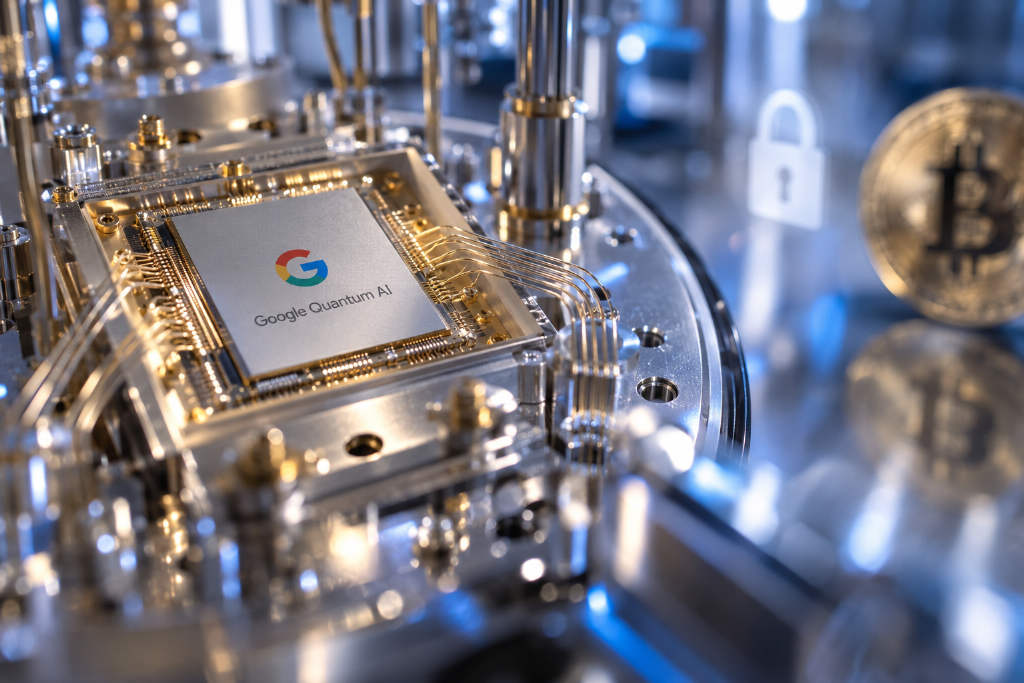
Google said it has turned one of quantum computing’s most promising paper ideas into something that works on a chip.
In a paper published Thursday in Science, the company’s Quantum AI team reported that a technique known as magic state cultivation cut errors by about 40 times on its Willow processor.
Why the result matters
Cheaper quantum computers would matter well beyond physics labs. It would move forward the point at which those systems can do useful work, such as designing drugs and new materials. It would also pull closer the day when quantum machines could break the encryption that protects bank logins and Bitcoin wallets.
Quantum computers run on qubits, or quantum bits, which can hold a blend of 0 and 1 at the same time. That lets them explore many possible answers in parallel. They are also extremely fragile: a small amount of heat or electrical noise can flip a qubit and ruin a calculation. That is why error correction sits at the center of the field. The idea is to spread one piece of information across many qubits so mistakes can be detected and fixed.
Error correction works well for simpler operations, but a useful quantum program also needs a harder class of operations that cannot be protected in the same way. To execute them, the machine first has to create magic states. Those states act like single-use fuel cells for the operations, and each one is consumed as soon as it is used.
The cost problem behind magic states
Producing clean magic states has long been expensive. Google said some estimates place the cost at as much as 95% of a quantum computer’s total capacity, leaving little room for the actual computation.
In 2004, physicists Sergei Bravyi and Alexei Kitaev laid out the standard solution: magic state distillation. The method takes many noisy magic states and refines them down into a smaller number of clean ones. It works, but it requires sprawling qubit “factories” that serve little other purpose.
In 2024, Google researchers proposed a cheaper route called magic state cultivation. Instead of a factory, the method behaves more like a filter. It injects a rough magic state into a small patch of the chip, runs a sequence of checks, throws out any attempt that shows a flaw, and keeps the survivors moving forward. That paper went as far as suggesting that additional distillation “may never be needed in practice.”
What Google showed on Willow
“On Google Quantum AI’s Willow processor, our protocol achieved an extraordinary 40-fold reduction in errors relative to un-cultivated states. And we got T-states with a record logical fidelity of 99.99%,” Google said.
The screening cost remains steep. Only about 8% of attempts passed every check, which means the chip discards more than nine out of every 10 tries to keep one clean state.
Until this experiment, cultivation had been tested only in theory and computer simulations. Google now says it has demonstrated the method on hardware.
RSA and Bitcoin security enter the discussion again
Cultivation is also one of the techniques behind Gidney’s 2025 estimate that RSA-2048 encryption could be broken with fewer than 1 million noisy qubits, a 20-fold drop from the 20 million he estimated in 2019.
Google kept pushing that line of work in March. A Quantum AI whitepaper co-authored with Ethereum Foundation researcher Justin Drake and Stanford cryptographer Dan Boneh put the cost of breaking Bitcoin’s elliptic curve cryptography at fewer than 500,000 physical qubits. That cryptography is the math that prevents someone from deriving a private key from a public address.
The article also points to Google’s Quantum Echoes experiment last October, described as the first verified quantum speedup on real hardware.
Still far from draining wallets
That does not mean anyone is emptying wallets with this result. The experiment used at most 54 of Willow’s 105 qubits, and the paper notes that factoring an RSA-2048 key would require magic states with errors around one in 10 billion, roughly 1 million times cleaner than what Google has now achieved.
Google said the next step is to run cultivation at larger scale. The team projects that halving Willow’s underlying hardware noise would push magic-state errors down to about two in 100,000, because errors in the process shrink with the cube of the chip’s noise level.