
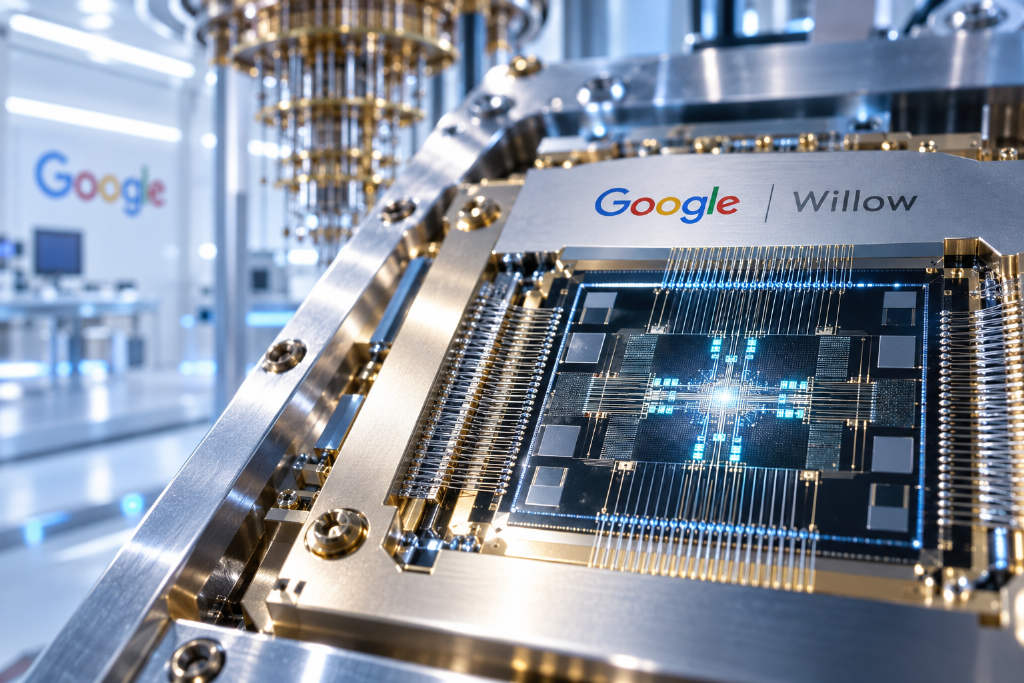
Google Quantum AI said Thursday that it used a technique called magic state cultivation on its Willow processor to reduce the error rate of magic states by about 40x, producing T states with logical fidelity of 99.99%. The results were published in Science.
The advance addresses a persistent bottleneck in quantum computing: producing high-quality magic states cheaply enough for useful machines. Google said magic states are a one-shot resource required for high-value quantum programs, and some academic estimates have suggested that making them could consume as much as 95% of a quantum computer’s total capacity.
From theory to a physical chip
Google said one of the field’s most promising theoretical ideas has now been turned into a technique that runs on real hardware. In the paper, the team showed that magic state cultivation worked on its latest Willow processor and sharply lowered the error rate relative to uncultivated raw states.
In Google’s words, “On Google Quantum AI’s Willow processor, our protocol achieved an extremely significant 40x reduction in error rate relative to the uncultivated raw state. We obtained T states with record logical fidelity of 99.99%.”
The implications go beyond lab physics. If the approach continues to improve, it could bring forward practical quantum computing applications in areas such as drug design and new materials. It also narrows, at least in theory, the distance to machines capable of attacking the encryption used in bank login credentials and Bitcoin wallets.
Why magic states matter
Quantum computers are built on qubits. Unlike classical bits, which are either 0 or 1, qubits can exist in superposition and explore many possible outcomes at once. They are also fragile. Small amounts of heat or weak electromagnetic noise can flip a qubit and derail a computation.
That is why quantum error correction has become central to the industry. By spreading information across many physical qubits, a system can catch and repair some faults. But complex, commercially valuable quantum programs also require higher-order operations that cannot be protected in the same way. To run those operations, a machine first needs magic states.
The report described them as disposable fuel cells for complex computation: once used, they are consumed. Producing low-noise, high-purity magic states has historically been expensive, leaving much of a machine’s capacity tied up in resource preparation rather than computation itself.
Replacing distillation with cultivation
In 2004, physicists Sergei Bravyi and Alexei Kitaev proposed the standard solution, magic state distillation. That process takes many noisy, low-quality magic states and filters them through multiple rounds to yield a smaller number of cleaner ones. It works, but it requires large factories of dedicated physical qubits that do little else.
In 2024, Google researchers proposed a lower-cost alternative called magic state cultivation. The method acts more like a precision filter. A rough raw magic state is injected into a very small region of the chip, then subjected to a chain of checks. Any attempt that shows defects is discarded immediately, while only the surviving states are kept and cultivated further.
The team’s earlier paper even suggested that in real engineering settings, traditional second-stage distillation might eventually become unnecessary.
There is still a clear trade-off. In the experiment, only about 8% of attempts passed every check. Put differently, the chip had to discard more than 90% of initial attempts to obtain one qualified high-purity magic state.
What this means for cryptography
Magic state cultivation is also one of the foundations behind earlier resource estimates from researcher Craig Gidney. The report said Gidney projected in 2025 that breaking RSA-2048 could require fewer than 1 million noisy physical qubits, down from his 2019 estimate of 20 million, a 20x reduction.
In March this year, Google Quantum AI, Ethereum Foundation researcher Justin Drake, and Stanford cryptographer Dan Boneh published a white paper that tightened the estimate again. It said breaking Bitcoin’s elliptic curve cryptography, the mathematical basis that prevents deriving a private key from a public key, could require fewer than 500,000 physical qubits.
That said, the report also made clear that no one’s crypto wallet is about to be stolen because of this result. The current experiment used at most 54 of Willow’s 105 qubits. The paper said that to actually factor an RSA-2048 key, the required magic-state error rate would need to fall to roughly one in ten billion. That is nearly 1 million times cleaner than what Google has just demonstrated with 99.99% fidelity.
Next step: larger hardware arrays
Google said it plans to run magic state cultivation on larger hardware arrays next. The team expects that if the underlying hardware noise in Willow can be cut in half, the magic-state error rate could be pushed down to around two in 100,000, because the error rate in this process scales with the cube of the chip’s noise level.
For now, the result marks a shift from theory and simulation to validation on an actual chip. Whether it can one day support attacks on classical encryption remains a much harder milestone, but the threshold described in the paper is moving lower.
