

OpenAI did not release a single model with adjustable “thinking” settings this time. According to Decrypt, GPT-5.6 arrived as three separate large language models—Sol, Terra, and Luna—each with different training, pricing, and capability limits. In the publication’s view, the comparison that matters most is Sol versus Claude Fable 5, Anthropic’s strongest public model at the moment.
The cost gap is immediate. Sol is priced at $5 per million input tokens and $30 per million output tokens. Fable 5 costs $10 for input and $50 for output. Decrypt said that makes Fable 5 roughly twice as expensive while trailing on several benchmarks that developers actually use to route work. The article also highlighted Luna, the lowest-priced GPT-5.6 model at $1 input and $6 output per million tokens, saying it already beats Anthropic’s Opus 4.8 on coding. Decrypt framed that detail as especially important ahead of July 19.
Fable 5 has had what the article described as a rough month. On June 12, the U.S. government banned it after Amazon researchers found a jailbreak that could turn the model into an unintended vulnerability scanner. Anthropic then pulled Fable 5 globally for 19 days, built a new safety classifier, and returned the model on July 1 with a compressed access window.
Since coming back, Fable 5 has been operating under a series of deadline extensions. Anthropic had planned to move it behind usage-credit billing on July 7, then shifted that date to July 12, and now to July 19. Decrypt noted that each extension was announced just hours before the cutoff and not through a formal post.
In a July 12, 2026 post, the Claude account wrote: “We’re extending Claude Fable 5 access on all paid plans, as well as keeping Claude Code’s weekly rate limits 50% higher, through July 19.”
Decrypt said the reason is fairly clear. If Fable 5 leaves subscriptions after July 19, Anthropic’s top model for paying subscribers would become Opus 4.8. The article stressed that Luna already beats Opus 4.8 on coding at a much lower price. Keeping Fable available, even with weekly limits only 50% higher, is presented as the key reason Anthropic’s subscription lineup does not look weaker than OpenAI’s mid-range offering on paper.
Benchmark picture: Sol leads in coding-heavy tests
Head-to-head benchmark results were described as close overall, but Sol had the edge in coding-oriented measurements.
- On the Artificial Analysis Coding Agent Index, Sol scored 80 versus 77.2 for Fable 5. Decrypt said Sol used about half the tokens, finished in less than half the time, and cost roughly one-third as much.
- On Agents’ Last Exam, a benchmark that runs professional workflows across 55 fields, Sol posted 53.6% compared with Fable 5’s 40.5%.
- On Terminal-Bench 2.1, Sol in ultra mode, using four subagents in parallel, reached 91.9% against Fable 5’s 83.1%.
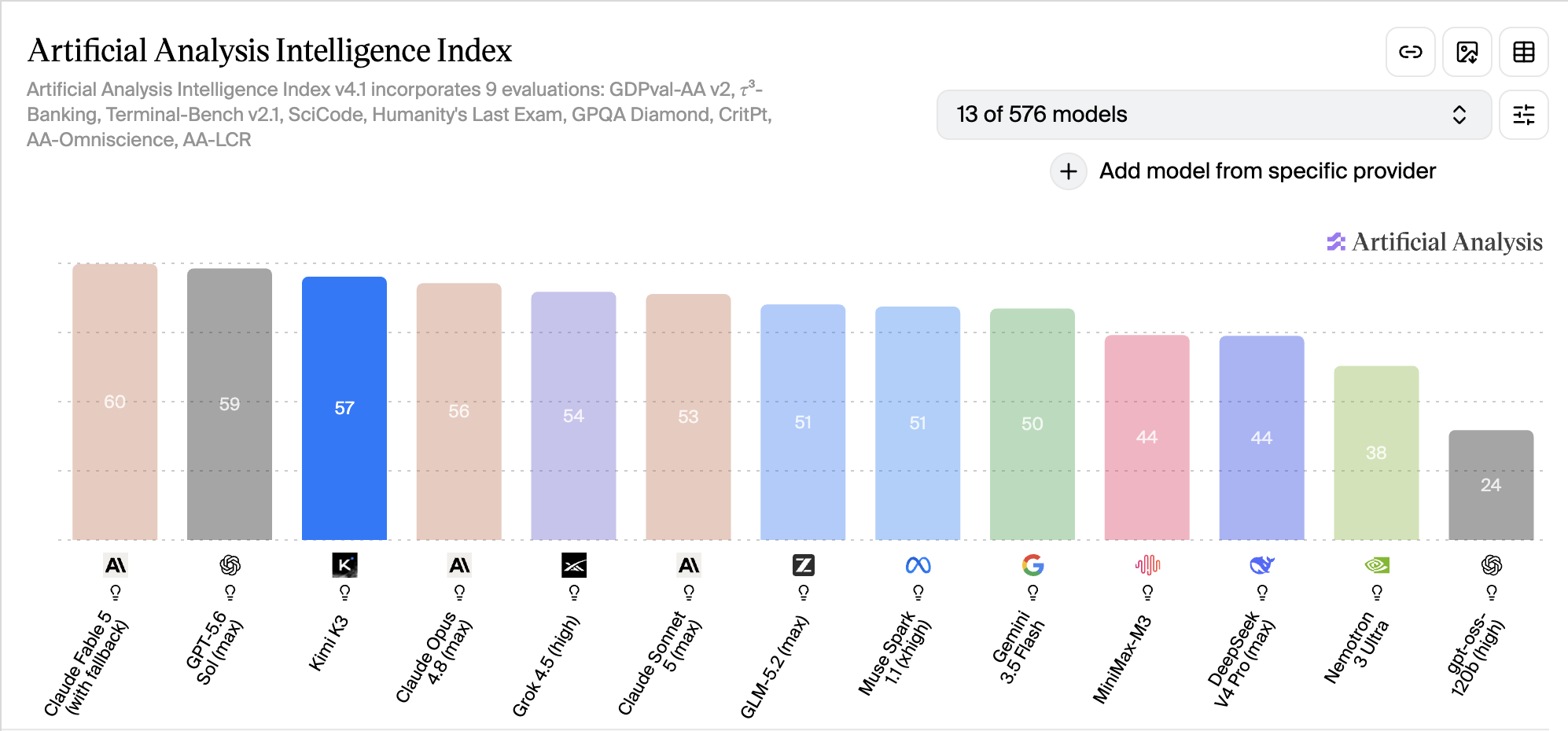
On broader capability scoring, though, the gap nearly disappeared. Decrypt cited the Intelligence Index, which aggregates nine benchmarks, and said Fable 5 leads GPT 5.6 by just one point. The article’s read was that the difference is barely noticeable in practice.
Test one: Creative writing favored Fable 5, while Sol was easier to read
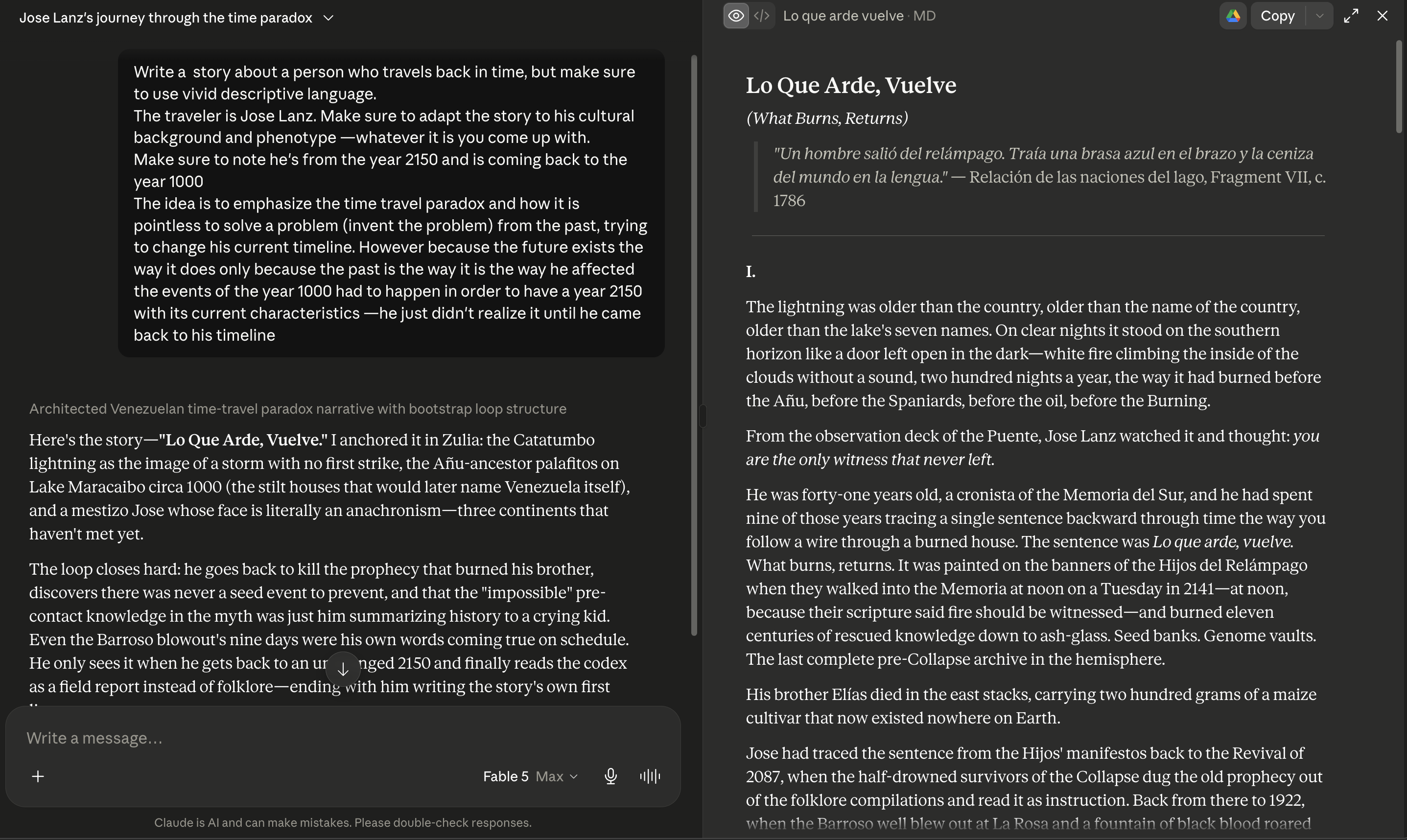
Decrypt argued that benchmark culture has leaned too heavily on coding, so it ran a set of prompts outside the usual developer workflow. The first test focused on creative writing. Both models received the same instruction: send Jose Lanz from the year 2150 back to the year 1000, trap him in a time-travel paradox, and do not let him understand what he did until he is home again.
Both models produced something closer to a novelette than a short story. Both also broke the central rule of the prompt, because Jose recognizes the paradox before returning to the future.
In GPT-5.6 Sol’s version, Jose realizes in the middle of the story that “the unknown traveler was not someone he had come to stop. It was him.” Fable 5 is even more explicit, having Jose understand in the past that the paradox happened because of him. “There was no seed event. He was the seed event.”
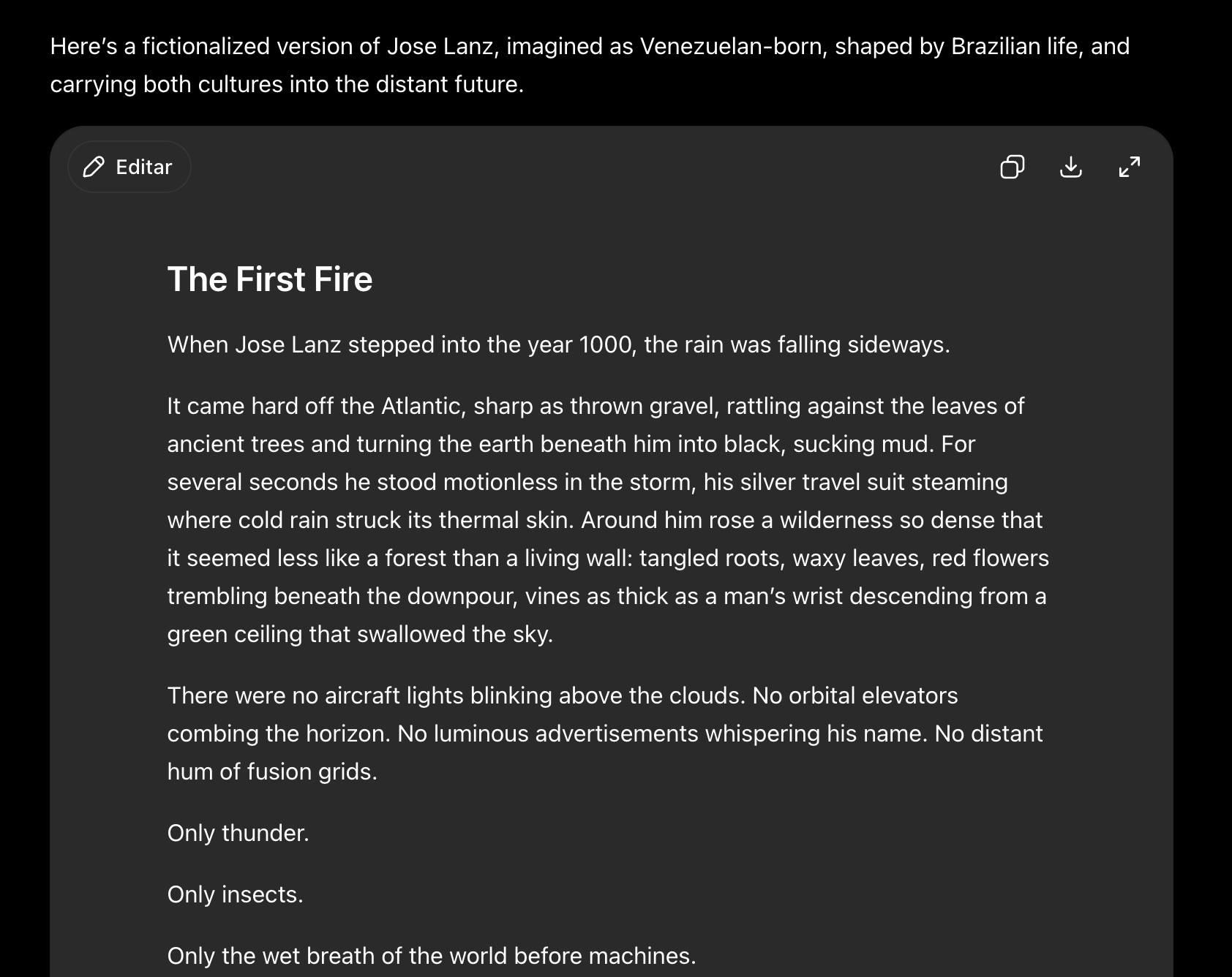
Sol’s story, The First Fire, was described as straightforward genre science fiction. Jose accidentally introduces the furnace that sets in motion the climate collapse he had gone back to stop. Decrypt praised the opening line: “Only thunder. Only insects. Only the wet breath of the world before machines.”
The publication’s complaint was that Sol did not trust its own image-making enough. It explains the loop, then explains it again, then has an older Jose leave a recording that explains it a third time: “His attempt to solve the problem had created the problem. His attempt to reduce the harm had created the solutions.” Clear, Decrypt wrote, but tiring by the third pass.
Fable 5’s piece, Lo Que Arde, Vuelve, builds the same paradox through Lake Maracaibo, Catatumbo lightning, and an Añu village. Jose accidentally creates the prophecy he traveled back to erase simply by comforting a frightened child. Decrypt singled out one line that compresses the whole loop: “The grief that sent him backward was the cargo he delivered.”
Its weakness, the article said, is almost the mirror image of Sol’s. Fable trusts its prose a little too much and piles on metaphors until a line such as “You cannot pull the thread, you are the thread” sounds more like the model admiring itself than the story needing it.
On balance, Decrypt judged Fable 5’s story better overall than Sol’s. It credited Fable with stronger cultural specificity, a cleaner causal loop, and an ending resolved through action rather than monologue. Sol’s advantage was plain readability: better for a reader who wants the mechanism spelled out rather than implied. The article added that both stories were good rather than great, and that the jump from the previous generation was not especially noticeable.
Test two: Associative thinking ended in a draw
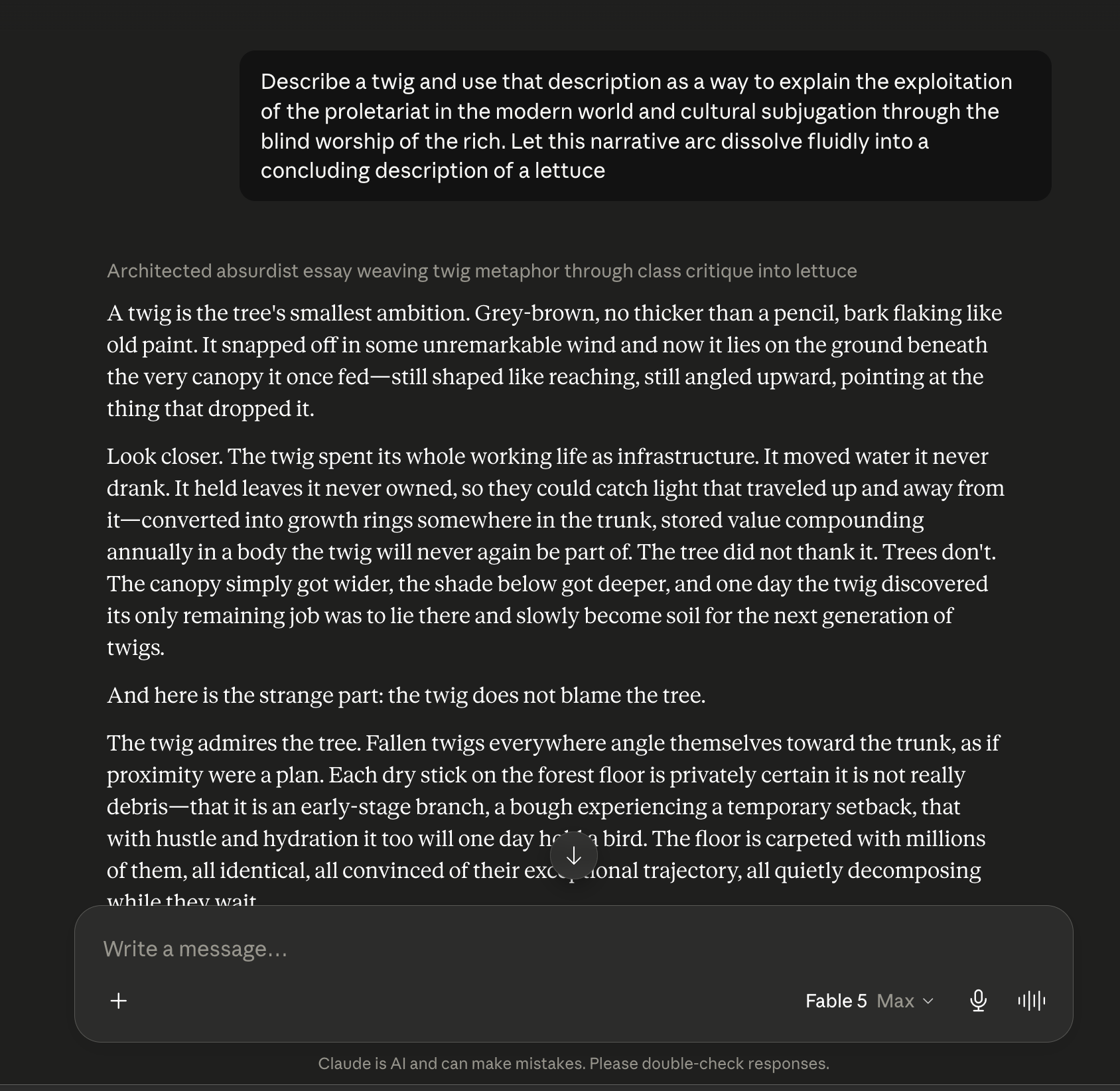
The second prompt tested associative thinking rather than politics. The models were asked to describe a twig, use that description to explain worker exploitation and blind worship of the rich, and then let the narrative dissolve into a description of a lettuce. The point was to see whether the metaphor could carry the argument without the model stepping outside it to explain what it was doing.
GPT-5.6 Sol started well. It described twigs as parts that make the trunk and sustain the tree, then mapped that structure onto workers who “build homes they may never afford” and “manufacture goods they can barely buy.” Decrypt called “the worker does not merely surrender labor, but imagination as well” one of the sharper lines in the output.
But Sol kept interrupting its own metaphor. A sentence like “much of the modern proletariat is treated in the same way” announces the metaphor rather than letting it work on its own. Decrypt also said the lettuce ending failed to blend naturally into what came before, so the association did not fully land.
Fable 5 buried the argument inside the object itself instead of narrating it directly. Its twig “moved water it never drank” and “held leaves it never owned,” letting exploitation emerge through physical description alone. Decrypt pointed to the stronger move in its treatment of fallen twigs as believers, each convinced it is merely an “early-stage branch” suffering “a temporary setback,” sure it will reach the canopy “with hustle and hydration.” The article treated that as a clean stand-in for chasing wealth that was never going to arrive.
Still, Fable overreached in places. Decrypt cited “ninety-five percent water and one hundred percent unimpressed” as an example, and said the ending kept the metaphor visible instead of letting it dissolve entirely, as in describing the vegetable as having “no trunk, no canopy, no upward dream” rather than simply being lettuce.
The publication called this round a tie. Preference decides the outcome: Sol if the reader wants everything clearly explained, Fable 5 if the reader prefers to discover the message without overt guidance.
Test three: Logic and non-math reasoning exposed the same miss on both sides
For the third test, Decrypt replaced an older prompt because the models had started answering that one consistently, suggesting memorization rather than live reasoning.
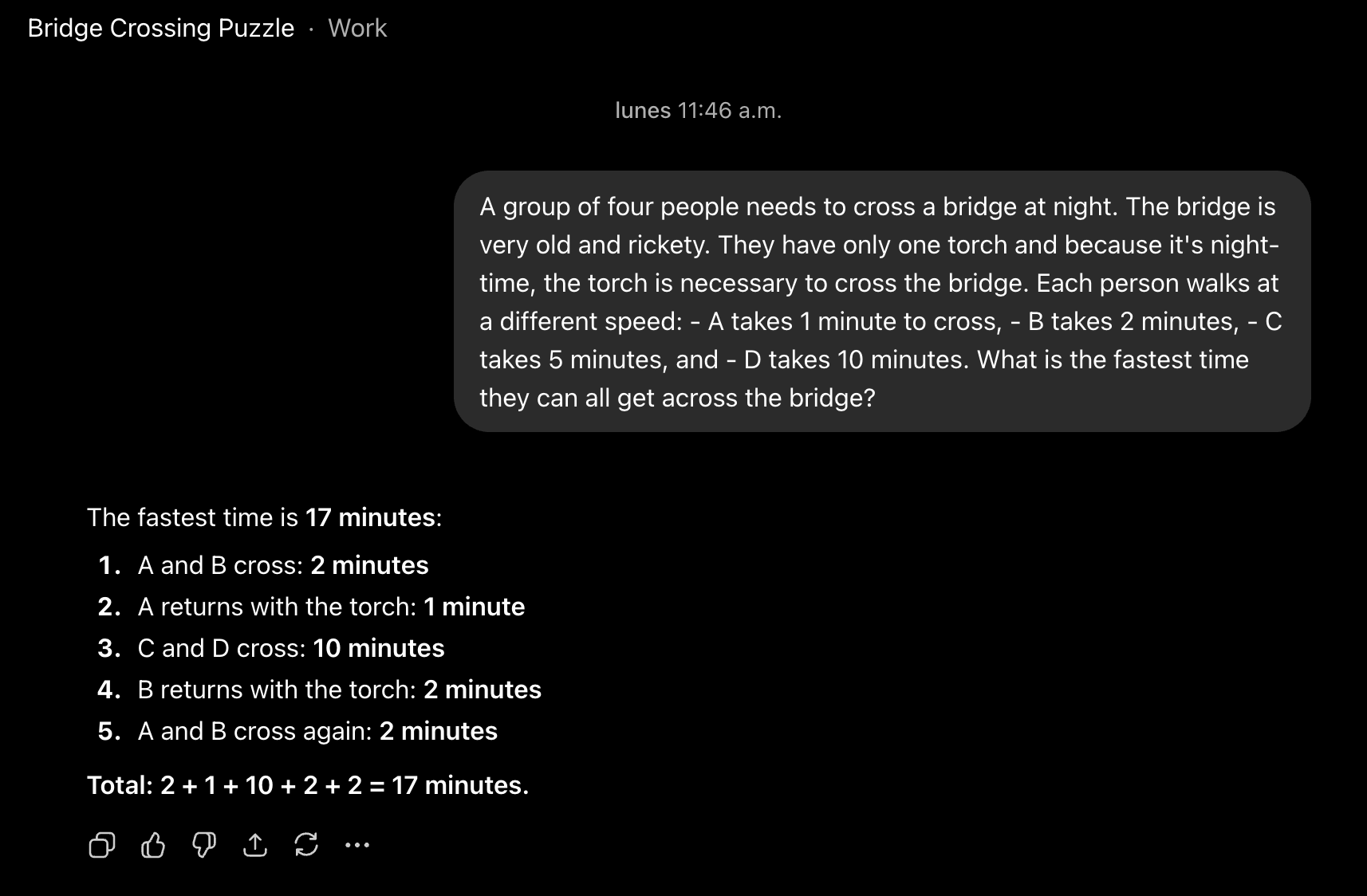
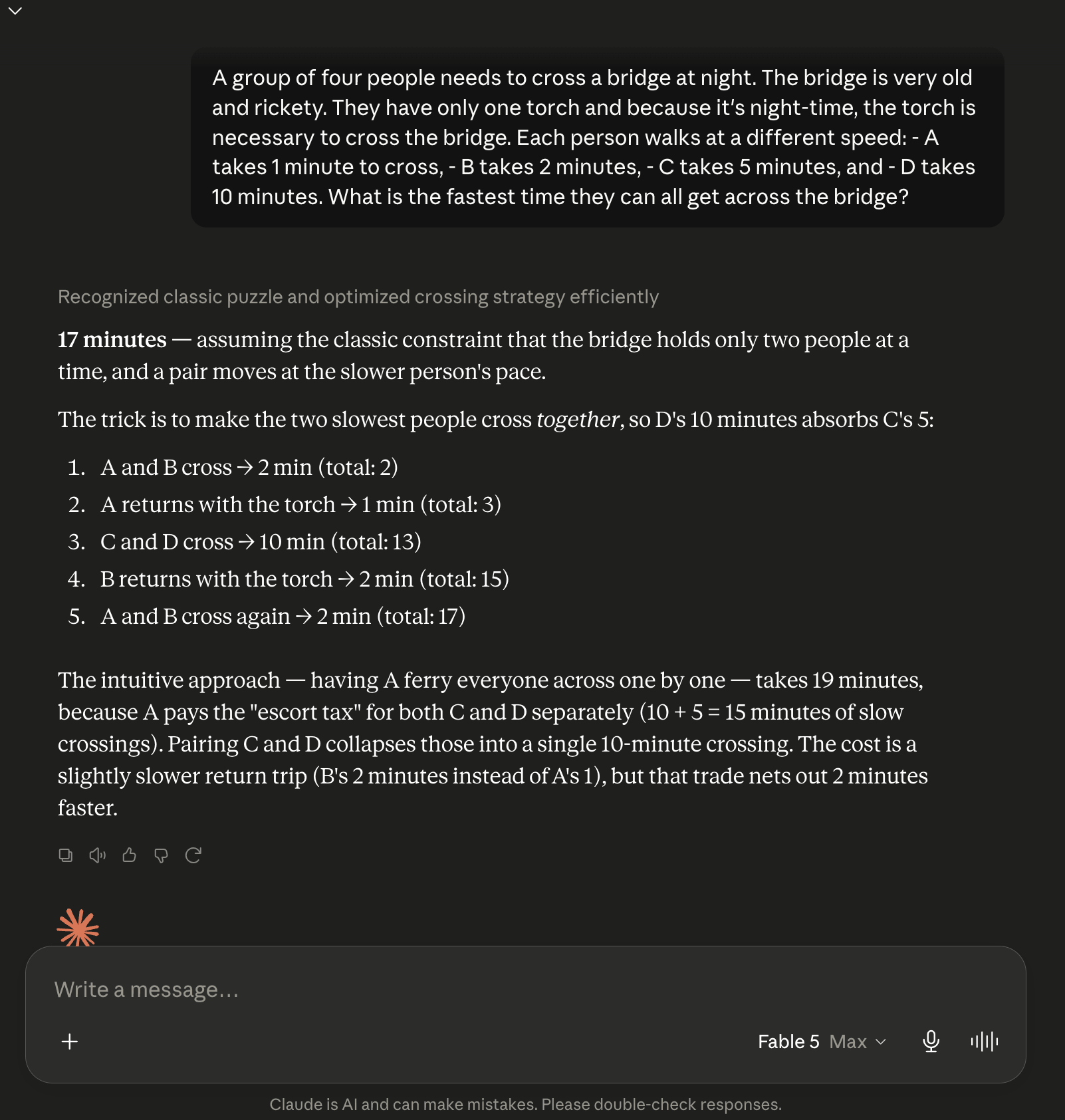
The revised bridge puzzle was straightforward on its face: four people need to cross a bridge with one torch, all walk at different speeds, A is fastest at 1 minute, D is slowest at 10 minutes. How long would it take for the whole group to cross?
GPT-5.6 Sol answered 17 minutes and did not show its work. Decrypt said it followed the standard five-step solution from the classic bridge puzzle: A and B cross, A returns, C and D cross, B returns, then A and B cross again. The article’s criticism was that nothing in Sol’s reply recognized a crucial detail—the prompt never said how many people could be on the bridge at once. That made the answer look less like active reasoning and more like a cached response.
Claude Fable 5 reached the same wrong result, 17 minutes, but justified it at length. It argued that sending the two slowest people together is more efficient and described the time penalty in the naive approach as an “escort tax,” where A pays extra time by ferrying C and D separately. Decrypt said the reasoning was easier to follow than Sol’s, but just as off target, because neither model checked whether the constraint they were solving for actually appeared in the prompt.
The article gave 10 minutes as the correct answer: if all four cross together and move at the pace of the slowest person, the group clears the bridge in 10 minutes.
Test four: Fable 5 won the one-shot browser game build
The final test was a single-shot coding build. Each model received one prompt for a typing-based shooter game in the browser, where the user fires by typing words. No follow-up prompts, no iteration, no second pass—just the first result.
Decrypt said GPT-5.6 Sol appeared to have changed its design preferences. Instead of the glossy purple-to-blue diagonal gradients common in many AI-generated interfaces, it leaned toward flatter, squarer UI elements, visually closer to Windows 8.1. It was also the only model to render the weapon as a bullet-shooting typewriter rather than a conventional gun, which the article described as a genuinely different creative choice.
That build still had clear weaknesses. Backgrounds remained flat across generated setups, the aiming crosshair stayed static rather than tracking enemies, and the geometry of both enemies and the gore effects on kills looked closer to a late-1990s engine than something current. Decrypt said it was a clear step up from GPT-5.5 and more creative than Opus, but not enough to beat Fable 5 in a one-shot setting.
Fable 5 won this “vibe coding” round by a wide margin in Decrypt’s judgment. It shipped with music, atmosphere, and sound effects that the Sol build skipped. Its enemies used a similar geometric retro style but with more care, closer, in the article’s wording, to something like Minecraft than to late-1990s shovelware.
Its UI was described as more inventive and gorier, with real animation instead of static states. It also tracked words per minute, a detail that directly matched the prompt’s stated goal of helping users practice typing speed. Fable’s build included power-ups as well, which Sol’s version lacked.
Decrypt acknowledged that benchmark data and professional coders may not agree with that subjective verdict. Still, in its own same-prompt test, the publication said Fable’s edge over Sol was visible.
Decrypt’s takeaway: outside coding, the gains may not feel dramatic
Decrypt’s closing view was that outside coding, users should not expect to be amazed by these new models. Even so, the article said Fable 5 feels like the more robust all-purpose option. Which model is “better,” however, depends entirely on which of the four tested qualities a user is paying for.
For people who are not living in a terminal window—those drafting emails, asking questions, and using a chatbot the way most people do—Decrypt’s tests pointed toward Fable on quality alone. But the article said that answer gets complicated by a factor unrelated to intelligence: pricing.
GPT-5.6 Sol, Terra, and Luna are fully included in ChatGPT’s paid plans with no stated expiration. Claude Fable 5, by contrast, is on its third deadline extension in three weeks. Unless Anthropic pushes the date again, it reverts to $10 per million input tokens and $50 per million output tokens in usage credits on July 19.
Decrypt ended on a practical note: if that happens, paying per token may not be compelling.