
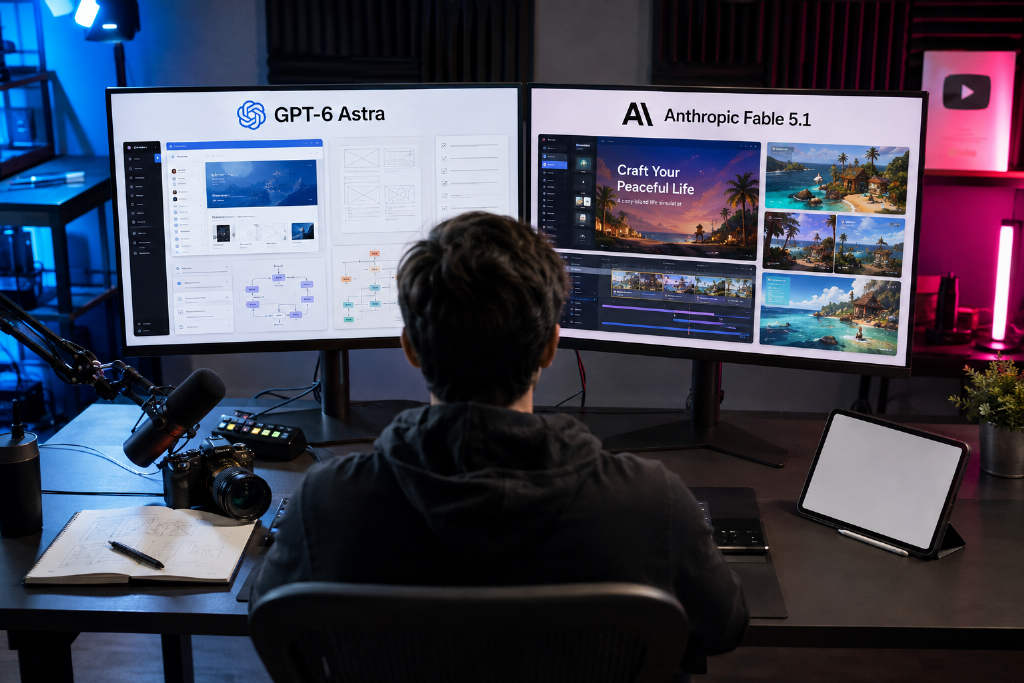
Tech YouTuber Paul J Lipsky ran a 48-hour practical work test comparing the newly released GPT-6 Astra with Anthropic Fable 5.1, using a set of day-to-day professional tasks to judge real-world usefulness. The test covered website design, presentation building, no-code development of an Animal Crossing-style game, content and video creation, and business auditing. The result was a clear split: Fable 5.1 showed stronger visual aesthetics and smoother dynamic transitions, while GPT-6 Astra led on instruction following, autonomous operation, and logical reasoning.
Website and presentation work showed different strengths
In website and presentation design, GPT-6 Astra posted stronger instruction compliance and more complete execution. According to the test summary, it was able to produce a modular website with a modern look and a fuller feature set.
Fable 5.1 was stronger on visual feel, especially in scrolling animation and transition smoothness for web-based presentations. But the test also flagged several problems in a website redesign task: it violated instructions, directly reused elements from the old site, and produced technical issues including shifted components and videos that would not play.
Vibe Coding was one of the clearest points of separation
The no-code development section, described in the report as Vibe Coding, exposed one of the biggest gaps between the two models. GPT-6 Astra was able to finish game development in one go and quickly generate an Animal Crossing-style project.
The review said one of Astra's biggest breakthroughs was its AI agent capability. It could independently install professional software such as Blender and Godot, removing much of the environment setup burden for non-technical users.
Fable 5.1, by contrast, generated functionally complete code but came with a higher operating threshold. Users still had to manually enter terminal commands, launch the development environment, and adjust settings themselves.
Content and editing tests favored Astra's tone and privacy handling
In scripting and video editing tasks, GPT-6 Astra was rated as more natural in tone. The test also credited it with privacy awareness because it could automatically apply mosaic blurring. Fable 5.1, on the other hand, was described as falling into more fixed language patterns.
Business audit work highlighted the difference between active verification and passive summarization
The business audit segment produced another sharp contrast. Paul J Lipsky's test found that GPT-6 Astra actively looked for information gaps during a broader enterprise audit task, asked for missing data, and brought in the latest external knowledge for analysis.
When it encountered inconsistent accounting records, Astra went into the email system to cross-check the financial trail and determined that the discrepancy came from a human recording error rather than unpaid debt. The review presented this as evidence of real logical verification, with the potential to cut down on manual review work in specialized tasks.
Fable 5.1 performed differently. In the same setting, it tended to treat the contents of existing folders as factual, accepted inaccurate financial records, and did not actively debug the error. The assessment said this reflected a model that still behaves more like a passive organization and summarization tool, without an active cross-platform verification mechanism.
Overall result from the 48-hour comparison
Across website design, presentations, Vibe Coding, content production, and business auditing, the test drew a fairly direct line between the two products. Fable 5.1 was stronger in visual detail and presentation smoothness. GPT-6 Astra stood out in complex task execution, software setup, agent-style autonomy, and reasoning.