
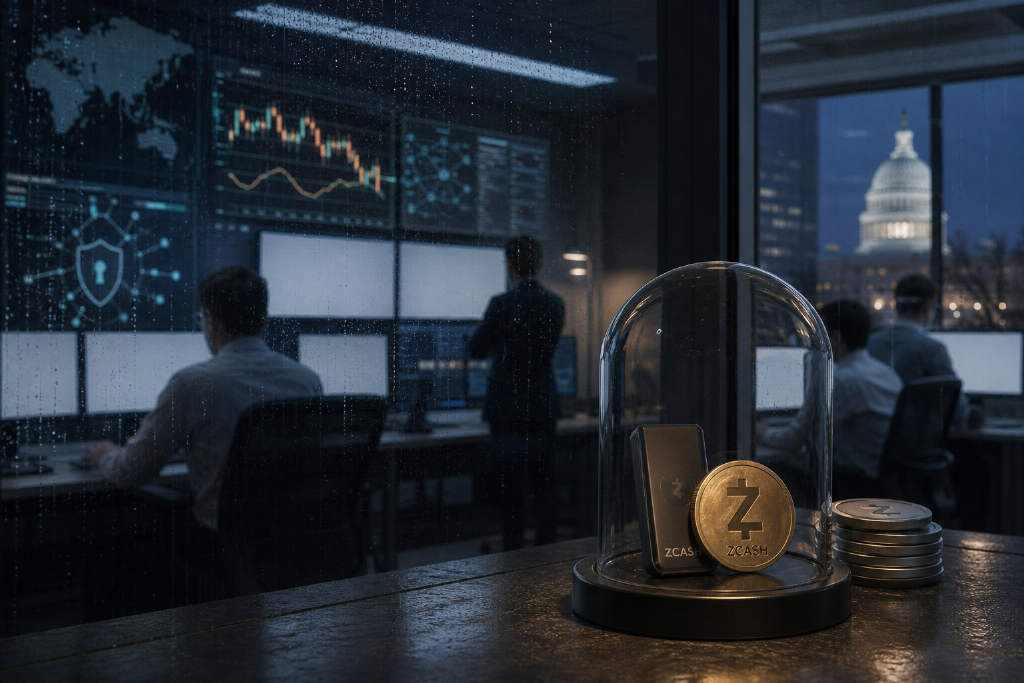
Grayscale Research says a new debate around financial privacy may be taking shape as stablecoins and blockchain-based applications spread and artificial intelligence opens new avenues for financial surveillance. In that setting, the firm argues that Zcash deserves closer attention as a privacy-focused digital currency whose market value may not reflect the role privacy could play in crypto.
The report was written by Michael Zhao of Grayscale Research and translated by Foresight News. Its central point is straightforward: privacy is not a niche monetary feature. It is part of what allows money to function. People generally do not want every transaction, account balance, and financial relationship exposed by default. Physical cash has long offered that property, and bank-based financial systems have historically preserved some practical confidentiality by limiting third-party access to records, even if leaks remain possible. Law enforcement agencies, the report notes, have also typically needed court orders to obtain personal financial data.
Why Grayscale says privacy is returning to the agenda
The report traces earlier periods when technology shifts and policy changes pushed financial privacy into the spotlight. In the 1970s, the digitization of financial records and the passage of the Bank Secrecy Act drew more attention to the issue. In the late 1990s and early 2000s, the rise of the internet, online banking, and the Patriot Act put privacy back at the center again and helped drive wider use of encryption tools and two-factor authentication.
Grayscale says the market may now be nearing a third wave. This time, it points to stablecoins, the broader adoption of blockchain applications, and AI-enabled monitoring tools as the triggers. The firm adds that several high-frequency indicators already suggest public attention to financial privacy has started to rise.
Where Zcash fits in
Against that backdrop, Grayscale places Zcash near the center of the discussion. The network is described as a decentralized digital currency with a logic close to Bitcoin’s, but with a mature privacy system built in. Bitcoin achieved digital scarcity, the report says, but not digital privacy. Its transparency supports auditability, yet it also limits monetary use cases where confidentiality matters. If crypto users eventually treat private digital money as a separate demand category from transparent digital assets, Grayscale says Zcash could serve that market.
The report says ZEC currently accounts for about 0.4% of total cryptocurrency market capitalization. Given Zcash’s technical capabilities and the potential size of the market for privacy-preserving digital money, Grayscale argues that the token appears undervalued.
Privacy as a standalone product category
On public blockchains, account balances, counterparties, and transaction histories are permanently visible. Even when users rely on pseudonymous addresses, exchanges, counterparties, wallet behavior, and blockchain analytics tools can often reconnect those traces over time. In practice, the report says, public chains disclose more than many users expect.
Grayscale argues that the need for financial privacy is much broader than a narrow group seeking total anonymity. Individuals may not want balances and spending records to be public by default. Businesses may want to keep supplier relationships, payroll distributions, treasury flows, and customer interactions confidential. Institutions may also prefer not to have wallet structures and trading patterns mapped in real time. In that framing, privacy demand is less about fringe behavior and more about ordinary confidentiality in economic activity.
At the same time, the report says privacy has faced a long-running distribution problem inside crypto. Strong privacy features add friction for exchange support, wallet integration, and market access. That means privacy is not just a technical issue. It also involves commercial trade-offs.
Different models for on-chain privacy
Grayscale breaks privacy systems into several categories, noting that each hides a different set of information.
- Mixing-based systems, such as CoinJoin on Bitcoin, CashFusion on Bitcoin Cash, and Dash’s PrivateSend, make transaction tracing harder but leave the base ledger fully public.
- Confidential transaction systems, including Litecoin’s MWEB, can hide transaction amounts and provide a base layer of structural privacy, but they do not match fully shielded designs.
- Default-private blockchains, represented by Monero, enable privacy by default without requiring users to opt in.
- Shielded transaction systems, represented by Zcash, verify that transactions are valid without exposing the sender, receiver, or amount.
Grayscale says Zcash occupies a distinct place in this field. It is an optional-privacy base-layer blockchain whose shielded transfers hide the sender, recipient, and amount at the transaction layer itself. That differs in kind from privacy add-ons built on top of transparent chains.
How Zcash works
Zcash is a blockchain for peer-to-peer value transfer with a maximum supply of 21 million tokens and a proof-of-work security model. In many respects it resembles Bitcoin. The key difference is choice: users can opt into shielded transfers instead of exposing all transaction details by default.
The network supports two transaction types. Transparent transfers are fully visible on-chain and work much like Bitcoin transactions. Shielded transfers allow the network to verify transaction validity without disclosing the sender, receiver, or amount. Put simply, Zcash is designed to validate transfers without making every detail public.
That design relies on zero-knowledge proofs and a shielded pool. As long as funds remain in the shielded pool, on-chain information leakage can be reduced as much as possible. The report adds that zero-knowledge proofs are used in blockchain not only for privacy, but also for scaling.
Zcash also includes selective disclosure. Through viewing keys, users can grant specific third parties permission to inspect shielded transactions when needed. In Grayscale’s framing, shielded transfers are not an absolute black box: they are private to the public while still allowing controlled disclosure by the user.
An older protocol that kept changing
Zcash launched in 2016, which makes it an older project by crypto standards. Grayscale says that age can make it look like a leftover from a previous cycle, but argues the original goal was always broader than simply adding private transfers. From the outset, the project aimed to bring zero-knowledge cryptography into a digital cash system.
Its core idea was early for the sector: borrow Bitcoin’s monetary model while enabling privacy transactions on a public blockchain. Zcash was among the first projects to build private digital cash at the base layer rather than treat privacy as a wallet feature or an upper-layer add-on.
Early on, though, the technical vision outran the surrounding product infrastructure. Shielded transactions were computationally expensive and harder to use than transparent ones. Grayscale says several major upgrades changed that picture over time:
- Sapling (2018) sharply reduced proving time and memory use, making shielded transfers practical. The report says creating one shielded transaction took only a few seconds and required as little as 40 MB of memory, which directly lifted usage.
- Orchard / NU5 (2022) upgraded the cryptographic base, introduced the Orchard shielded protocol and Halo2, and removed the need for a trusted setup in the new shielded pool.
- Ironwood (2026) fixed an Orchard circuit flaw, created a new shielded pool, and eliminated the theoretical risk of token forgery in order to protect supply integrity.
- Unified addresses and wallet improvements simplified the user experience so people no longer had to manage multiple address formats to receive both transparent and shielded funds.
For Grayscale, the question is no longer whether private transfers can exist. It is whether they can be used at scale and without excessive friction. The report says years of work to reduce usability hurdles are finally starting to show results.
Wallets, payments, and infrastructure
The wallet layer is presented as a critical piece. Zodl, formerly Zashi, is described not just as a storage tool but as an interaction point built around shielded-first use. According to the report, it includes swaps based on NEAR Intents, CrossPay for cross-asset transfers, and cold storage support for shielded balances.
Grayscale says those features matter because they reduce the number of steps that force users to leave the shielded pool. Deposits, payments, and asset swaps can stay inside a more private crypto environment for longer. In the firm’s view, Zcash’s biggest historical bottleneck was not whether private transactions were technically possible, but whether users could remain secure throughout an entire transaction flow.
The report also points to progress in broader ecosystem infrastructure. Foundry, a major mining pool, announced in April 2026 that it would launch a U.S.-based Zcash mining pool aimed at institutions and publicly listed company miners. Grayscale says that does not directly increase shielded wallet usage, but it does point to a maturing ecosystem, more industrial-grade support, and higher institutional awareness of the chain.
It also notes policy tweaks related to fees and mempool behavior that eased congestion caused by spam transactions and improved network stability under heavy load. Those changes are not the core of the investment case, the report says, but they help move Zcash from theoretical privacy toward practical usability.
What Grayscale is watching next
The next stage for Zcash depends on whether the protocol can move from proving that privacy works to proving that privacy can scale. Grayscale highlights three areas to watch:
- Tachyon, which it calls the most important scaling proposal, is intended to reduce the cost and synchronization burden of shielded transactions and address a longstanding barrier to wider adoption.
- Crosslink focuses on transaction finality and network reliability. It would not fully replace the current proof-of-work model, but would strengthen settlement assurances. Grayscale says that matters because Zcash’s future depends not only on privacy features, but also on the network’s stability and operational reliability.
- Shielded assets would allow assets beyond native ZEC to use Zcash’s privacy system. If revived and deployed, that could extend shielded transaction capabilities to more assets and applications.
How the report values ZEC
As of July 2026, Grayscale says the crypto market assigns very little value to privacy as a property. In the firm’s framework, assets used as “money” sit in a “currencies” segment that currently includes 15 assets with a combined market capitalization of $1.4 trillion. Bitcoin accounts for about 90% of that segment.
Within that set, ZEC’s market capitalization stands at about $8 billion, or roughly 0.6% of the category. Grayscale says that if ZEC were to capture 5% of the segment, its market value would increase ninefold.
The report says current pricing reflects a prevailing market assumption: privacy is a marginal need with a small audience and does not deserve a valuation premium. But if privacy becomes more valuable in an environment of heavier monitoring, tighter compliance requirements, and more frequent financial scrutiny, then a 0.6% share may not represent equilibrium. Instead, Grayscale argues, it could reflect option value the market has not yet fully priced in.
The bullish case rests on the view that the market is still treating privacy demand as niche even though on-chain behavior shows otherwise. As of July 20, shielded transactions accounted for about 90% of all Zcash transactions, according to the report. Roughly 4.2 million ZEC were in the shielded pool, equal to 25% of circulating supply and a record high.
That, Grayscale says, means privacy is not just a narrative. It is visible in on-chain activity. Zcash does not need immediate explosive growth to support potential upside in this view. What it needs is a market reassessment of privacy’s role in the future value of crypto money. If investors decide privacy should carry some premium in a cryptocurrency system, current ZEC pricing could look conservative.
Risks and constraints
Regulatory risk
Grayscale says Zcash’s regulatory risk goes beyond the simple fact that it offers privacy. The real question is whether regulators and service providers accept that selective disclosure can satisfy compliance needs. Compared with privacy systems that offer no disclosure path, the report says Zcash’s viewing keys provide a clearer compliance route.
A full viewing key can authorize a chosen party to inspect incoming shielded transactions, recipient addresses for standard shielded transfers, amounts, and memos. Even so, disclosure is permissioned rather than chain-wide by default. The report notes that global anti-money laundering rules and the European Union’s MiCA framework continue to impose hard requirements on virtual asset service providers, including customer due diligence, recordkeeping, suspicious transaction reporting, and travel rule compliance. Viewing keys may reduce the risk that exchanges and custodians refuse to support shielded transfers, Grayscale says, but they cannot eliminate it.
Legacy trusted-setup issues
One longstanding controversy around Zcash came from the trusted setup used by the earlier Sprout and Sapling shielded protocols. The report says NU5 introduced Orchard and the Halo proving system so that the new Orchard pool no longer required a trusted setup.
Still, in 2026 a soundness flaw was found in the original Orchard circuit that theoretically could have enabled undetectable token forgery inside the pool. Network upgrade NU6.2 fixed the circuit. Ironwood, or NU6.3, introduced a new independent shielded pool, blocked new assets from entering the old Orchard pool, and required funds leaving the old pool to pass through Zcash’s validation and accounting mechanism. Grayscale says that restored independently verifiable circulating supply and materially improved the cryptographic outlook.
The legacy issue is not fully gone. Older pools still exist, and historical funds remain there. The report says that risk should decay over time, but it remains relevant when comparing older and newer versions of the protocol.
Quantum computing risk
Quantum computing is described as a long-term risk shared by most public blockchains, not something unique to Zcash. Transparent and shielded funds face different quantum threat paths because the cryptographic components exposed on-chain are not the same.
Electric Coin Company, which has long led Zcash development, has already included quantum resistance in its roadmap. Grayscale says that means the issue is not purely theoretical, though for investment decisions it remains a longer-dated concern. In the near to medium term, the report puts more weight on product usability, ecosystem adoption, and market structure.
Execution risk
Zcash has relied on repeated protocol upgrades to improve usability, security, and scale. That history also creates execution risk. First, the roadmap is technically demanding. Tachyon and Crosslink are major engineering efforts rather than simple parameter changes. Second, upgrades require coordination across engineers, wallet developers, infrastructure providers, and the wider ecosystem. Grayscale says Zcash’s well-documented improvement proposal process is an advantage, but the investment thesis still depends in part on continued delivery quality and coordinated execution.
Grayscale’s bottom line
The report ends by arguing that privacy has always been an important part of money’s practical utility, even if that is easier to forget in a digital age. Zcash was created to address what Grayscale calls a built-in weakness of public blockchains: transactions are easy to verify but hard to keep confidential. After years of technical refinement, the firm says, it has become one of the clearest examples of a project trying to close that gap.
Whether private digital money becomes a mainstream sector or stays a niche one remains unsettled. Grayscale’s point is narrower. At current valuations, the market appears to be assigning little or no price to the possibility that privacy could become much more valuable in the future. For investors, the opportunity is not about Zcash replacing Bitcoin. It is about a privacy-focused digital currency still being underrecognized by the market.