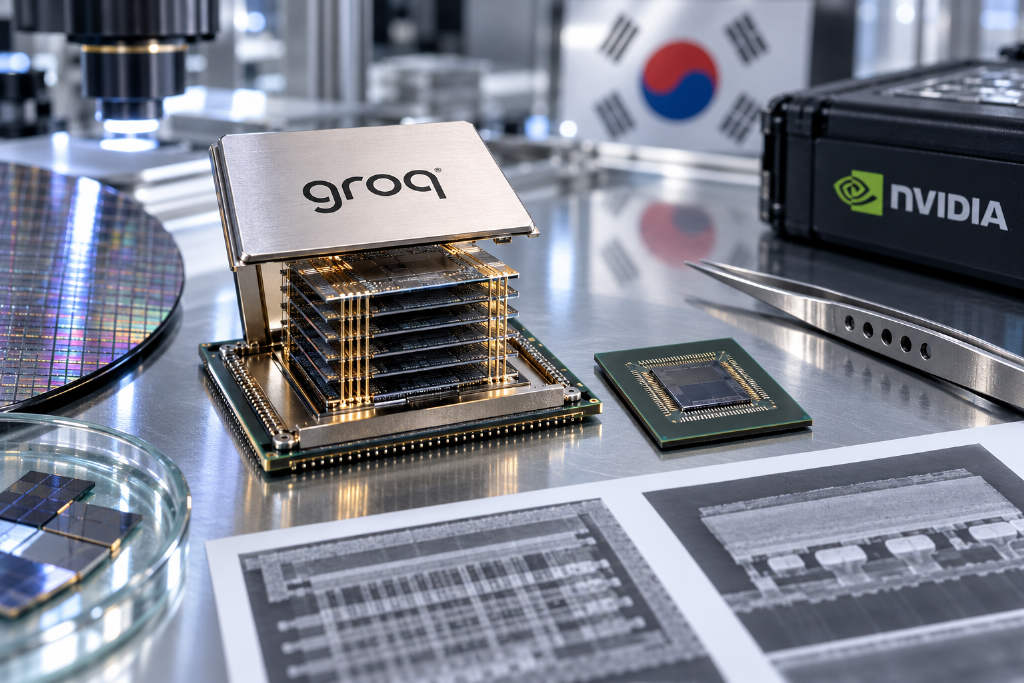
Groq, the AI chip company that ZDNet Korea said was effectively acquired by Nvidia, is evaluating a shift in memory packaging for its next-generation processor, according to a semiconductor industry report cited on Oct. 20. The company is said to be considering 3DS, a high-capacity packaging method that vertically connects DRAM chips through through-silicon vias, instead of relying on SRAM, which is faster but offers less capacity. Groq was founded in 2016 by former Google TPU designer Jonathan Ross. The report also said Nvidia acquired the company last year through an indirect structure. In the comparison outlined by the report, both 3DS and HBM use through-silicon vias, but HBM is designed around transfer speed, while 3DS keeps the existing DRAM interface and focuses on expanding capacity. Two unnamed industry sources cited in the report said Groq plans to stack DRAM rather than SRAM in its next chip, and that the decision reflects demand shifting toward chips with larger memory capacity.
Groq, the AI chip company that ZDNet Korea said was effectively acquired by Nvidia, is pushing to introduce DRAM-based 3D stacked packaging in its next-generation chip, replacing an SRAM approach that offers higher speed but less capacity, according to a semiconductor industry report cited by ChainCatcher on Oct. 20.
Groq was founded in 2016 by former Google TPU designer Jonathan Ross. The report said Nvidia acquired the company last year through an indirect structure.
3DS under review
The packaging option under evaluation is 3DS, described in the report as a high-capacity method that vertically connects DRAM chips through through-silicon vias. With 3D packaging, multiple dies can be stacked vertically and operate as a single chip. Compared with a planar design, that can reduce footprint and improve power efficiency.
The report added that both 3DS and high-bandwidth memory, or HBM, use through-silicon vias. The difference, it said, is that HBM is geared toward transfer speed, while 3DS keeps the existing DRAM interface and centers on expanding capacity.
What industry sources said
One unnamed industry source said Groq plans to use 3D packaging in its next-generation chip and stack DRAM rather than SRAM. Another source said market demand is shifting toward chips with larger capacity, leading Groq to choose DRAM for its capacity advantage.
This article was originally published by Bit.Fan. For more cryptocurrency news and market insights, visit www.bit.fan. Disclaimer:
The market information, project data, and third-party content displayed on this platform are for industry information sharing only and do not constitute any form of investment advice or return commitment.
Cryptocurrency trading carries high risks. Users should fully assess their risk tolerance and make independent decisions. All profits, losses, and legal responsibilities are borne by the users themselves.