
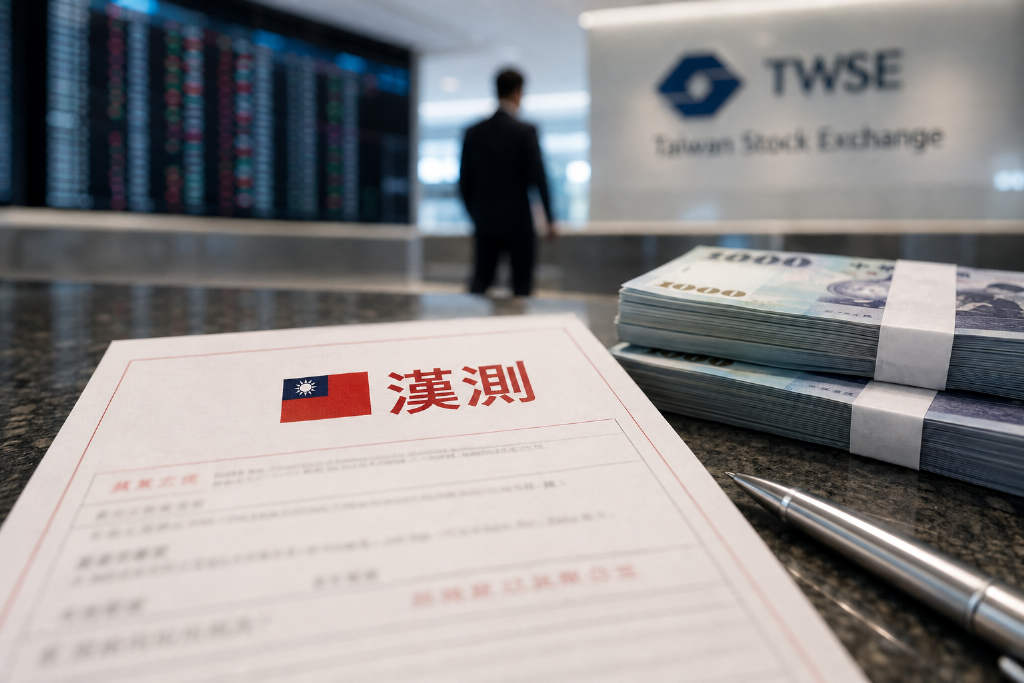
HanMin Testing System (HanCe, stock code 7856), one of the pricey names on the OTC market, is set to open public subscription from September 10 to 14. The provisional underwriting price is 2,250 New Taiwan Dollars (NTD) per share, the highest price ever set for an initial public offering (IPO) on the Taiwan Stock Exchange. Using the recent OTC price of about 4,700 NTD, the paper gain for one board lot (1,000 shares) comes to 2.45 million NTD, or roughly 109%. Sounds wild. But anyone joining still has to park 2.25 million NTD as a subscription guarantee, which also breaks the market record for required capital.
Why the Huge Gap Between IPO Price and Market Price? Taiwan's Pricing Mechanism
That big spread between the underwriting price and the market price comes from how Taiwan handles IPO pricing and share allocation. It runs in two steps: a competitive auction first, then public subscription.
Competitive Auction: Market Bidding
The underwriter starts by setting an auction floor price. In HanCe's case, that floor was 1,800 NTD. Then deep-pocketed investors and institutional investors bid up from there at the highest price.
Public Subscription: Retail Lottery
Then comes the retail side. To keep small investors from getting stuck buying at overheated prices, the rules say the public subscription price cannot be higher than 1.15 times the auction floor price. That floor price is set by the underwriter and accountant using financial metrics and industry P/E ratios. And if the company was already trading on the OTC market, the floor price is usually capped at 70% of the average OTC price over a set period before the filing, such as 30 business days.
That 70% rule gives retail investors a built-in discount if they win the lottery. Simple as that. If the market price does not slide hard on listing day, they can walk away with a hefty gain.
Wealth Creation Story: UPI (6719) Made 210,000 NTD on Debut
In Taiwan, IPOs with huge price gaps have a long history of whipping investors into a frenzy. One classic case was UPI Electronics (6719), an ASUSTeK subsidiary, which went public in early 2022. Its public subscription price was 589 NTD, while its OTC price sat near 1,000 NTD. More than 170,000 applications poured in. On its first trading day, UPI opened with a gap up and reached a high of 808 NTD. Anyone who sold at the open could have locked in more than 210,000 NTD in one day. Stories like that are exactly why IPO lotteries keep pulling people in.
Crash Case: Yitai (7818) Locked in Loss from Day One
But a lofty IPO price does not mean gains will last. The honeymoon can end fast. Yitai (7818) is the ugly example. It listed in May 2026. During subscription, the market figured investors might make 39,000 NTD, a 55% return, based on the average OTC price. That brought in 300,000 investors, and the lottery win rate sank to only 1.03%. Then reality hit. On day one, the stock opened at 68.6 NTD, under the 70 NTD underwriting price, meaning it broke the IPO, and it dropped as low as 64 NTD during the session. Winning investors were staring at paper losses right away. One month after listing, the company even rolled out an emergency stock buyback program, but the price still did not get back above the IPO price. Right now, Yitai shares still trade around 60 NTD.
Liquidity and Pricing Risks Behind High Returns
So back to HanCe. That 2.45 million NTD paper profit looks seductive. No question. But before tying up 2.25 million NTD, investors need to think hard about volatility. The OTC market is far less liquid than the main board, and that makes prices much easier to whip around. Between the subscription period and the actual listing date, the OTC price can swing on sentiment or outside events, which changes the real profit picture.
An IPO lottery is not free-money arbitrage. It just isn't. Paper gains are one thing; the actual call should rest on the company's fundamentals, not only on the size of the price gap. That is how investors avoid grabbing a falling knife during the honeymoon phase. And under the rule that uses the average OTC price over a period before filing, such as 30 business days, low OTC liquidity also leaves room for another problem: it is not impossible for insiders to artificially push up the OTC price during the 30 days before the filing.

