

Hashi’s testnet on Sui has gone live with more than 25 institutions taking part in stress testing, centered on a single goal: letting BTC enter DeFi without leaving the Bitcoin network. In the article’s framing, that marks a change in the market conversation. The issue is no longer simply whether Bitcoin needs programmability, but where that programmability should be written.
Idle Bitcoin, rising institutional exposure, and a trust gap
The article says Bitcoin’s market value has passed $1 trillion. Spot ETFs and treasury strategies have increased institutional holdings, yet most BTC still sits idle. The problem, it argues, is not a lack of demand from institutions but the absence of a security model they are willing to treat as sufficient.
wBTC and cbBTC solved usability, but they did so by introducing bridge and custody risk. Users swap BTC for wrapped assets, trust a centralized custodian, and move the underlying asset off the Bitcoin mainnet. The article describes that model not as native Bitcoin finance, but as finance on another chain that borrows Bitcoin’s name.
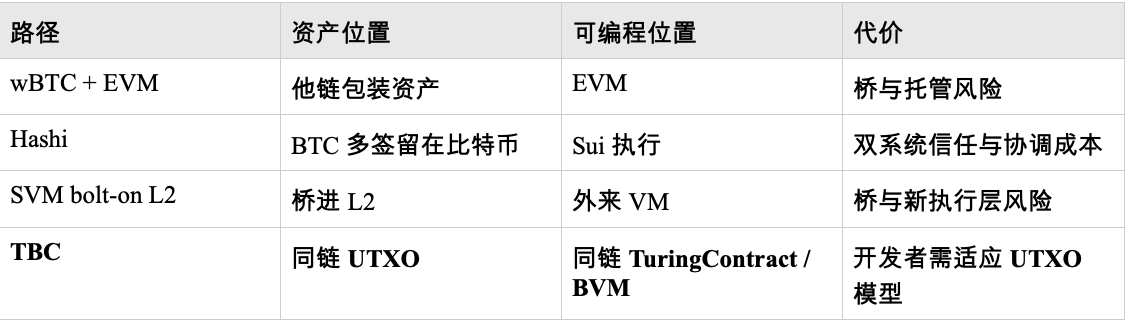
Hashi’s improvement, according to the piece, is that deposited BTC goes into a 2-of-2 multisig Bitcoin address created for the account, keeping the underlying coins on the Bitcoin network. One key is held by Hashi’s validator committee through MPC, and the other by the Guardian Layer enclave. Neither side can move BTC on its own. The Guardian Layer can also be configured to slow or block large or suspicious collateral inflows and outflows.
That addresses asset safety, but the programmability question remains. Assets stay in Bitcoin multisig while programmable logic runs on Sui. In practice, users must trust both the security of Bitcoin multisig and the execution environment on Sui. The article presents that dual-system coordination and trust requirement as a new fracture line.
It also points to the broader market setup. Hashi has not announced a mainnet launch date and is still in its stress-testing phase. At the same time, more than 75 Layer-2 projects are trying to answer the same question: how to turn idle BTC into the base layer of programmable finance. Most of those efforts, the author says, separate the asset from its programmability across two chains.
The core bottleneck is the split between UTXO assets and account-model contracts
The article notes that some projects bringing the Solana Virtual Machine to Bitcoin L2 promote sub-second speed, while Stacks’ PoX-5 pushes a model built around self-custody and BTC-denominated yield. Those routes may each carry value, but they still run into the same structural issue: assets live in the UTXO model, while smart contracts typically live in the account model.
That is not treated as a minor engineering detail. The article calls it a fundamental architectural divide.
On one side, the UTXO model offers parallelism and decentralization. Transactions are independent, do not rely on global state, and naturally support high concurrency. The cost is limited expressiveness in traditional UTXO scripting, which makes complex business logic hard to build.
On the other side, the account model, represented by the Ethereum Virtual Machine, offers strong smart-contract expressiveness. Developers can more easily build DeFi, NFTs, and lending protocols. The trade-off is state contention across the system, which can slow execution and drive gas fees sharply higher during periods of congestion.
Most projects, the article says, choose to bridge the two worlds: keep assets on a UTXO chain and run contracts on an account-model chain. That creates a new bundle of problems.
- Bridge risk, because cross-chain assets depend on the bridge’s verification mechanism.
- Execution risk, because contract outcomes need to be reflected back onto the chain where the asset resides.
- Coordination cost, because the two chains have different consensus processes, confirmation times, and rollback rules.
Viewed through that lens, Hashi keeps assets in Bitcoin multisig and executes contracts on Sui. SVM-based Bitcoin L2 designs bridge assets into L2 and run contracts inside the Solana Virtual Machine. Stacks uses PoX to stake BTC into the Stacks chain. The article’s critique is that each path is still built around wrapping or bridging, rather than changing the UTXO model itself.
TBC’s route: put Turing completeness into UTXO itself
TuringBitChain, or TBC, is presented as the alternative. The article says TBC does not split assets from contracts. Instead, it writes Turing-complete smart contracts directly into the UTXO model. It is not framed as a Layer-2 system, but as a Layer-1 implementation of Turing-complete UTXO contracts derived from Bitcoin’s original protocol.
The piece breaks that difference into three core components.
OP_PUSH_META
With OP_PUSH_META, the article says, a script can for the first time “see” itself. It can read internal transaction metadata such as version number, lock time, input and output counts, and hash fingerprints from upstream and downstream transactions. That gives the script enough context to answer where it came from and where it is going.
OP_PARTIAL_HASH
OP_PARTIAL_HASH allows scripts to recompute hashes piece by piece for arbitrarily long data streams within a constrained stack environment. In the article’s wording, that turns hash checking from passive trust into active verification performed by the script itself.
Layered TXID
Layered TXID is described as the mechanism that keeps introspection and self-proof costs constant across generations. Each generation only needs to inherit the parent TXID, a single 32-byte fingerprint, so the amount of carried data does not increase with depth. The article calls this a hereditary contract model for UTXO.
Taken together, these three elements are presented as solving one problem: reaching EVM-level contract expressiveness without depending on global state.
Performance claims and ecosystem constraints
To support that path, the article cites TBC performance figures that include mainnet throughput above 13,000 TPS, an initial block size limit of 4 GB, and fees that decline as the number of users grows. The comparison is drawn against the common pattern in traditional blockchains where more users tend to push fees higher.
The article also lays out the costs of that route. TBC’s application ecosystem remains at an early stage. Hashi, by contrast, has disclosed a list of more than 25 institutional partners, including BitGo, Cumberland, OCC-chartered bank Erebor, and SEC-registered investment adviser Wave Digital Assets. On the maturity of compliant products and institutional tooling, the article says TBC is not yet comparable.
There is also a developer trade-off. Building in UTXO comes with a real learning curve, and developers accustomed to EVM must adapt to a different contract model. As interest in the sector increases, competition is becoming more intense as well, which means TBC still has to close gaps in applications and ecosystem depth.
The market’s next question
The article’s final argument is that Hashi’s launch is a signal. The market is moving from asking whether Bitcoin should be programmable to asking where that programmability should live. Institutions are no longer satisfied with wrapped assets running through DeFi. They want the security anchor of native BTC and the flexibility of programmable execution at the same time.
TBC’s answer is that assets and contract logic should not be separated across two chains. If Turing completeness is built directly into UTXO, with transactions themselves carrying state and state passing along UTXO lineage, then lending, liquidation, and staking logic tied to BTC collateral could run inside the same security model as the asset.
That leaves the market with a direct question. If BTC does become the base layer for programmable finance, is the programmability written into an external VM, or into UTXO itself?
Hashi’s 25 participating institutions are testing the feasibility of keeping BTC on the Bitcoin network. TBC is testing whether programmability can stay inside the UTXO model. The article says both routes answer the same question, but at different levels of depth. Its closing point is that the current test is about asset safety, while the larger test is whether contract logic and asset security can ultimately be completed on the same chain.