
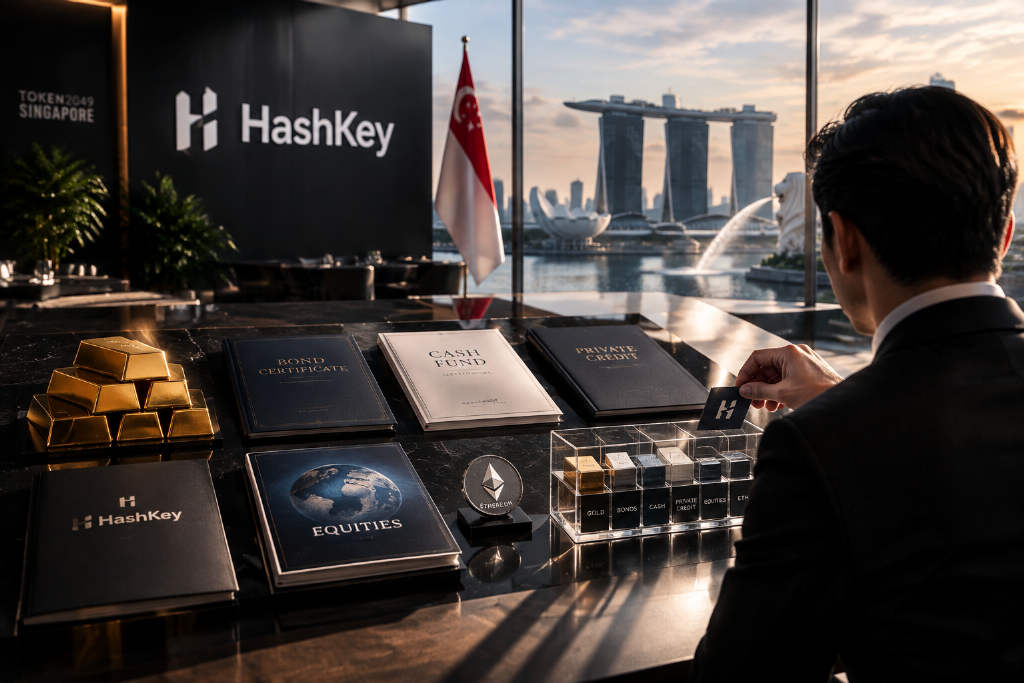
TOKEN2049 has long been treated by the industry as a read on where the market is heading. This year’s Singapore event looked, at first glance, more like a gathering of traditional financial institutions. The agenda, though, stayed firmly tied to crypto. Tokenization, stablecoins and AI remained at the center of discussion. What changed was the framing: the debate was less about distant ideas and more about how these technologies and assets can enter the financial system and be used at scale.
That shift matters in tokenization. Once more assets can move on-chain, the next question is straightforward: how do those assets reach investor accounts and become part of a portfolio?
Viewed from that angle, MarsBit focused on HashKey. The article says the exchange, known for its compliance positioning, has shown little visible push in crypto-native token listings since the market entered a bear phase, while its wealth management channel has expanded its asset range at a striking pace. On the surface, that looks like product growth. Taken together, MarsBit argues, it points to a larger question: when digital asset users no longer want to keep taking crypto risk, where can the money go?
What digital asset users lack is not more tokens, but more sources of return
The article sums up the current bear market in simple terms: token issuance helped build the last cycle, and token excess also helped break it. Crypto did not suffer from a shortage of assets. It suffered from too many of them, inflated valuations and, eventually, a burst bubble. More users, MarsBit writes, have come to see that outside a very small group of native assets such as BTC and ETH, most tokens struggle to move independently of Bitcoin.
It describes a familiar setup: an account holds dozens of coins, Bitcoin falls and the rest drop harder, while a Bitcoin rally does not guarantee that the rest will follow. In that context, the line that “nothing outperforms Bitcoin” is no longer just a joke.
The core issue, in the article’s view, is not the number of crypto assets. It is the lack of genuinely independent return streams. That is presented as a structural problem left behind by the previous expansion cycle. In stronger markets, almost every asset can be sold on a growth story. When conditions weaken, users struggle to find a real destination for capital. A market that cannot diversify risk, the article says, has at times disappointed users and kept outside institutions at a distance.
Tokenization is changing that, according to MarsBit. Its main significance is not that it adds another batch of tokens. It brings different sources of return from the traditional financial system into digital asset accounts.
That is why the structure of HashKey’s wealth products matters in the article. If the product names are set aside and the focus shifts to the economic drivers behind each asset, the change looks bigger than simple product expansion.
| Asset class | Core source of return | Role for users | Representative product on HashKey Wealth |
|---|---|---|---|
| Money market / liquidity assets | Short-end interest rates | Manage idle funds while waiting for opportunities, with liquidity and capital efficiency | Franklin OnChain U.S. Government Liquidity Fund (grBENJI); Guotai Junan U.S. dollar / Hong Kong dollar money market funds (GUSDT/GHKDT); GF U.S. Dollar Money Market Fund (GFUSD) |
| Fixed income | Interest rates + fixed-income asset returns | Reduce portfolio volatility and add a relatively stable source of return | Short-term asset-backed liquidity note STBL |
| Private credit | Credit spread | Add another risk premium outside public markets and broaden return sources | ACRED (Securitize Tokenized Apollo Diversified Credit Fund) |
| Global equities | Corporate earnings growth + equity risk premium | Capture long-term growth and add traditional equity exposure to digital asset accounts | WisdomTree 500 Digital Fund (SPXUX) |
| Gold | Real rates, safe-haven demand and monetary factors | Add a risk source different from crypto and equities, improving diversification | Hang Seng Gold ETF (tokenized unlisted class, HSGLD) |
| ETH staking | Ethereum network validation rewards | Keep ETH price exposure while earning native on-chain yield | HashKey Exchange ETH Staking |
MarsBit argues that the key point is not the six categories themselves. It is that a professional investor’s account can start to hold multiple, distinct return engines. Money market funds depend on short-term rates. Private credit depends on credit risk premia. Long-run equity returns come from earnings growth. Gold responds to real rates, monetary credibility and safe-haven demand. Staking income comes from the blockchain network itself.
Those assets will not all perform best in every market environment. That is exactly why they have portfolio value. The article presents this as the main difference between multi-asset allocation and simply buying more coins.
No need to leave the market, only to switch assets
Once different sources of return enter a digital asset account, the most direct change for users is not access to more products. It is a different way to manage risk.
MarsBit gives a simple example. An investor holds $1 million in assets, with 70% allocated to BTC and ETH. After a clear rally, that investor decides short-term crypto risk has risen and wants to cut exposure. In the past, the path may have been limited to BTC / ETH → stablecoin / fiat → withdrawal. In an account built mainly around crypto, reducing risk often meant reducing investment or leaving the account system altogether.
The article says HashKey Wealth is changing that path. As money market funds, fixed income, private credit, global equities, gold and ETH staking products enter the channel, users no longer face only two choices — keep holding crypto or sell and leave. They can rebalance the whole portfolio based on market conditions.
- If crypto’s risk-reward profile weakens, users can trim BTC and ETH positions and move part of the capital into money market funds, fixed income or gold.
- If opportunities return, they can raise allocations to global equities or digital assets again.
- If the outlook is unclear, they can keep more liquidity and wait for the next setup.
Under that framework, the question changes from “Should I stay in crypto?” to “How much risk should I take now, and where should my returns come from?” MarsBit treats that as a meaningful step from trading toward asset management.
The article says the value of HashKey’s wealth channel sits there. It is not just a page that places different assets side by side. It gives those assets different jobs inside a portfolio: money market products manage waiting capital and liquidity, fixed income and private credit provide rate and credit income, global equities target long-term growth, gold helps diversify macro risk, crypto keeps higher upside and risk elasticity, and staking lets part of a digital asset position earn native on-chain yield while it is held.
With a fuller risk ladder and a broader set of asset classes, the capital path described by MarsBit becomes: earn returns, adjust the portfolio, move part of the profits into assets with different risk profiles, keep capital efficient and liquid, wait for the next opportunity, then reallocate. Capital starts to circulate rather than stop.
For users, the article says, HashKey Wealth offers more than a one-off yield product. It gives already-earned money somewhere to go, gives risk-averse capital somewhere to sit, and keeps waiting capital in an allocated state.
That, in MarsBit’s framing, is the real value of a multi-asset account. It describes HashKey Wealth as an allocation system that can adapt to different market cycles: add crypto and equities in offensive phases, add fixed income, gold and liquidity assets in defensive phases, use money market tools when direction is unclear, and let long-term ETH holders earn native on-chain rewards through staking.
The article also says this creates a positive loop for HashKey itself. If users can find assets that match their risk preferences across more market conditions, they are more likely to keep allocating within the same account system. More continuous allocation creates more stable and more genuine product demand. That demand raises HashKey’s distribution value for global asset managers, which can attract more high-quality products. A more complete product set then gives users another reason to stay and allocate on the platform.
MarsBit summarizes that loop as: more asset classes, more risk-return choices, more continuous capital allocation, more stable real demand, more high-quality products entering, and stronger allocation capability.
A good multi-asset account, the article adds, should not require users to stay bullish at all times, and it should not matter only in bull markets. The ideal state is one in which users can find assets that match their risk preferences whether they are in attack mode, defense mode or waiting mode.
Why HashKey Wealth, according to the article
MarsBit then asks a direct question: if banks can sell funds and brokerages can sell stocks, why is HashKey Wealth needed?
Its answer is that HashKey does not need to replace banks, brokerages or DeFi in every single asset class. Traditional financial institutions have deeper product accumulation in funds, equities and bonds. DeFi has its own strengths. What HashKey Wealth is trying to connect, the article says, is a licensed digital asset account, crypto trading and on-chain capabilities, traditional and tokenized financial assets, institutional clients, and multi-asset allocation tools.
Put together, those capabilities carry significant value. For professional investors, that means a broader asset menu and the ability to reallocate across assets with different risk and return characteristics when market views change, without repeatedly exiting the account system.
For high-net-worth and institutional clients, the value shows up more clearly in capital efficiency. The article says professional investors do not mainly care whether a platform offers one specific product. They care whether capital can move, with lower friction, across assets with different risks, return sources and liquidity profiles.
That is also why tokenization is drawing more institutional attention, MarsBit writes. It gives assets that used to sit in separate financial infrastructures a chance to enter a more unified digital account and capital system. When MMFs, fixed income, private credit, global equities, gold and crypto can all be managed through one digital asset entry point, users get more than a place to buy more products. The distance between assets shrinks, and capital can be allocated more continuously.
The same logic applies on the asset manager side. Franklin Templeton, WisdomTree and Apollo, the article notes, do not lack asset management or product design capabilities. But once a financial product is tokenized, the next question is how that product reaches real investors and real capital.
HashKey sits between those two ends. On one side is traditional financial asset supply seeking access to the digital asset market. On the other is professional investors, high-net-worth clients and institutional capital that already hold crypto and stablecoins and are gradually developing multi-asset allocation needs. Asset managers create and manage the assets. HashKey, the article says, provides compliant accounts, digital asset infrastructure and a distribution entry point, bringing those assets in front of real allocation demand and turning the wealth channel into an infrastructure layer between TradFi asset supply and crypto capital demand.
Once those two ends connect, MarsBit says, a natural positive loop can form: better assets enter, users get a more complete allocation set, more real and more durable capital demand appears, HashKey’s distribution value to asset managers rises, and more mature products become willing to enter.
That, the article argues, is what makes HashKey Wealth attractive. For mature investment clients, the scarce thing has never really been a single product. It is a system that allows assets to stay allocated and capital to keep moving efficiently.
The shift from “what coin to buy” to “how to allocate money” may look like a small change in wording. MarsBit presents it as a broader upgrade in digital assets, from a trading-led market to one shaped more by asset management. For HashKey, the wealth channel is trying to absorb that change: not by asking users to carry crypto risk all the time, but by giving capital more suitable places to sit in different market environments.
If that direction keeps expanding, the article says, the value of a digital asset account may one day be measured less by how many tokens it can trade and more by how many kinds of assets, risks and return sources it can help users manage. MarsBit closes by suggesting that this may be the most compelling part of HashKey Wealth’s development.