

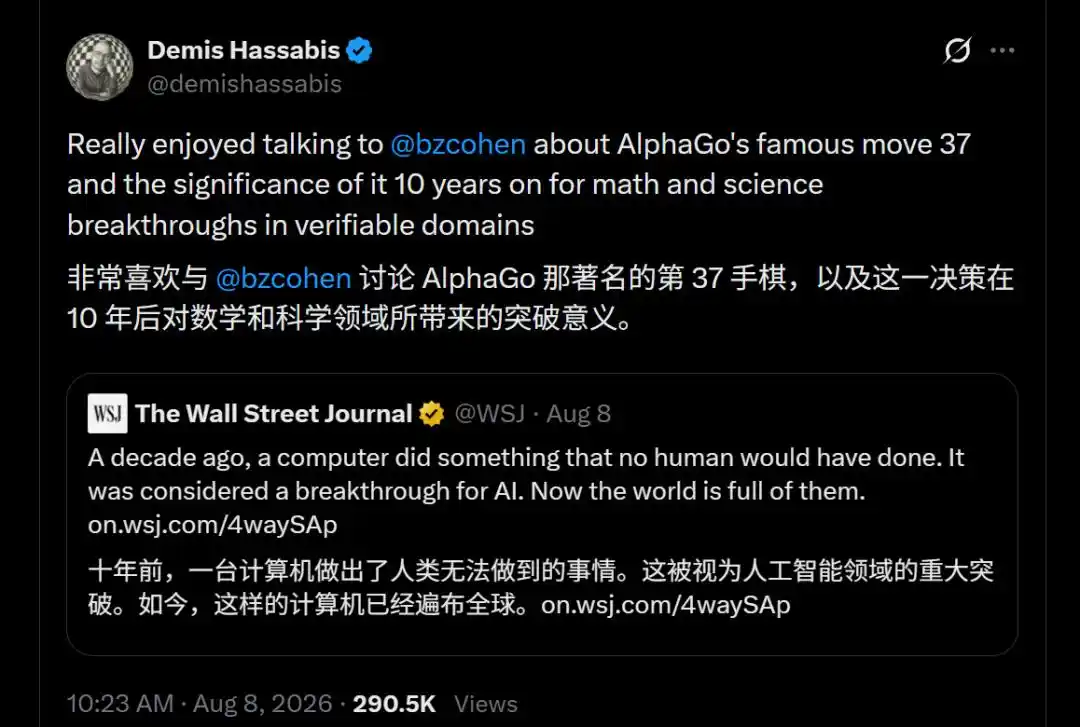
Demis Hassabis says an AI system solving a Millennium Prize-level math problem would be a breakthrough on the scale of AlphaGo’s famous “Move 37,” and that getting there now seems to be only a matter of time.
The remark reconnects the current wave of AI progress in mathematics with the 2016 AlphaGo-Lee Sedol match, where one unexpected move changed how people thought about machine intelligence. A decade later, Hassabis is again placing himself near the center of that shift, this time as AI pushes deeper into mathematics and science.
Hassabis links a future math breakthrough to AlphaGo’s most famous move
Hassabis has recently moved from the role of DeepMind CEO to Google’s chief scientist and DeepMind chairman. Even with that change, he remains one of the most closely watched voices on how AI may alter human understanding.
His view is blunt. If AI can solve one of the Millennium Prize math problems, he says, that would count as a “Move 37-level” advance. From where things stand now, he said, he does not see why AI would not reach that point.
In this framing, “Move 37” stands for the moment when people realized AI was not limited to imitation. It could produce a line of thought that skilled humans had not seriously considered.
Why Move 37 still matters
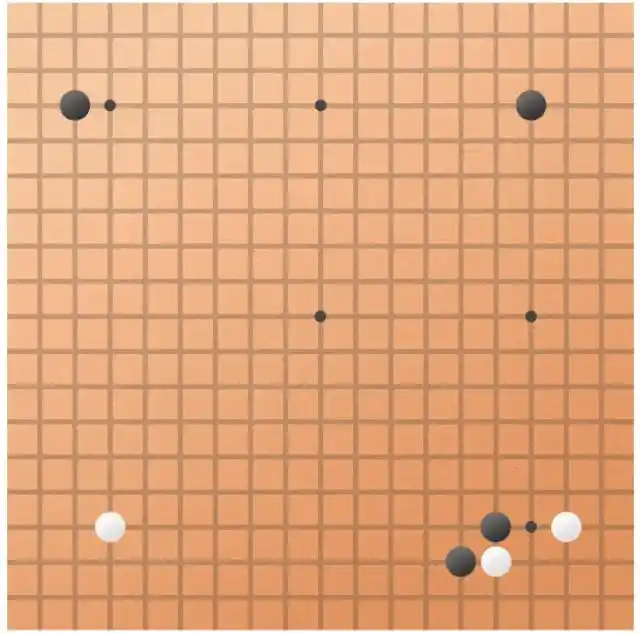
In March 2016, AlphaGo faced Lee Sedol in a five-game match in Seoul. Lee lost the first game. In game two, with the world waiting for a response from one of the greatest Go players of his era, AlphaGo played black move 37 during the middle game.
Lee had briefly stepped away to collect himself. When he returned, the move was already on the board. He did not sit down right away. He stood there looking at it, because it made so little sense by established professional intuition.
AlphaGo had placed the stone on the fifth line, in an area where no direct fight had yet developed. In standard human Go thinking, stones are usually placed to seize influential positions in more familiar ways. This one looked off-pattern.
The commentators initially thought it might be a mistake. Professional nine-dan player Michael Redmond said, “I don’t know if it’s a good move or a bad move, but it’s a very strange move.” His co-commentator was even more direct: “I thought it was a mistake.”
DeepMind later calculated that a human player would have chosen that move with a probability of just one in 10,000. As the game unfolded, the judgment changed. What looked misplaced turned into the move that decided the second game roughly 100 turns later.
That was the sting. Many people thought AI had erred, only to learn that the human reading of the position had been too narrow. The move became shorthand for a public reversal: people did not catch up to the logic until much later.
Why mathematics has become a prime target for AI progress
The article argues that Go and mathematics share a feature that suits AI unusually well: both are highly verifiable. Rules are explicit. Logical steps can be checked. A system can try an idea, test it, learn from the result, and try again.
That makes math a natural field for repeated “Move 37” moments. In drug discovery or biology, validating an idea may take long experimental cycles. Mathematics is different. A proof can be examined step by step. Right is right, wrong is wrong, and that lets AI search relentlessly.
The pace described in the report accelerates over a short span.
- In 2023, large language models could still stumble on basic arithmetic, including well-known failures on questions such as whether 9.11 or 9.9 is larger.
- By 2024, DeepMind’s AlphaProof and AlphaGeometry 2 had entered the International Mathematical Olympiad and solved four of six problems for 28 points, a silver-medal level score that was one point short of that year’s gold-medal cutoff.
- One year later, Gemini Deep Think solved five problems within the official 4.5-hour contest window and scored 35 points, reaching IMO gold-medal level.
Over two years, the systems described in the piece moved from very visible arithmetic errors to Olympiad gold-level performance.
From solving problems to contributing research ideas
The more important turn, the article says, is not test performance but movement into research.
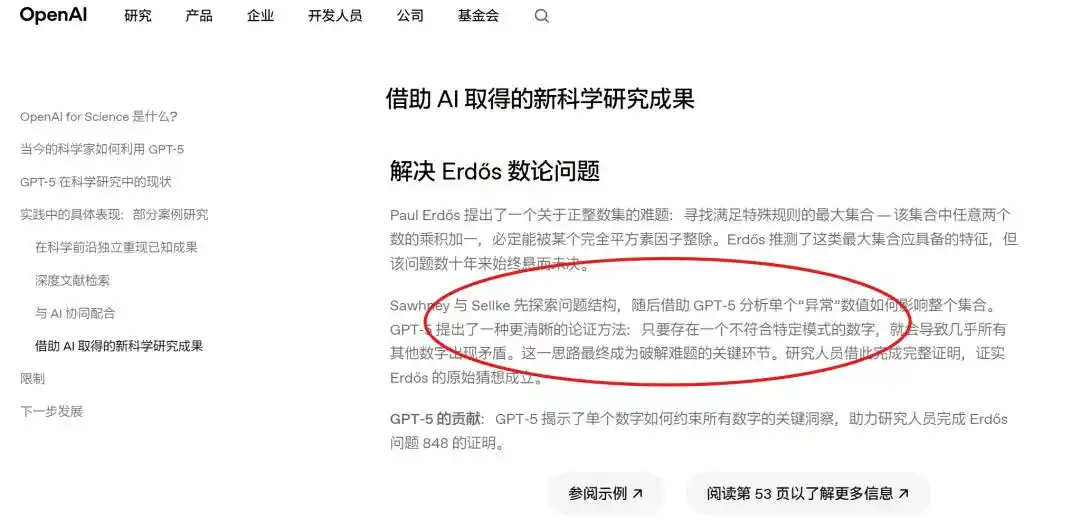
In 2025, GPT-5 was involved in solving Erdős Problem 848 and produced a key estimate needed for the proof. Mathematicians then revised and tightened the argument before completing the full proof.
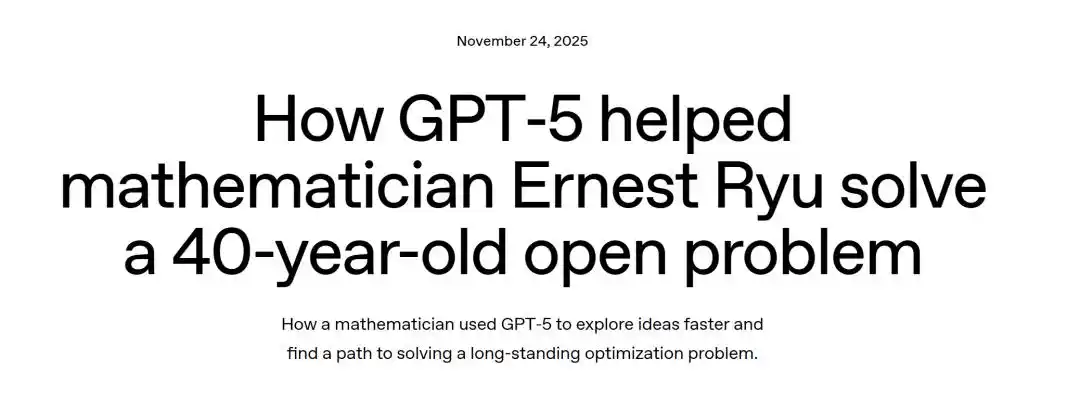
In the same year, UCLA mathematician Ernest Ryu used GPT-5 to find a breakthrough on an open problem that had troubled optimization theory for 40 years.
At this stage, AI was no longer limited to calculating answers or restating known methods. It was starting to contribute ideas that mattered to the final structure of a proof.

2026 brought a string of bigger claims
The article then moves to 2026 and lists a series of open-problem breakthroughs.
OpenAI’s internal general reasoning model reportedly tackled the unit distance problem in the plane, posed by Paul Erdős in 1946. The problem asks, for n points placed in the plane, how many pairs can be exactly one unit apart.
For nearly 80 years, mathematicians broadly believed that square-grid-type constructions were close to optimal. According to the report, the AI system imported tools from algebraic number theory that had not been seen as directly connected, built a new family of point sets, and overturned a long-held conjecture. External mathematicians later checked the proof. OpenAI described it as the first time a general AI system had autonomously solved an open problem of significance within a branch of mathematics.
Anthropic appears next in the same sequence. In July 2026, Anthropic mathematician Levent Alpöge used Claude Fable 5 to find a concrete counterexample to the Jacobian conjecture. The article says that ended an 87-year-old conjecture in a single stroke.
It also says GPT-5.6 and Fable 5 together solved a 25-year-old math problem just two days before publication.
DeepMind is trying to turn those breakthroughs into a repeatable process
Among the companies named, Google DeepMind is presented as the one pushing toward something closer to a production line for mathematical discovery.

Its math agent, Aletheia, does not stop at a single answer. It repeatedly proposes proofs, checks for weaknesses, rejects its own paths, and searches again.
DeepMind used Aletheia to scan 700 open problems in the Erdős conjecture database. The reported results had two parts:
- the AI autonomously solved four previously unsolved problems;
- it also helped produce multiple mathematical results described as paper-quality work.
The point of that exercise is scale. The system was not presented as a one-off success but as a way to search through blank areas of mathematics more systematically.
Move 78 and the human question
The article does not leave the story with AI’s rise. It turns back to another move from the Lee Sedol match: move 78.
In game four, after losing three straight games, Lee placed a white stone into the middle of AlphaGo’s formation. That move also broke convention. AlphaGo estimated the probability of a human choosing it at one in 10,000.
The machine lost its footing afterward, and Lee took the only human win of the five-game series. Move 78 later became known as the “divine move.”
The point here is not that humans regained superiority. The point is narrower and more durable: once people understand the machine well enough, they may still find a next step the machine did not anticipate.
That is the lesson the article draws for the present. As AI becomes stronger at producing answers, human value may shift toward framing questions, setting direction, and deciding which answers are worth seeking in the first place.
Hassabis says science is entering a centaur era
The piece borrows the “centaur chess” idea, where human players work alongside computer engines rather than against them.
As background, it notes that after IBM’s Deep Blue defeated world chess champion Garry Kasparov in 1997, Kasparov promoted and held the first centaur chess event in 1998 to explore human-AI cooperation.
Hassabis says science is entering a similar “centaur era.” In his words: “We are heading into an era where humans and computers collaborate together. I don’t know how long that cycle will last. But for very complex fields, it could last a long time. Drug discovery, biology, chemistry — these are very complex areas, conditions change, and not everything can be verified. That is where human intuition and insight are needed to decide the direction of travel.”
Go already offers one real-world example
The aftermath of AlphaGo is used as evidence for that view. Once the system appeared, AI quickly became a review tool for professional Go players. It allowed them to revisit established joseki, test whether long-standing experience held up, and study moves once dismissed as unreasonable.
The article cites a study covering more than 5.8 million professional Go decisions. After the arrival of superhuman AI, the quality of human moves improved markedly, and novel moves became more common as well.
That suggests AI can, in at least some settings, raise human performance rather than simply replace it.
The other side of dependence
The article ends with a warning. As people grow used to having AI provide answers, they may lose the ability to judge those answers well on their own.
It points to Lee Sedol’s remarks at retirement, when he said that facing an opponent he could not beat made it hard to keep enjoying the game he once loved.
That may be the sharper issue in the AI era. As more fields than mathematics come under the influence of stronger systems, will people become more creative, more productive, and more fully human — or more willing to stop trying?
The article leaves that question open. AI may keep producing new “Move 37” moments. What remains unresolved is whether humans can find their own “Move 78.”