
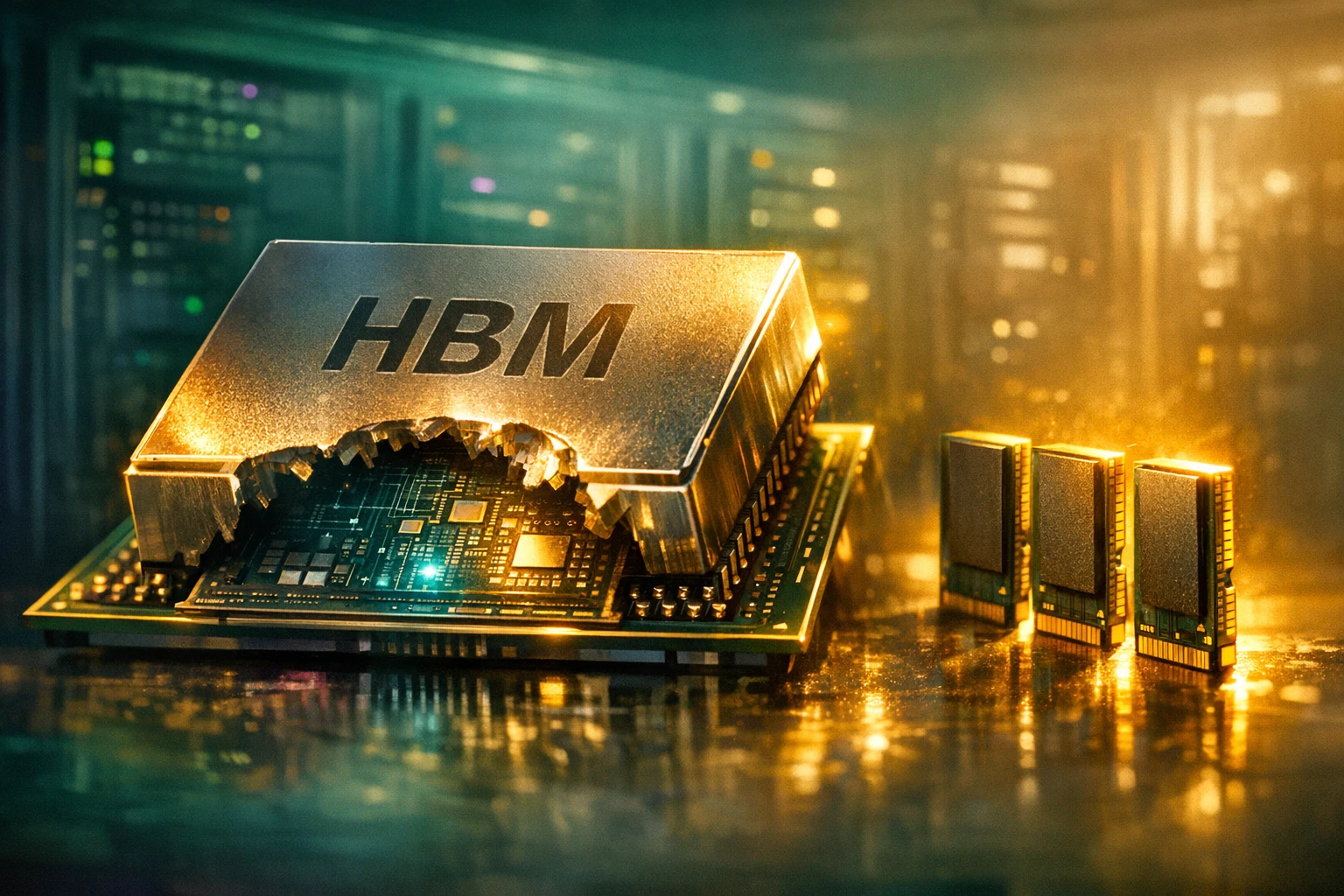
HBM now makes up 63% of AI chip component costs, up from 52% in the first quarter of 2024, according to new research from Epoch AI. Over the same period, absolute spending on HBM climbed from $12 billion to $32 billion, a 167% increase. The data points to a clear shift: the cost bottleneck in AI compute is moving away from chip design and toward memory supply.
Memory is taking a larger share of the bill
Epoch AI tracked component cost structures across four major chip designers: Nvidia, AMD, Google, and Amazon, covering the period from Q1 2024 to Q4 2025. HBM, or High Bandwidth Memory, is built by stacking memory dies vertically and placing them close to the GPU package. That design helps AI systems move large amounts of data much faster and with lower latency than conventional memory setups.
The function of HBM is straightforward. It does not make the GPU itself compute faster; it reduces the time the GPU spends waiting on memory access. That has made it central to both AI training and inference workloads, where rapid data movement is critical.
The supply side is tight. Only SK Hynix, Samsung, and Micron currently have mass-production capacity for HBM, and Epoch AI’s figures show how that scarcity is changing the cost mix. While HBM’s share rose by 11 percentage points, other categories either slipped or lost ground: logic chips fell from 14% to 13%, advanced packaging dropped from 19% to 15%, and auxiliary components declined from 15% to 9%.
Higher HBM prices are flowing into capex plans
The impact is moving down the supply chain. If HBM accounts for nearly two-thirds of AI chip component costs, and AI chips already represent a major part of large tech companies’ capital spending, then higher memory prices show up quickly in spending plans and earnings disclosures.
Epoch AI cited Microsoft’s fiscal 2026 capex plan, which separately identified $2.5 billion in component price increases. That was one clearly attributable piece of a broader $25 billion increase. Meta also raised its 2026 capital expenditure range by $10 billion, citing higher component costs.
In absolute terms, the change is sharp. HBM spending rose from $12 billion in 2024 to $32 billion in 2025, while total AI chip component spending increased from $22 billion to $52 billion. That translates into growth of 167% and 136%, respectively. The supply chain is expanding fast, but rising capex does not necessarily mean compute capacity is growing at the same pace. Part of that spending is simply absorbing higher memory costs.
Epoch AI expects the pressure to continue in 2026
Epoch AI said HBM’s share of AI chip component costs is expected to keep rising in 2026. That suggests the key constraint on AI infrastructure spending may be less about GPU design alone and more about whether HBM supply can keep up. For major buyers of AI hardware, memory pricing is now one of the main variables shaping the economics of compute expansion.