

A new VISTA paper from He Kaiming’s team has drawn heavy attention on X after reporting that a different interface for vision and memory sharply changed how frontier models performed on ARC-AGI-3.
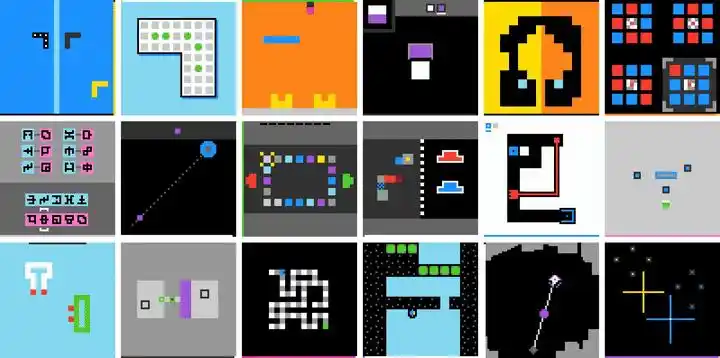
The headline result is straightforward. Under VISTA, Claude Opus 5 completed all 25 public ARC-AGI-3 games, clearing all 183 levels and scoring 100 on every game. GPT-5.6 Sol also cleared the full set and scored 99. The paper says Claude used 7,302 steps in total, equal to 0.43x the number taken by first-time human players.
ARC-AGI-3 was introduced in March by Keras creator François Chollet and the ARC Prize Foundation. The benchmark consists of interactive pixel games with no instructions at the start, leaving the player to infer the rules through observation and trial and error.
The scoring rule is strict. According to the paper, the official evaluation involved nearly 500 novice human participants, and an AI system must not only finish the tasks but also avoid taking more steps than humans if it wants a perfect score.
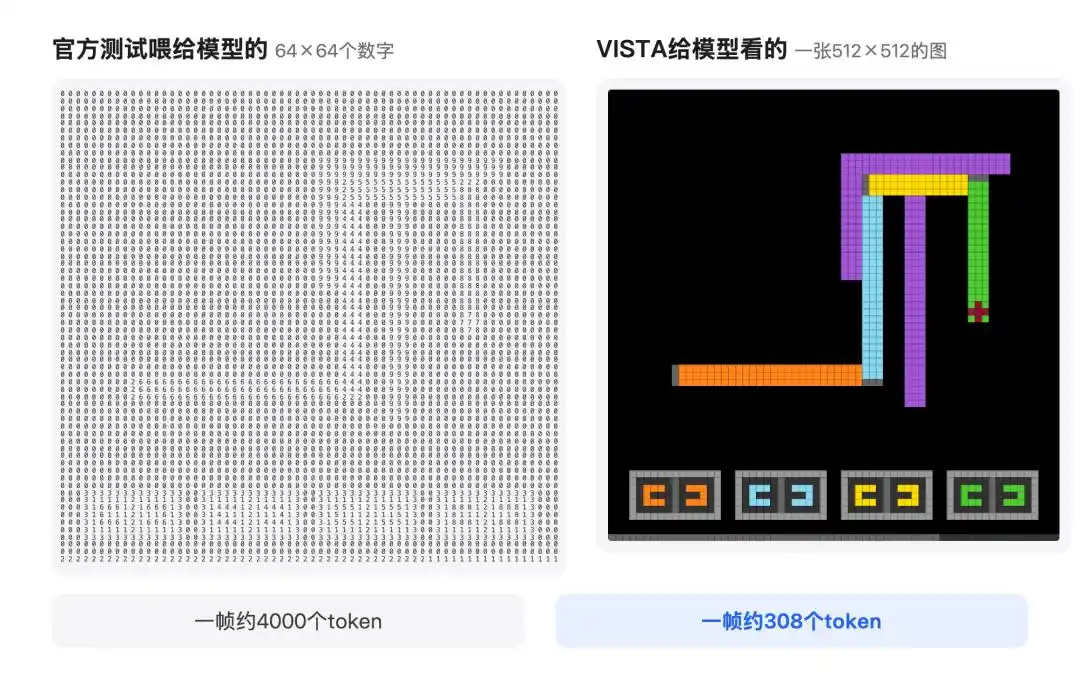
The authors argue that the official setup handicaps models from the start. Instead of receiving the same game screen a human sees, the model gets a 64×64 numeric table. What appears to a person as a character, obstacles, and a route becomes 4,096 numbers for the model.

Replacing the numeric grid with images
VISTA begins with a simple change: it swaps the numeric table for direct image input.
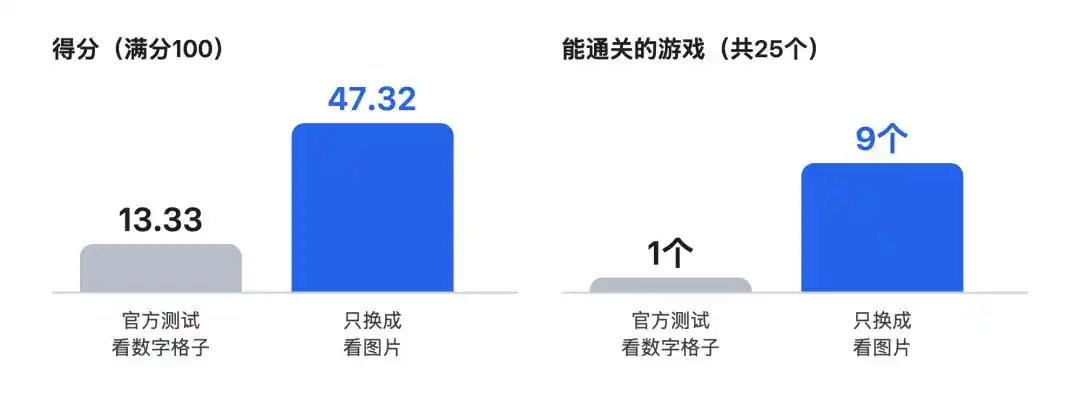
Nothing else was changed in that comparison, yet GPT-5.6 Sol’s score rose from 13.33 to 47.32, according to the paper. The token bill also fell. One numeric grid consumed about 4,000 tokens, while a 512×512 image required 308.
Across a full run, the text-based version used 71.9 million tokens, while the image-based version used 30.7 million and still scored higher. The paper says that change alone recovered roughly 34 points. In another comparison, simply replacing numbers with images lifted GPT-5.6 Sol’s score by more than 3x and increased the number of solvable games from 1 to 9.
A lossless visual memory the model can revisit
The paper says vision alone was not enough. ARC-AGI-3 games can run for hundreds of steps, and multimodal models often lose access to earlier frames once the context window fills up or compress them into short text summaries. When the model needs to verify a detail later, the original frame may already be gone.
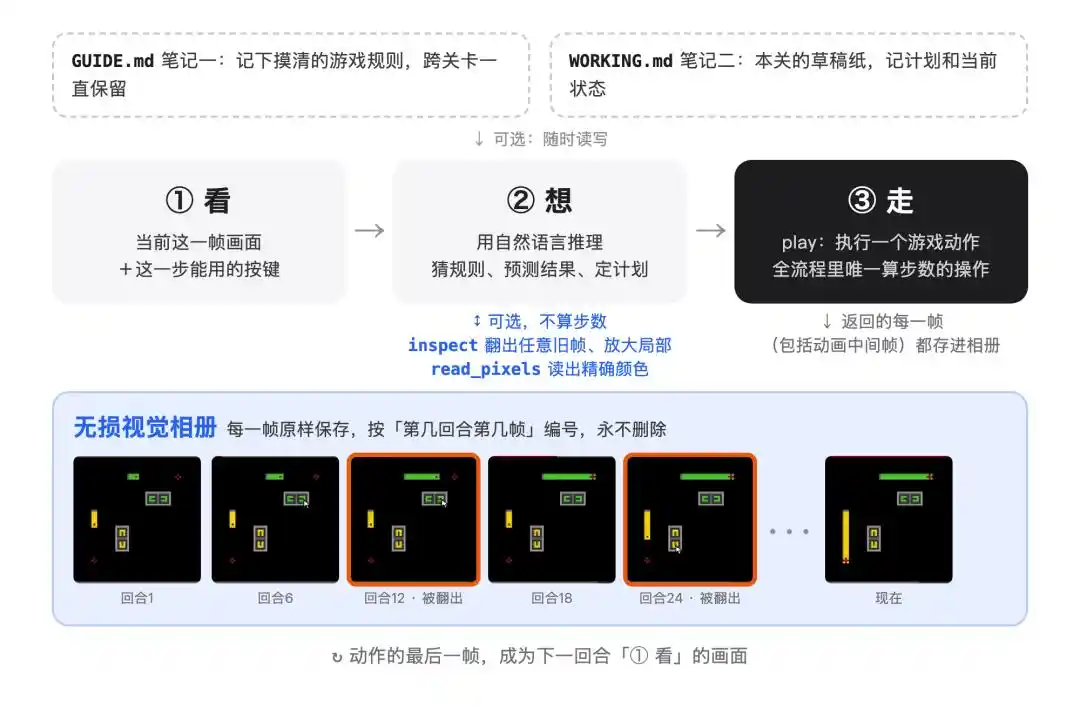
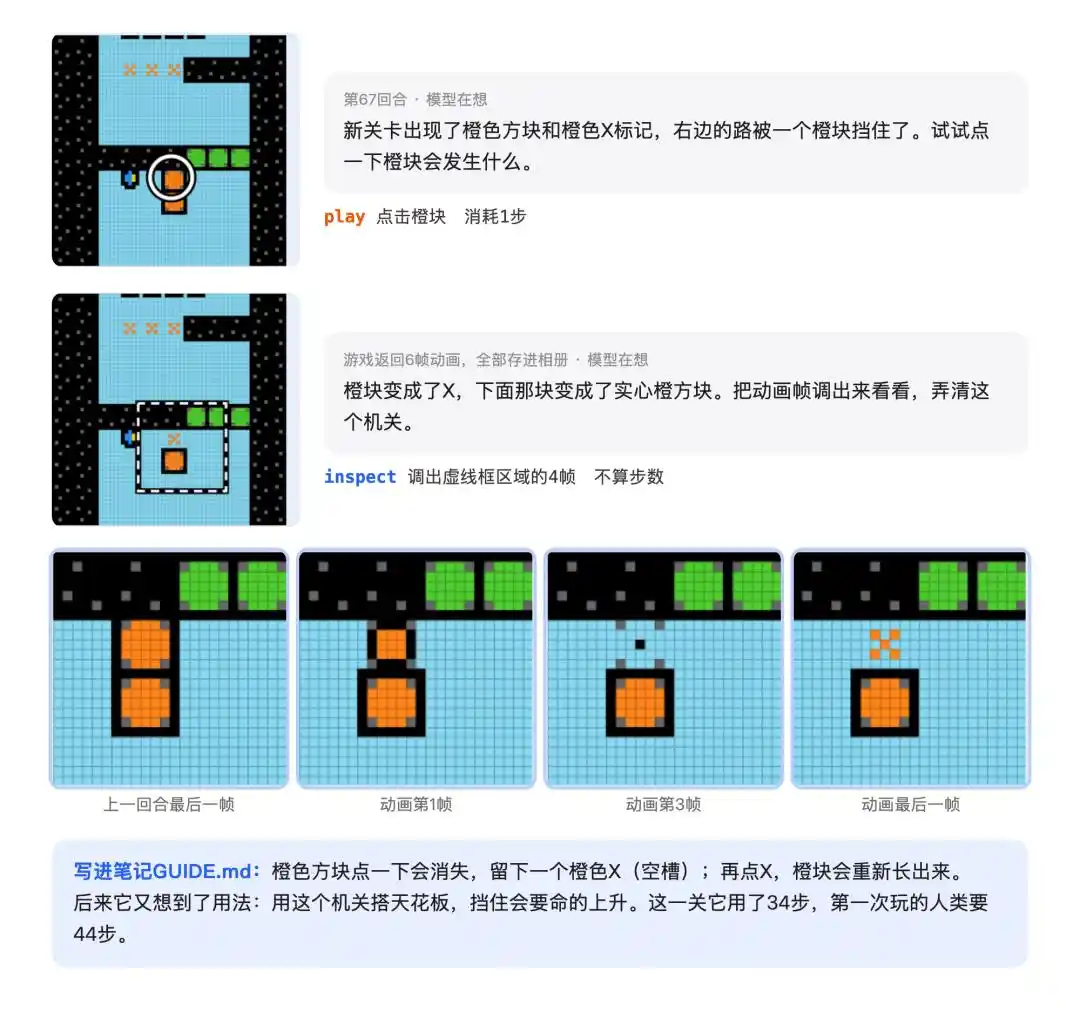
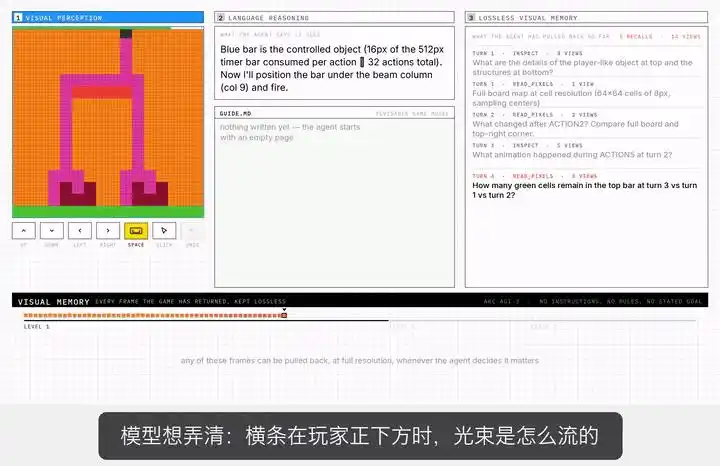
VISTA addresses that with what the authors describe as a lossless visual memory album. Every frame produced during the game, including animation frames, is stored in order. The model can call inspect to retrieve any frame, compare several frames side by side, zoom into a corner, or use read_pixels to obtain exact colors.
One detail matters for the benchmark: looking back at stored frames does not count as a step. Only actual in-game actions are counted. The team calls this mechanism “explicit attention,” meaning the model itself decides which frame to revisit and which region to inspect.
VISTA also gives the model two text files. GUIDE.md is used to record game rules, and WORKING.md serves as scratch space. In each turn, the model looks at the screen, reasons about the rules, checks the album if needed, and only then makes a move.
The paper includes a concrete example from level 3 of BP35. An orange block appeared on screen. After the model clicked it, the block turned into an X. Instead of moving on, the model paused and pulled up the final frame from the previous turn together with the three animation frames that had just appeared, then compared them side by side.
A few turns later, it found that clicking the X caused the orange block to reappear and wrote in its notes: “This is the tool I need; use it to build a ceiling to block the deadly rise.” In that level, first-time human players took 44 steps, while the model took 34.
In a Pac-Man task, where pellets disappear once eaten, the model went back to the opening frame twice, on turns 13 and 36, to recover the maze layout and plan its route.
More context and larger images did not help
The paper also tested two common ideas: extending the context window and increasing image size. Neither improved performance.
When context was expanded from the default 200K to 780K, token usage per game rose from 30.7 million to 105.7 million, but the score fell from 99 to 93.9.
The same pattern appeared in image scaling. At 16x enlargement, each frame consumed 1,229 tokens and the score dropped to 88.3. At 4x enlargement, the score reached 99.7, which was higher than the default 8x setting.
The explanation offered in the paper is that oversized images consume context budget without making the model understand the scene any better. The team said in its blog that the system was intentionally designed to stay minimal.
No new model was trained for VISTA, and every game used the same prompt. The full prompt was just four sentences, with no game-specific instructions.
Near-perfect results without writing programs
Many of the top ARC-AGI-3 approaches this summer followed a code-heavy path. The paper cites systems such as Tycho and Schema, where a large model writes executable code for each game and uses a simulator to iterate through trial and error.
For the checkers-style game LF52 alone, Schema wrote about 4,000 lines of Python, according to the paper. In VISTA, by contrast, the model summarized the same rule in three natural-language notes.
The authors describe VISTA as the first system to reach perfect or near-perfect ARC-AGI-3 performance without relying on program synthesis. They argue that this matters beyond games because the real world will not come with a prewritten 4,000-line simulator.
The paper highlights one more comparison. In the game m0r0, humans took 1,107 steps, while Claude used 219. It says both scorecards are listed on the official ARC Prize platform.
Tests beyond ARC-AGI-3
The paper says the harness is general enough to transfer beyond the benchmark.
In a 3D setting with perspective, VISTA scored 84.12. When paired with GPT-5.6 Sol and tested on 34 browser games, including Mario, 2048, and Minecraft, it reached a 63.3% task success rate, above the 55.3% recorded for novice human players.
The same mechanism also appeared in a static vision task. In one BabyVision matching problem, the model connected the moose and the rabbit incorrectly without VISTA, but answered correctly after using VISTA’s zoom capability.
The paper also reports that a 320B open-source model that scored only 1.89 under the official implementation rose to 66.93 after VISTA was added, a roughly 35x increase.
Part of a year-long argument that ARC is a vision problem
The paper places VISTA in a broader research line from He Kaiming’s group. While mainstream ARC work has largely been dominated by text-based reasoning with large language models, this team has spent the past year arguing that ARC should be treated first as a vision problem.
The first paper, VARC, trained a small 18 million-parameter vision model from scratch and matched average human performance using image input alone. The second, NAT-ARC, examined whether pretraining on ImageNet could strengthen abstract reasoning. The third is VISTA, which drops the small-model training step and instead equips frontier models with direct visual input and replayable memory.
The article says the three papers are tied together by He Kaiming’s PhD student Hu Keya, who studied in Shanghai Jiao Tong University’s ACM program and served as first author on two of the papers and second author on one. VISTA’s other co-first authors are MIT PhD students Qiushi Han and Linlu Qiu, and MIT associate professor Cathy Wu is also listed as an author.
The paper frames the result as a challenge to the industry’s default direction. For years, progress has largely been tied to larger models and longer reasoning chains. VISTA points to a different lever. The same Claude model moved from 40 points to a perfect score through an external pair of “eyes” and a replayable “album.”
ARC Prize co-founder Mike Knoop is also cited as saying that more and more “learning” will happen outside model weights. The paper’s closing view is that the next stage will depend on who can help models see the world clearly and retain what they see. The team’s next target is embodied environments filled with real visual scenes, where no one will translate the world into a numeric table in advance.