


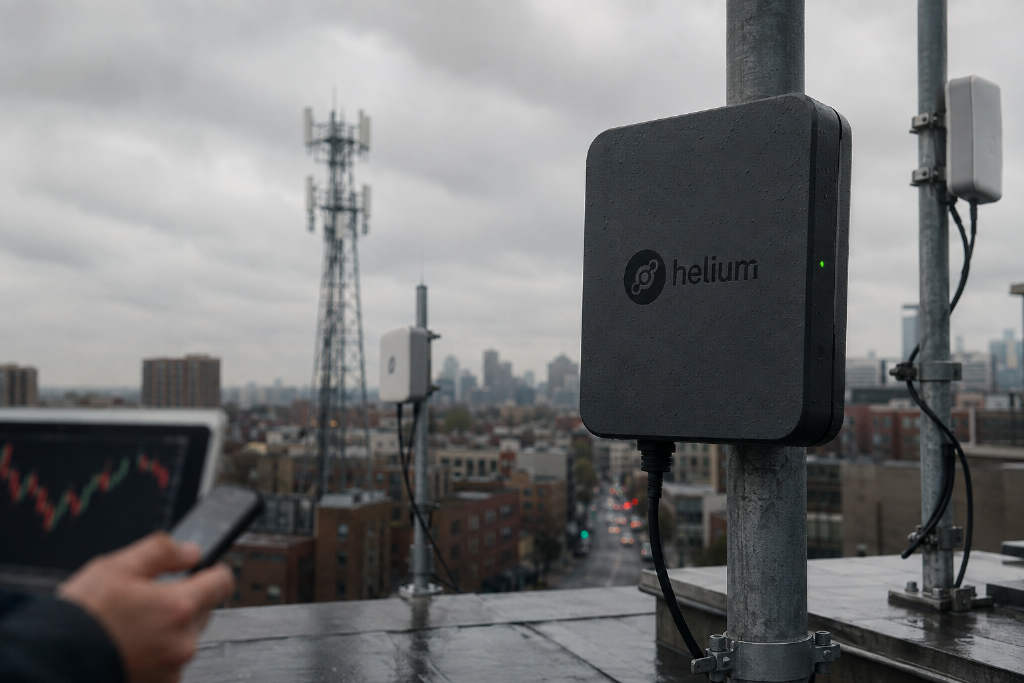
Helium’s HNT token posted one of the sharper moves in the market over a two-week stretch, but the network’s revenue data did not follow the same path.

According to the figures cited in the piece, HNT bottomed at $0.167 on Aug. 15, a multi-year low that valued the network at roughly $31 million. Two weeks later, the token touched $0.96 intraday. By Thursday morning, it was trading near $0.50, still up more than 125% on the week, with a market capitalization of about $95 million.
What lit the initial move
The rally did not come out of nowhere. The article lays out four steps that shaped the market’s reaction.
On Aug. 21, Helium published HIP-150, a proposal to direct Mobile subDAO emissions toward deployers carrying paid data traffic.
On Aug. 28, Helium said Celina, Texas had converted its public Wi‑Fi footprint into carrier coverage on the network.
Over that weekend, short positions were squeezed, and on Aug. 31 the community approved HIP-150 with 96.2% of voting power in favor.
Then on Tuesday, Helium launched HeliumOS, described as a B2B platform that gives carriers and MVNOs tools to lease coverage instead of building it themselves.
How much Celina contributed
The U.S. Census Bureau lists Celina as the fastest-growing U.S. city with a population above 20,000, according to the article. Helium’s setup there layered carrier offload onto existing Wi‑Fi in public libraries, senior centers, and downtown stores, with phones connecting through Passpoint credentials stored on SIM cards.
Helium oracle data showed that the entire mobile network transmitted 78,000 GB of data on the day of the announcement. Celina accounted for about 0.1% of that total.
So the municipal partnership was a real operating development, but its immediate weight in network-wide traffic was still small.
Usage up, revenue down
The more striking split showed up in the operating data.
On the usage side, rewardable carrier offload traffic rose 2.4x year over year, from 1.26 PB in August 2025 to 3.06 PB last month. Daily traffic kept climbing during the rally and did not show an inflection point.
Revenue told a different story. Payers spent $263,000 in Data Credits on mobile traffic in August, down 82% from the March peak of $1.47 million.
That left Helium with stronger apparent usage growth, but much lower paid traffic spend than it showed at the high earlier this year.
Why the March peak and August reading diverged
The article traces that gap to the withdrawal of subsidies.
As it notes, the $0.50 per GB rate behind the March peak was subsidized by Nova Labs, which burned its own HNT as a temporary measure while carriers negotiated location-based pricing. Those prices ranged from zero at lower-value sites to more than $0.50 at airports.
HIP-143 later moved the headline rate to roughly $0.10 per GB, a level the article says carriers could accept at scale. Oracle data showed the subsidy fading out through June.
Under that framing, the March peak measured not only carrier demand but also Nova Labs’ balance sheet. August Data Credit burns, by contrast, offered what the article called the first clean read on organic carrier spending.
What HIP-149 and HIP-150 changed
The end of subsidies also helps explain the urgency behind Helium’s governance changes.
HIP-149, passed in July, set the deployer floor at 50% of the new carrier rate, or $0.05 per GB. The August proposal, HIP-150, raised that floor to 80%, or $0.08 per GB, with hotspot multipliers reaching as high as 5x.
It also formalized location-based pricing that carriers had already negotiated off-chain and redirected Backstop minting straight into the deployer data rewards pool. That, the article said, closed a leakage in which only 1.00 HNT reached deployers for every 1.60 HNT minted by the DAO.
Nova Labs will provide its service provider rewards through July 2027, according to the piece, lifting the Mobile data bucket’s share of the subDAO allocation from 70% to 94%.
Valuation still faces a hard supply backdrop
Even after the repricing, the math remained demanding.
Annualized from August Data Credit spending, paid revenue comes to about $3.1 million. Against a $95 million market cap, that works out to roughly 30x payer revenue.
The supply side is also heavy. The article says HIP-149’s growth subsidy mints around 5.96 million HNT per month in the first year to a treasury managed by Nova, lifting effective maximum supply from 206 million HNT to 347 million HNT.
At the current pace, carrier burns remain well below one-tenth of monthly issuance.
Positioning filled the gap
The article’s market read centers on derivatives positioning as the force that turned a real catalyst into a violent squeeze.
HNT perpetual funding fell below -1.2%. Weekend short liquidations reached $1.6 million, while long liquidations stayed below $200,000. On Aug. 30, trading volume hit $248 million, more than the entire market capitalization at the time.
That combination, in the article’s telling, described a short squeeze that found a credible narrative and then accelerated through positioning pressure.
What has to happen next
The final test is whether carrier offload burns can scale fast enough to outpace issuance.
Nova has sold its consumer business, ended the subsidy program, and is now using the HIP-149 treasury to fund carrier expansion, the article says. Under that setup, value accrual depends on growth in offload-related burns rather than subsidy-supported activity.
Management set its own target in June: an inflection point at 7x to 10x current traffic. At that level, Helium’s roaming share with partner carriers would reach the double digits and pricing leverage would flip.
HIP-150 is meant to keep deployers solvent until the network reaches that point. HeliumOS, meanwhile, is presented as the platform layer promised on the Di Dio roadmap. Its launch customer, Affinity Ventures, owns Noble Mobile and recently acquired Helium Mobile.