
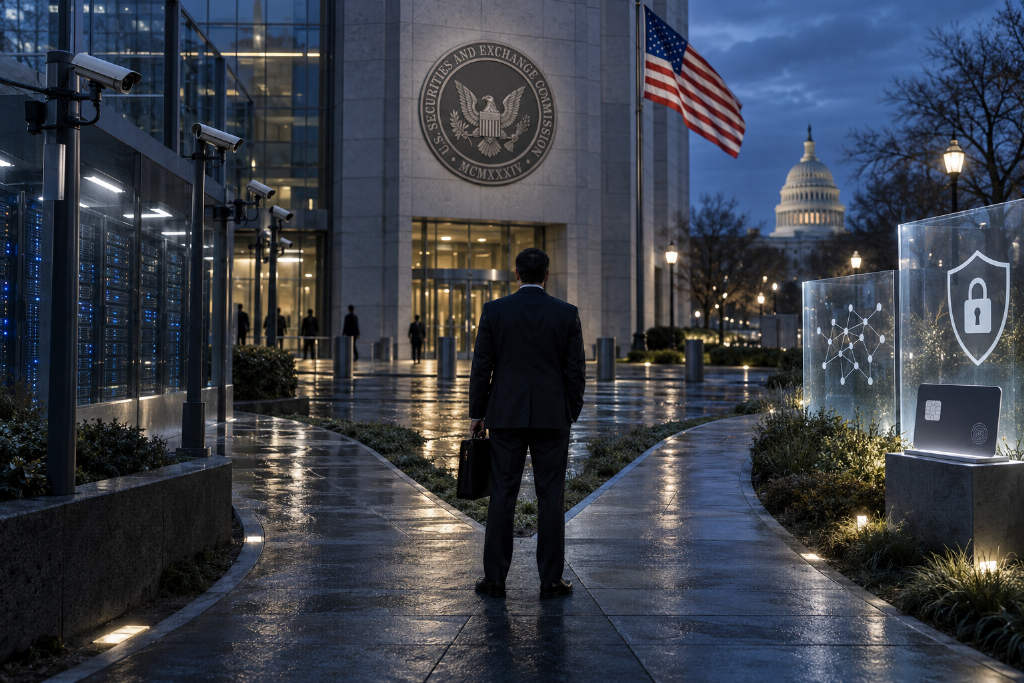
CoinDesk has published an opinion article arguing that Hester Peirce’s departure from the U.S. Securities and Exchange Commission leaves behind a larger question than crypto oversight alone: whether the United States will continue down a path of mass surveillance and centralized data collection, or build a regulatory framework that protects both privacy and security.
The article was written by Will Schwartz, a policy associate at the Blockchain Association. Schwartz wrote that Peirce’s last day as an SEC commissioner is a moment that the digital asset industry, along with Americans who believe regulation should reduce risk while supporting innovation, should mark with gratitude.
Eight years of opposition to regulation by enforcement
Schwartz described Peirce as a principled voice at the SEC for more than eight years. Under the previous SEC chair, he wrote, she often dissented when the commission chose to bring enforcement actions instead of writing rules that the industry could actually follow.
The article also points to Peirce’s token safe harbor proposal, which Schwartz said she introduced years before regulators were ready to hear it. He added that she led the Crypto Task Force and maintained that investor protection required the agency to use its authority to create regulatory guardrails for a fast-growing industry.
Schwartz wrote that Peirce brought humility, conviction and humor to the job. He said that while she is leaving the SEC, the ideals she represented will remain.
The piece identifies Schwartz as a policy associate at the Blockchain Association, where he works on research and analysis related to digital asset legislation, regulation and emerging policy developments.
Her final public remarks focused on unfinished work
According to the article, Peirce did not use some of her final public appearances as a commissioner to celebrate past wins. Instead, at SIFMA’s Digital Assets Conference on Sept. 23, she laid out what still needs to be done even after her departure.
As Schwartz recounted, Peirce said society is standing at a major crossroads. One road leads to the world people already know: dragnet surveillance, the conversion of every part of life into data, and cybersecurity breaches that expose highly sensitive information to bad actors around the world. The other road leads to a system that preserves both privacy and security, where Americans can prove they are following the law without handing over sensitive personal information.
The article criticizes a financial regulatory model built on mass data collection
Schwartz wrote that Peirce has seen firsthand how U.S. financial regulation is structured to extract as much personal data from consumers as possible. He said the regulatory framework for more than 50 years has relied on the mass collection and storage of personal data from Americans who interact with the financial system.
In the article’s description, businesses collect personal information from consumers and share it with the government, which then tries to identify actual criminal activity. Peirce framed that process as looking for the “needle” in the “haystack” of data belonging to innocent Americans.
Schwartz argued that the needle is rarely found in the haystack, even though the law is built as if a larger haystack makes the search easier. He said the opposite is true. Under the current system, the government ends up holding a vast cache of consumer data that it must sift through in search of evidence of crime.
He then laid out what he described as the consequences of that model. Centralized data stores make breaches more damaging, exposing consumers to greater harm and putting national security at risk. Mandated disclosures, he wrote, also supply data brokers that scrape public filings and records to assemble and sell detailed profiles, which companies then use to target consumers, set prices and generate profit. Mass surveillance, the article said, also leaves Americans of any political persuasion exposed to censorship and discrimination.
Schwartz added that the state of digital privacy is likely to worsen as artificial intelligence becomes more embedded in daily life, gathers more data and enables more advanced surveillance and profiling.
The alternative path centers on privacy-enhancing technology
The article argues that the United States does not have to accept endless surveillance as inevitable. At the crossroads Peirce described, Schwartz said there is another route, one where consumer privacy is not traded away in the name of security. In his account, privacy and security are not mutually exclusive because privacy-enhancing technologies already exist, and many of them are native to the blockchain ecosystem.
Schwartz wrote that blockchain infrastructure may allow individuals to transact while keeping full control over their personal information, while transaction records remain public and secure. Zero-knowledge proofs can support selective disclosure, allowing a person to show they are permitted to transact without revealing unnecessary information. Verifiable credentials, he said, can use the same approach to prove that someone is trustworthy and genuine without disclosing identity.
He argued that the tools needed for a more private and consumer-centered digital economy already exist. Quoting Peirce, the article says: “What is missing is the regulatory framework that would allow and encourage their adoption.”
Schwartz calls for Peirce’s agenda to continue
The article closes with a call to carry Peirce’s mission forward. Schwartz wrote that technology already exists to let consumers keep control of their data while still meeting legal obligations and giving law enforcement the information it needs to monitor transactions and pursue bad actors.
He said the U.S. needs a modern regulatory framework that permits the use of privacy-enhancing technology to reduce unnecessary exposure of consumer data. That future, he wrote, is within reach and is distinctly American, because the country has never accepted the idea that liberty is the price of security. Schwartz said Peirce carried that conviction through eight years at the SEC, and that it is now up to others to continue the work.
A note at the end of the article says the views expressed are those of the author and do not necessarily reflect those of CoinDesk, Inc. or its owners and affiliates.