


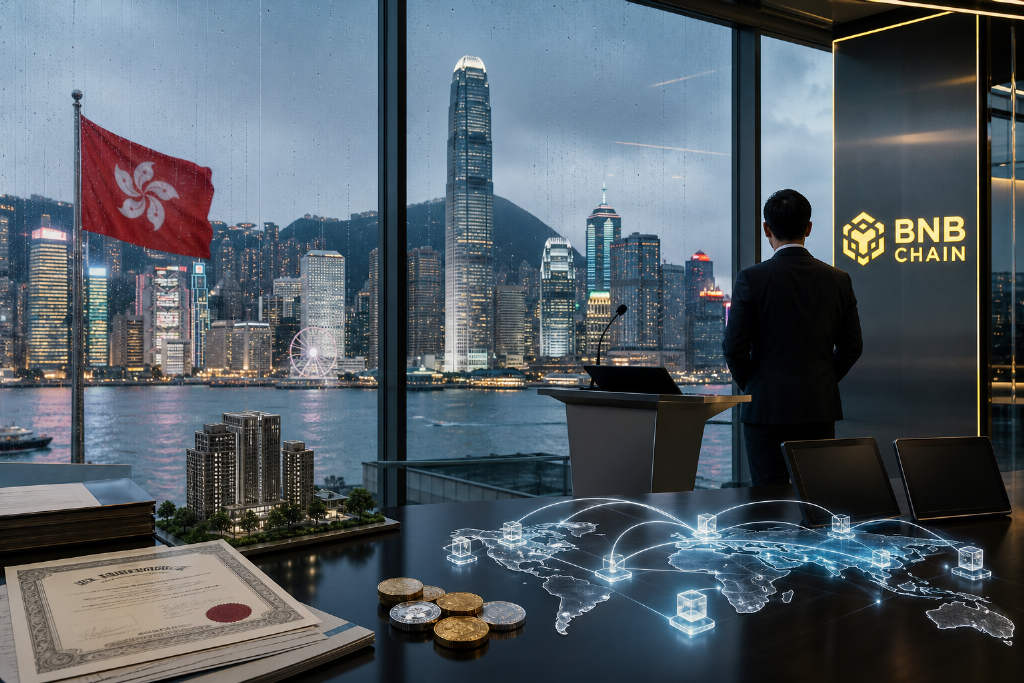
Hash Global founder KK said Hong Kong’s next opening as an international financial center may lie in using RWA, stablecoins, DeFi and public blockchain networks to move from a traditional capital hub to what he called IFC 2.0, a system that links Asian assets with global onchain capital.
The piece is based on remarks delivered at Cyberport in Hong Kong on Aug. 27, 2026. It also states that the text is for information exchange only and does not constitute investment advice or a recommendation of any securities, tokens or crypto assets. Any assets, ecosystems and projects mentioned are presented only to discuss industry trends and infrastructure.
From IFC 1.0 to IFC 2.0
For the past three decades, Hong Kong’s core role as an international financial center has been to connect Chinese assets with global capital. Through listings, bonds, funds and a professional-services stack that includes banks, brokerages, legal, accounting and custody, the city has packaged local and Asian assets into financial products that global institutions can understand, buy and hold.
KK described that model as Hong Kong’s IFC 1.0. In his framing, it was built around “asset productization” and “capital globalization,” helping Chinese companies and Asian assets enter institutional allocation systems worldwide.
He argued that global capital markets are now entering a new phase. Blockchain, stablecoins, RWA and DeFi are changing the underlying market structure, while the internet itself is moving from connecting information and commerce to connecting assets. Financial assets, business rights, user assets and IP rights, he said, will increasingly be issued, registered, transferred, settled and operated onchain. In his view, that is also the core of Web3 today.
On that basis, he wrote that one of the defining themes of the next decade may be “everything onchain.” Onchain capital markets are global by design rather than split across separate regional markets, giving Hong Kong a chance to connect Asian assets with global onchain capital and upgrade into IFC 2.0.
Web3 as an internet for assets
The article breaks internet development into three stages. The first generation solved information connectivity through content publishing, distribution and traffic monetization. The second solved commercial connectivity by moving trade and user relationships online through e-commerce, payments and platform economics. The third generation, Web3, is described as solving asset connectivity by bringing asset issuance, rights transfer, fund settlement and business operations into a truly internet-native structure.
In that structure, blockchain provides a globally unified accounting standard. Onchain assets carry features such as programmability, accessibility, composability, divisibility, verifiability and 24/7 circulation. KK argued that the technical base of capital markets will gradually move away from traditional account systems and centralized trading architecture toward open, transparent and programmable onchain financial networks.
RWA, or real-world assets, is presented as a key entry point into that shift. The article says RWA is not merely about turning traditional assets into tokens. Instead, it is about allowing ownership confirmation, issuance, settlement, use and financing of real-world assets to work together onchain, bringing assets, capital flows, business rights and user relationships into a sustainable operating network and opening what it called a second onchain life cycle for assets.
“Everything onchain” goes beyond financial products
The piece says the next technology cycle will push both financial and non-financial assets toward onchain issuance, trading and transfer. In current RWA discussions, the first categories people usually mention are government bonds, funds, money market funds, private credit, real-estate income rights, gold and commodities. Their cash flows and return structures are relatively clear, while compliance, ownership confirmation and disclosure requirements are easier to define. That also makes them easier to place inside custody, valuation and risk-management systems, which is why the article sees them as the most natural starting point for onchain capital markets.
Over a longer horizon, though, the larger incremental opportunity may come from non-financial RWA. The article lists entertainment IP, membership and ticketing rights, collectibles, gaming, consumer rights, user behavior and data assets. These categories have historically been difficult to standardize and circulate globally. Web3, in KK’s view, could combine user relationships, rights certificates, consumer scenarios, IP value and asset transfer into a new commercial loop.
He wrote that all five projects incubated by Hash Global over the past two years are in this area. The firm has also invested in several RWA-related projects and worked alongside many institutional partners and startup teams.
His conclusion is that financial RWA provides a base for institutional allocation, while non-financial RWA opens new user-asset and business-scenario growth. Together, the two could move Web3 from financial experimentation into commercial infrastructure.
Why Hong Kong is positioned to develop RWA
The article says Hong Kong has gradually built the institutional base for RWA over the past few years. That includes digital-asset policy, a licensing-based regulatory system, tokenized bond practice, infrastructure exploration such as Project Ensemble, and a regulatory regime for stablecoin issuers.
Just as important, KK argued, is the city’s long-built financial capability: banks, brokerages, funds, insurance, legal services, accounting, auditing, custody, tax services, cross-border capital services and a network of professional investors. Together, those functions form the base for credible issuance, continuing disclosure and institutional distribution.
In his telling, Hong Kong’s edge is not simply running technology experiments. It lies in turning real-world assets into financial products that are credible, compliant, investable, disclosable, custodiable and settleable. That, he wrote, is the institutional foundation of IFC 2.0.
A three-step path for Hong Kong IFC 2.0
The article says IFC 2.0 only makes sense when viewed as an extension of IFC 1.0. Hong Kong’s earlier success came from institutional credibility, professional services and experience in international capital markets, which allowed the city to convert Chinese companies and Asian assets into standardized products global institutions could understand, buy and hold. KK stressed that this capability was built over time through institutional development and market practice. IFC 2.0 does not reject IFC 1.0; it carries that capacity into the onchain capital market era.
The next opportunity for Hong Kong, he wrote, is to rely on trusted regulation, financial expertise and RWA technology to organize quality Asian assets, complete compliant structures and tokenized issuance, and then connect them with global stablecoin capital, onchain users and liquidity networks. Hong Kong would build the trusted entry point for assets, while onchain ecosystems would expand their global reach, use cases and circulation.
He outlined three steps:
- First, organize Asian assets by selecting financial assets, industrial assets, IP assets and business rights that can be productized.
- Second, conduct compliant issuance and productization in Hong Kong through legal and fund structures, custody, auditing, disclosure and investor suitability arrangements so the assets become credible, compliant and investable products.
- Third, connect those products with global onchain capital, users and liquidity through stablecoins, wallets, trading venues and lending protocols to achieve worldwide reach, 24/7 circulation and ongoing operation.
In that framework, Hong Kong is not competing with onchain finance. It is aiming to become the center through which global onchain finance organizes Asian assets. If IFC 1.0 connected Chinese assets and global capital, IFC 2.0 would connect Asian assets and global onchain capital.
Liquidity, not issuance, is the hard part
The article argues that many RWA projects currently focus on issuance, but the real work starts after that point. Before issuance come asset selection, compliance structure, product design, custody, investor access and disclosure. After issuance come wallet-based distribution, stablecoin settlement, DEX trading, collateralized lending, user scenarios, market operations and scale growth. Both sides are required.
If an asset is tokenized but lacks real users, liquidity, usage scenarios and sustained trading and financing capacity, it remains only a static certificate onchain, the article says.
From that perspective, the main challenge for RWA is not whether assets can move onchain. It is whether they can secure global liquidity after they do.
Why BNB and other public-chain ecosystems matter
Within the proposed Hong Kong IFC 2.0 structure, public-chain ecosystems are not replacements for Hong Kong’s financial system. They are the source of global users, capital, distribution channels and liquidity for assets issued in compliance through Hong Kong.
The article contrasts different chains. Ethereum, or ETH in the piece’s wording, stands for long-term orientation, a decentralized developer ecosystem and open infrastructure. The BNB ecosystem, by contrast, is described as having clear strengths in user scale, trading activity, wallet entry points, stablecoin capital, trading liquidity and links to Asian markets. Hong Kong also already has ecosystems such as HSK Chain, and collaboration across multiple chains could help the city remain technologically neutral and open.
KK wrote that moving RWA from proof of concept to commercialization depends on user reach, trading habits, stablecoin capital and coordination at the application layer. He cited a BNB ecosystem matrix made up of Binance, BNB Chain, CoinMarketCap, Binance Wallet, Trust Wallet, PancakeSwap, Venus, ListaDAO and Aster, covering exchanges, public chains, wallets, data, DEX, lending, stablecoins and user networks. For Asian assets, he said, that kind of complete global entry and application system has immediate practical value.
His summary was straightforward: Hong Kong can place Asian assets onchain in a credible way, and the BNB ecosystem can help those assets circulate across a global network. In the article’s wording, the BNB ecosystem has the traits of internet-style financial infrastructure and can provide a unified global liquidity layer for capital.
Onchain capital markets need a new service stack
The article says traditional finance tends to design standardized products, rely on banks, brokerages and wealth-management channels for distribution, use financial media for marketing, and divide user operations among institutions, high-net-worth clients and retail customers.
RWA changes that requirement set. Products need multi-version, tiered and composable tokenized structures. Distribution extends to exchanges, wallets and onchain entry points. Marketing adds KOLs, communities and global user networks. User operations are built around product functionality, onchain rights and usage scenarios over the long term.
KK argued that this is not only a channel shift. It is a restructuring of how products are organized and how client relationships are built. If Hong Kong wants to make IFC 2.0 real, he wrote, it will need not just regulation and financial capability, but also service firms with onchain operating skills — the new era’s version of asset managers and investment banks.
Hash Global’s BNB yield fund with YZi Labs
On the business side, Hash Global said it has long invested in Web3 infrastructure, financial payments, stablecoins, DeFi, RWA, user assets and application ecosystems, while also participating in the BNB ecosystem over time.
The firm said it has seen institutions face practical barriers when investing directly in BNB, including account opening, capital security management and sharing in ecosystem returns. In response, Hash Global and YZi Labs launched an institution-focused BNB yield fund with third-party custody. According to the article, the goal is to help traditional financial institutions invest in and participate in the BNB ecosystem in a safer, more convenient, lower-cost, transparent and institutionalized way.
KK said the fund should not be understood only as an investment product. More importantly, it is meant to serve as a bridge for traditional finance and Web2 institutions entering the BNB ecosystem. He said he hopes to see a two-way positive cycle between institutions investing in BNB and institutions carrying out RWA business within the BNB ecosystem.
The article says the fund can function both as an allocation tool and as a starting point for institutions to understand the BNB ecosystem, build partnerships and explore business opportunities. It may also help institutions share in ecosystem growth through investment while participating in the ecosystem’s development.
Through a combination of fund investment and ecosystem coordination, institutions can lower learning, compliance and operational friction when entering the BNB ecosystem, the article says. The BNB ecosystem, in turn, can gain long-term capital, real assets and business scenarios, forming what KK called a two-way value exchange between traditional institutions and onchain ecosystems.
He described that arrangement as a long-term “investment plus business” coordination mechanism. Hash Global also said it is in discussions and cooperation with teams including BNB Chain, with the aim of linking Hong Kong’s financial capabilities to real business deployment.
From concept to execution
The article closes by arguing that Hong Kong IFC 2.0 cannot remain a concept. What matters is building demonstration paths that can be verified and replicated. Asian real estate, private trust fund shares, regional financial products, entertainment IP, trading cards, collectibles and user rights can all be explored for entry into onchain ecosystems under compliant structures.
Different asset classes should choose different product structures based on ownership confirmation, cash flow, investor suitability and circulation boundaries. KK said the team is currently advancing three products, with underlying assets from Japan, Taiwan and Hong Kong. Those assets require Hong Kong’s institutional and financial capabilities, as well as operating support from global onchain ecosystems.
His framework is built on four elements: Hong Kong provides a trusted institutional structure; Asia provides quality assets; ecosystems such as BNB provide global users, stablecoin capital and onchain liquidity; and firms such as Hash Global help connect the sides and move projects forward. Only when those four elements form a closed loop can IFC 2.0 become an executable industry strategy.
Closing argument
KK wrote that IFC 1.0 proved Hong Kong could connect Chinese assets with global capital. IFC 2.0, in his view, can prove that Hong Kong can also connect Asian assets with global onchain capital. He did not frame that as a replacement for Hong Kong’s traditional financial-center role. He framed it as an upgrade: from organizing assets into products global capital markets can understand, buy and hold, to becoming a digital-asset center where global onchain capital can access, trade, use and continue to operate those assets.
The article identifies RWA as the digital-asset track best suited for Hong Kong, stablecoins as the settlement base for global onchain funds, and DeFi and wallets as the application layer for asset usage and liquidity. It describes public-chain ecosystems such as BNB as the base network of global onchain capital markets.
KK added that he started his career as an investment-banking employee within Hong Kong’s IFC 1.0 system. In what he called the era of “everything onchain,” he said he is honored to have a chance to contribute to the realization of Hong Kong IFC 2.0.
The article ends with a disclaimer stating that markets carry risk and investing requires caution. It says the piece is not investment advice, and readers should determine whether any opinions, views or conclusions fit their own circumstances and bear responsibility for any investment decisions made on that basis.