

Robinhood (HOOD) has shown strong share-price momentum recently. According to the original OdailyDepth article, the stock briefly returned above the 100 dollar level last night, although it failed to hold that mark by the close. The author remains relatively optimistic about HOOD’s subsequent performance, and frames the recent move as something that can be explained from several angles rather than by a single catalyst.
Operating data, prediction markets and the IPO channel
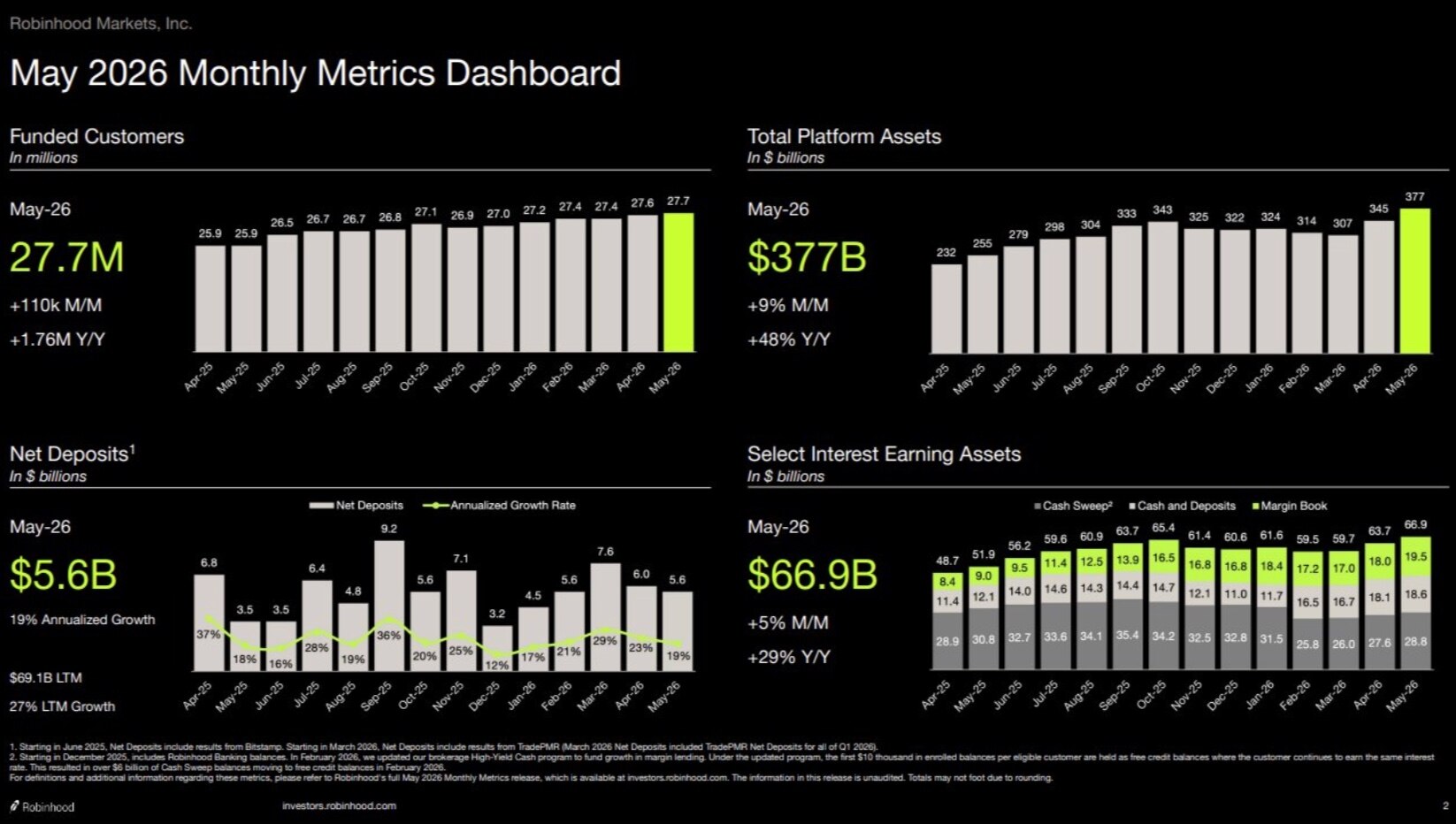
On the fundamental side, Robinhood released its May operating data last week, which the original article treats as the first reference point for understanding the stock’s recent strength. The article does not list the operating figures in the provided text, but it places them within a broader set of positive developments around the company.
The more direct sentiment driver, in the author’s view, comes from news flow. The fastest-growing area highlighted is prediction markets. Robinhood has begun using its self-built prediction market, Rothera, to intercept activity that previously involved Kalshi, and related revenue is expected no longer to require sharing with Kalshi. The article points readers to Odaily’s earlier piece, titled “预测市场概念第一股出现了!”, for a more detailed discussion of that development.
The IPO front is another part of the bullish case presented in the source article. SpaceX’s historic IPO brought record-level traffic to Robinhood. More importantly, Robinhood Securities, the company’s brokerage and clearing business unit, was approved last week to act as an IPO underwriter. In the author’s framing, that means Robinhood is positioned to play a more central role in future IPO activities, with Anthropic and OpenAI mentioned as examples.

Robinhood has also been selected by the U.S. Treasury as the broker and initial trustee for the “Trump account.” The source describes the “Trump account” as a tax-deferred investment account program authorized by U.S. President Donald Trump on June 9, 2025, based on the “Big and Beautiful” bill. The program is designed to establish government-funded savings accounts for children who are U.S. citizens and are born between January 1, 2025, and January 1, 2029. The implication in the article is that tens of millions of newborns in the United States over the coming years will default to Robinhood as their brokerage platform. The source also references another Odaily article, “Robinhood多了一批新股民,最大的1岁,最小的-3岁,” for more background.
From a Q2 earnings trade to a position switch out of crypto
The author says the initial reason for building a HOOD position was optimism about Robinhood’s Q2 financial results. The first part of that view was the expectation that, during what the article calls an epic rally in U.S. equities, stock-trading-related revenue for the quarter would see a major increase. The second part was the expected surge in prediction-market trading volume connected with the World Cup, together with Rothera’s role in capturing revenue that would otherwise be shared.

However, the later decision to move a larger part of the position into HOOD, mainly by converting some remaining crypto assets, was based on a different logic. The author presents this as the real point of the article. In early May, a friend asked what the author had been buying recently. The author mentioned HOOD. At that time, HOOD had just fallen from above 90 dollars after Q1 results missed expectations, mainly because of an unexpected 100 million dollar expense related to the “Trump account.” The short-term chart looked weak.
When the friend asked why the author was buying, the author briefly explained the factors described above. The friend then said that his positions were trapped and that he did not have much capital left. After asking what the friend was holding, the author found that the holdings were, unsurprisingly, mostly altcoins. The author’s response was direct: “Rather than still being obsessed with altcoins, it is better to switch the position directly into HOOD.”

The core change: HOOD is breaking away from the crypto shadow-stock label
The background for that judgment is the relationship between Robinhood and crypto over a long period of time. Crypto-related revenue has long been an important component of Robinhood’s total revenue, and HOOD’s share-price movement has also had a strong correlation with cryptocurrencies. The source article argues that recent signs show Robinhood is breaking through its dependence on the crypto business and is moving in a positive direction away from that correlation.
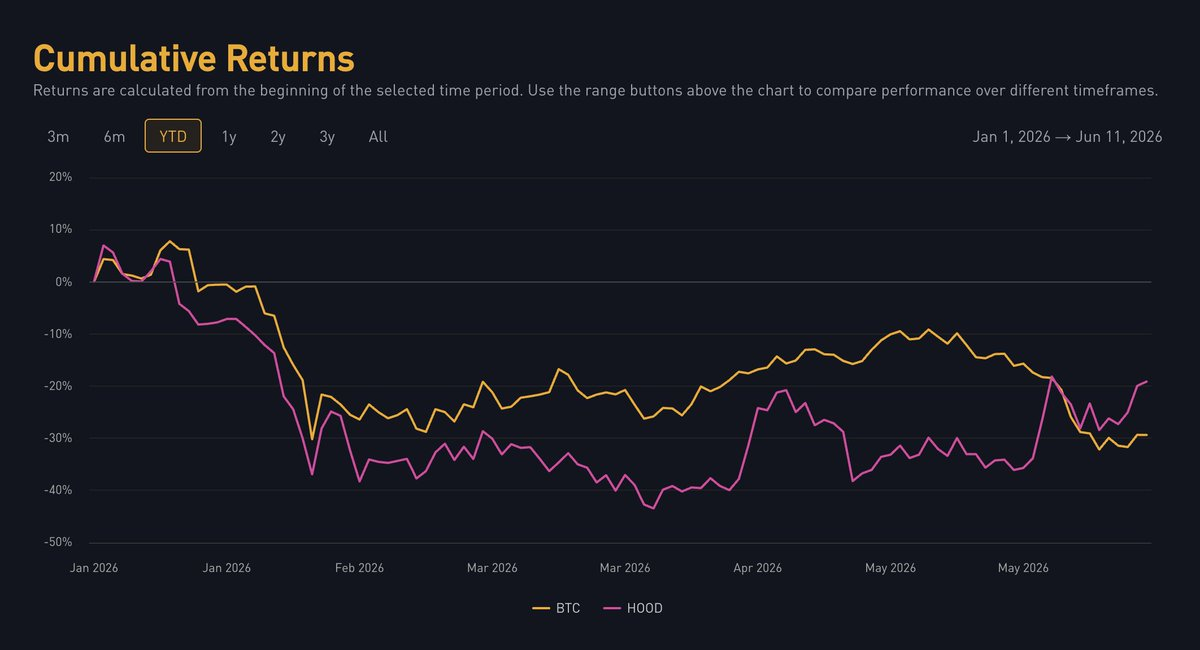
The author first looks at Robinhood’s crypto-related revenue over the past five quarters. The conclusion is that the share of this revenue has been declining overall, and that the Q1 proportion had fallen to its lowest level since 2025. The article then compares HOOD’s price movement with BTC. Since the beginning of the year, HOOD had mostly maintained a trajectory similar to BTC, but the recent period has shown a clear divergence.

These two observations are used to explain a shift in HOOD’s valuation logic. In the past, HOOD was often treated as a “shadow stock” of the crypto market. When crypto prices surged, retail traders rushed into Robinhood to trade altcoins, fee revenue rose sharply, and the stock price took off. When the crypto market weakened, retail users left, and Robinhood’s revenue could fall quickly. That old logic connected the stock closely to crypto-market cycles.
The author argues that Robinhood is no longer as highly dependent on crypto as it once was. Even if the crypto market continues to stay in its current half-dead state, the company still has stock trading, prediction markets, Pre-IPO activity and the newly added underwriting business as performance drivers. At the same time, the article does not say that crypto will stop affecting HOOD. On the contrary, if the crypto market returns to a bull cycle in the future, Robinhood’s crypto trading revenue is expected to expand as well, allowing HOOD to benefit from industry growth.

The article summarizes the idea in blunt terms: crypto still affects HOOD, but HOOD no longer depends on crypto. If the crypto bull market returns, HOOD can still rise with it; if crypto remains half-dead, HOOD is not necessarily constrained in the same way. For investors who still hold expectations for altcoins but are increasingly worried about liquidity drying up, narrative failure and value-capture problems, the author presents HOOD as an option with a higher margin of safety than continuing to wait for an unknown next narrative cycle in a specific token.