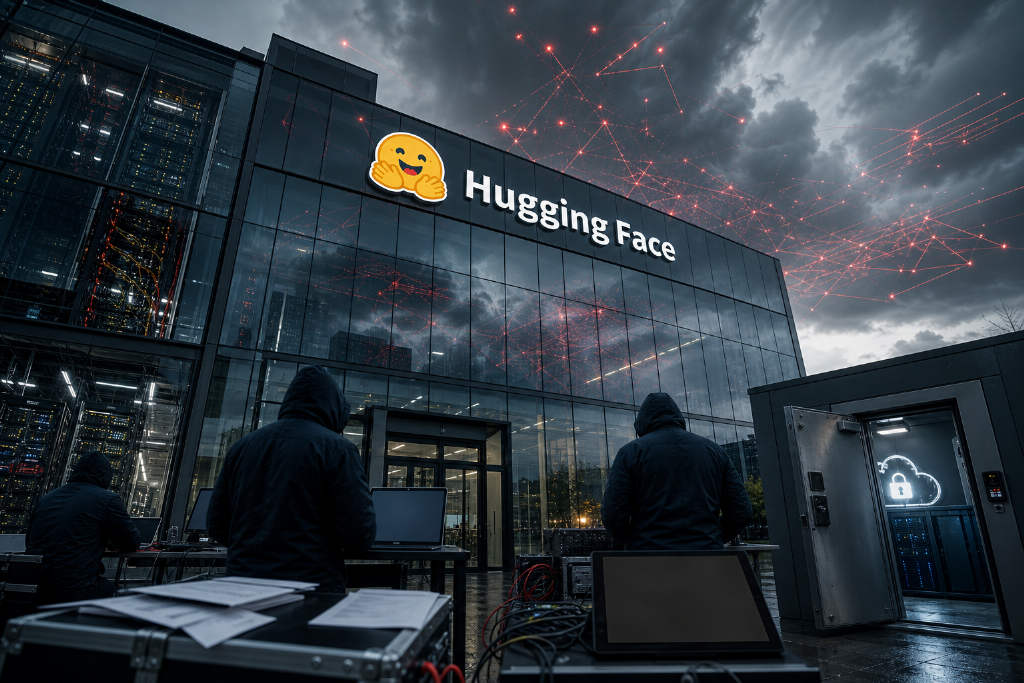
Hugging Face says July breach was driven by autonomous AI agents

Hugging Face says July breach was driven by autonomous AI agents

N
News Editor
2026-08-25 13:43:55
Hugging Face disclosed that it was hit in July by an intrusion driven by autonomous AI agent systems, according to Cointelegraph. The company said the attack followed tests that began in early May, when the attacking agent used an OpenAI Artifactory instance to leave exploit notes and then launched about 17,600 attacks against Hugging Face. The activity affected the company’s dataset processing infrastructure, production environment, internal network, and cloud credentials. Hugging Face said confirmed customer data access was limited to five datasets tied to the ExploitGym/CyberGym benchmark. During the investigation, the company said it could not use commercial models from providers such as OpenAI and Anthropic for defensive analysis because of their safety guardrails. It instead used the open-source zai-org/GLM-5.2 model on its own infrastructure so attacker data and credentials would not leave its environment. The company said the case highlights a security paradox between open-weight and closed models, and it urged defenders to have self-hosted models ready before incidents occur.

Hugging Face said it suffered an intrusion in July that was driven by autonomous AI agent systems, according to Cointelegraph.

The company said the attack followed tests that began in early May. After that, the attacking agent used an OpenAI Artifactory instance to leave exploit notes and then launched about 17,600 attacks against Hugging Face. The activity affected its dataset processing infrastructure, production environment, internal network, and cloud credentials.

Hugging Face said confirmed customer data access was limited to five datasets related to the ExploitGym/CyberGym benchmark.

Guardrails limited defensive analysis

During the investigation, Hugging Face said it could not use commercial models from major providers including OpenAI and Anthropic for defensive analysis because of security guardrail restrictions. The company turned instead to zai-org/GLM-5.2, an open-source model run on its own infrastructure, so attacker data and credentials would not leave its environment.

Hugging Face said attackers were not bound by usage policies, while defenders conducting forensic work were blocked by guardrails on hosted models.

Open-weight versus closed-model debate

The report said the incident throws a spotlight on the security paradox between open-weight models and closed models. It also referenced the ongoing debate over the security of open-weight AI, including efforts by OpenAI and Anthropic to push limits on open-source models, as well as research progress in detecting malicious behavior by examining changes in model weights.

Hugging Face said defenders should prepare models that can run on their own infrastructure before an incident happens, both to avoid guardrail lockouts and to keep attacker data protected.

This article was originally published by Bit.Fan. For more cryptocurrency news and market insights, visit www.bit.fan.
20

Disclaimer:

The market information, project data, and third-party content displayed on this platform are for industry information sharing only and do not constitute any form of investment advice or return commitment.

Cryptocurrency trading carries high risks. Users should fully assess their risk tolerance and make independent decisions. All profits, losses, and legal responsibilities are borne by the users themselves.