

HYPE, the native token of the decentralized derivatives exchange Hyperliquid, has surged to a new all‑time high of $75, reigniting market focus. The rally comes as spot HYPE exchange‑traded funds (ETFs) record 14 consecutive days of net inflows, absorbing nearly 1% of the token’s market capitalization, while institutional heavyweights like a16z and Galaxy Digital continue their aggressive accumulation.
Earlier, BitMEX co‑founder Arthur Hayes publicly declared that “HYPE should at least overtake SOL before the end of this bull market,” and made a $100,000 bet with Multicoin Capital co‑founder Kyle Samani that HYPE would outperform all top‑10 cryptocurrencies for the remainder of the year. The recent price action and ETF inflows are giving weight to that wager.
14 Straight Days of Inflows: HYPE ETFs Absorb 1% of Market Cap
Two spot HYPE ETFs are currently trading in the United States: the 21Shares Hyperliquid ETF (THYP), listed on Nasdaq on May 12, and the Bitwise Hyperliquid ETF (BHYP), launched on the NYSE on May 15. As of June 2, the combined products have attracted over $136 million in net inflows across 14 consecutive trading sessions, swallowing roughly 0.9% of HYPE’s total market cap. BHYP alone accounts for $82.96 million, making it the largest HYPE ETF by assets.
By cumulative net inflow, HYPE spot ETFs now rank fifth among all U.S. crypto spot ETFs, trailing only BTC, ETH, XRP, and SOL funds—well ahead of many ETFs that launched earlier. This rapid adoption contrasts sharply with outflows from Bitcoin and Ether ETFs that dominated May. BTC spot funds shed over $2.43 billion during 12 straight days of outflows, while ETH ETFs saw 16 consecutive days of withdrawals totaling more than $540 million. Even the recently listed VanEck BNB ETF recorded four consecutive zero‑inflow days. Traditional capital is clearly rotating out of leading crypto ETFs and into HYPE.
When measured by market‑cap absorption, HYPE’s debut is unprecedented. In its first two weeks, the HYPE ETF absorbed about 1% of the token’s market cap, while BTC spot ETFs managed only 0.2% in the same window (with $1.46 billion in net inflow), SOL ETFs gathered 0.47% ($380 million), and ETH ETFs experienced net outflows of around $400 million. This demonstrates that institutional FOMO around HYPE has surpassed that of any previous crypto ETF launch.

Dual Buying Pressure: AF Buybacks and ETF Flows Counteract Unlock Sell‑off
Beyond ETF flows, Hyperliquid’s own Assistance Fund (AF) mechanism provides a consistent bid. Launched in early 2025, the AF initially directed 97% of all protocol trading fees (from perpetuals and spot) into automated HYPE buybacks, later increasing to 99%. With daily protocol revenue in the $1–3 million range, the fund has accumulated over $1.1 billion worth of HYPE, forming a robust price floor.
The arrival of spot ETFs is now layering an additional source of demand. In just half a month, the ETFs have already drawn in the equivalent of one‑tenth of the AF’s total buyback volume, with May 29 marking a single‑day peak of $31.62 million in net ETF inflows. This incremental capital could effectively offset sell‑side pressure from team token unlocks.

Under the current schedule, team tokens are released monthly on the 6th, with the June 6 unlock totaling roughly $38.7 million in HYPE. Notably, ETF investors—who often have little sensitivity to on‑chain tokenomics and may never have interacted with a DeFi protocol—care primarily about gaining exposure. As long as Hyperliquid’s fundamentals remain stable, unlocking alone is unlikely to depress buying interest.
Moreover, additional ETF products are on the horizon. On June 2, Grayscale filed an amended S‑1 for a Hyperliquid Staking ETF under the ticker HYPG, seeding the fund with approximately 2 million HYPE. Trading is slated to begin on June 4, a move that will further deepen liquidity and institutional participation.

Institutions Pile In: a16z, Galaxy, and Grayscale Step Up
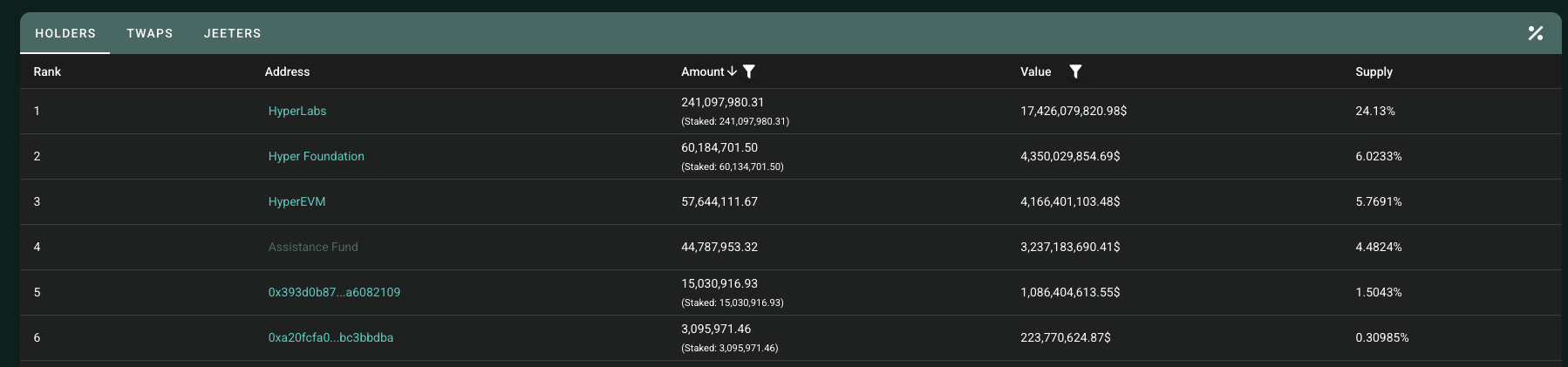
Institutional FOMO is every bit as intense as retail frenzy. According to on‑chain analyst Ai Yi (@ai_9684xtpa), a16z began aggressively accumulating HYPE in August 2025. One a16z‑linked address now holds 3.095 million HYPE, worth over $223 million, ranking as the sixth‑largest on‑chain entity and the largest external holder—the top five being Hyperliquid ecosystem protocols. The data also reveals multiple associated addresses actively buying: on May 28, an address starting with 0x4c6 withdrew 253,947.43 HYPE from various exchanges and market makers at an average price of $59.20; on May 30, Lookonchain flagged another address (0xb5E) that purchased 226,121 HYPE, bringing its total since April 14 to 3.9 million HYPE at an average cost of $49.40.
Galaxy Digital is also ramping up its position. On June 3, it moved 179,000 HYPE (approximately $12.62 million) off Coinbase, and a separate wallet had already bought 158,100 HYPE on May 21 for around $8.8 million. This steady institutional buying is providing a solid capital base for the token.

Bitwise CIO Matt Hougan has publicly stated that HYPE should not be viewed as an ordinary altcoin, but rather as a “second‑generation cryptocurrency” thanks to its value‑capture mechanism, buyback program, and institutional demand. Grayscale, in its latest report, went further, suggesting that Hyperliquid could one day challenge traditional derivatives markets and exchange infrastructure, potentially evolving into a “financial services giant.” Institutions are clearly re‑rating HYPE from a speculative tool to a blockchain‑grade financial infrastructure asset.
A New DAT Narrative: PURR in the Russell 3000 Could Generate Fresh Demand
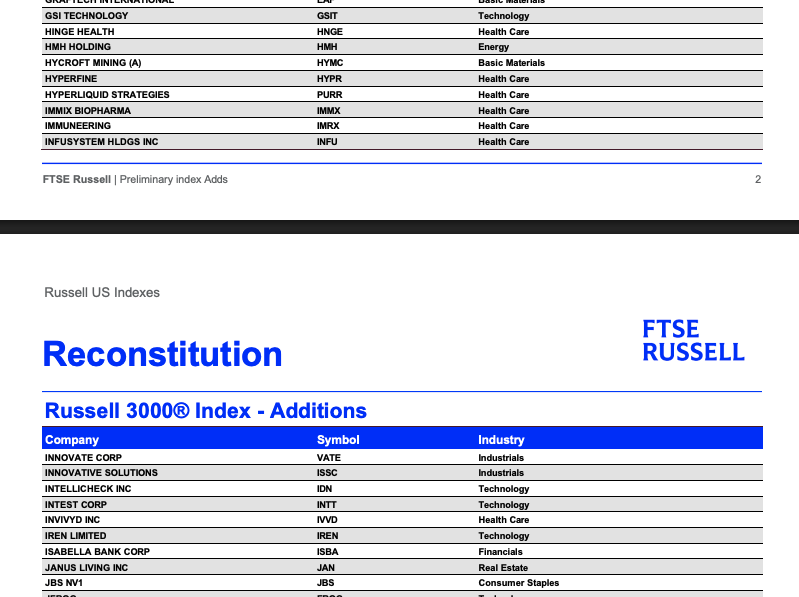
While the broader Digital Asset Treasury (DAT) concept has cooled—with even Strategy, the sector’s bellwether, beginning to sell bitcoin—DAT companies that hold HYPE continue to enjoy substantial profits. Some have reported floating gains as high as $1.25 billion. On May 22, FTSE Russell included PURR in the preliminary rebalance list for the Russell 3000 Index, with the change expected to take effect on June 26. The Russell 3000 is one of the broadest U.S. equity benchmarks, covering approximately 3,000 companies and tracking around $10.6 trillion in assets. Inclusion would trigger mandatory allocations from index funds.

Should PURR be formally added to the index, its visibility and capital inflows will rise significantly. To offer investors more HYPE exposure, the company may eventually emulate Strategy’s “raise capital to buy tokens” model, thereby creating yet another source of steady buying support for HYPE.