
Price discovery for ChangXin Memory Technologies has started on-chain before the company begins trading in Shanghai.
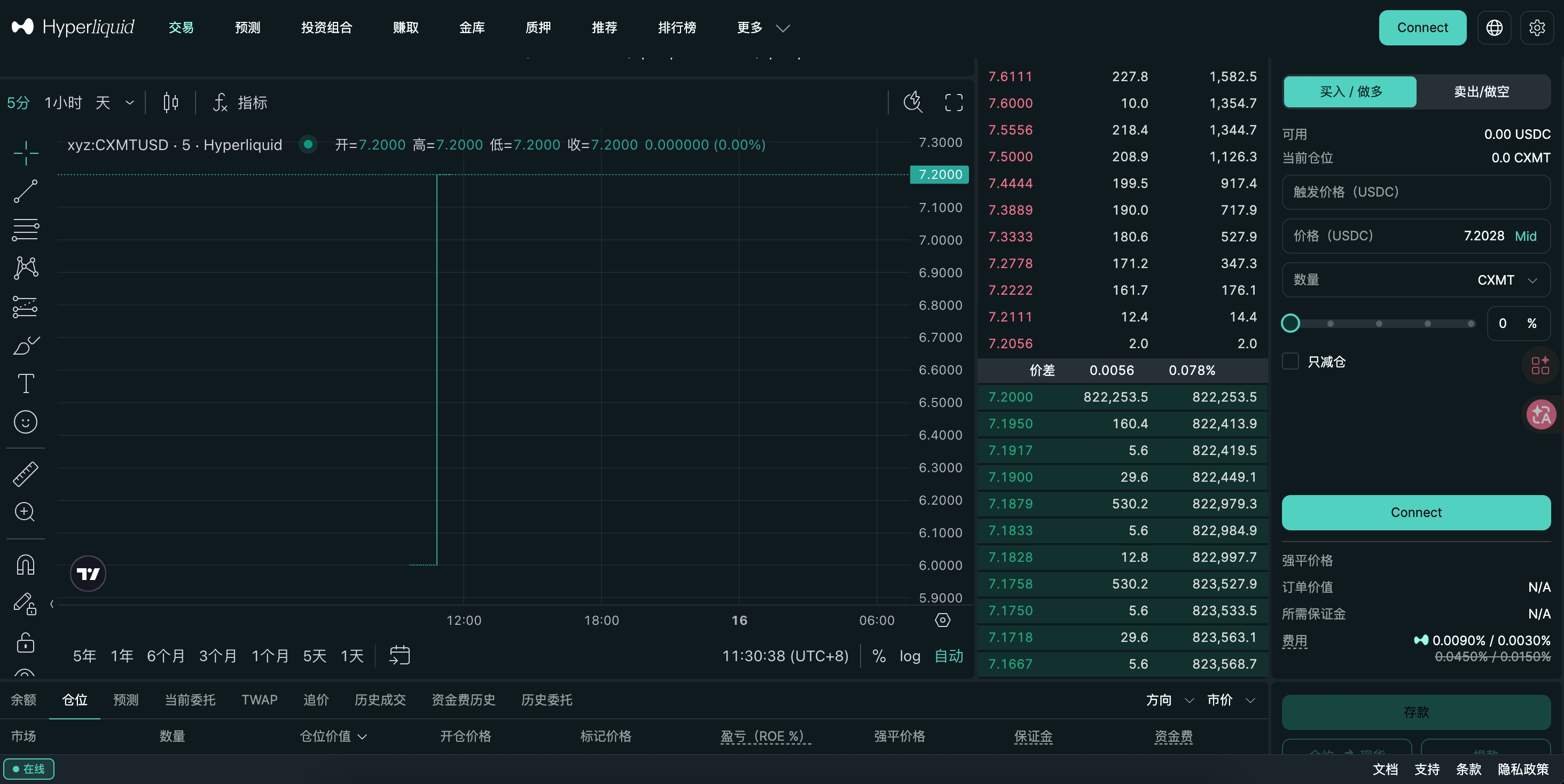
According to Bloomberg on July 15, Trade.xyz deployed a perpetual contract for ChangXin Memory Technologies, or CXMT, on the Hyperliquid blockchain under the symbol xyz:CXMTUSD. At the time of writing, the contract had posted about $1.32 million in 24-hour trading volume, around $2.41 million in open interest, and a 0.0014% funding rate. The price moved from an initial mark near $6 to $7.2, a 20% gain over 24 hours.
Hyperliquid has listed pre-IPO contracts before. In May, its pre-listing contract for AI chip company Cerebras traded within 1.3% of the stock’s Nasdaq opening price, and on the day of SpaceX’s June IPO, the related on-chain contract recorded $1.38 billion in single-day volume. What is new here is the target: this is the first such contract tied to an A-share listing on Shanghai’s STAR Market.
$7.2 a share points to roughly RMB 52 and an implied valuation near RMB 3.5 trillion
The CXMT contract is denominated in USDC and tracks a per-share price, using the same structure Trade.xyz used for SpaceX and Cerebras.
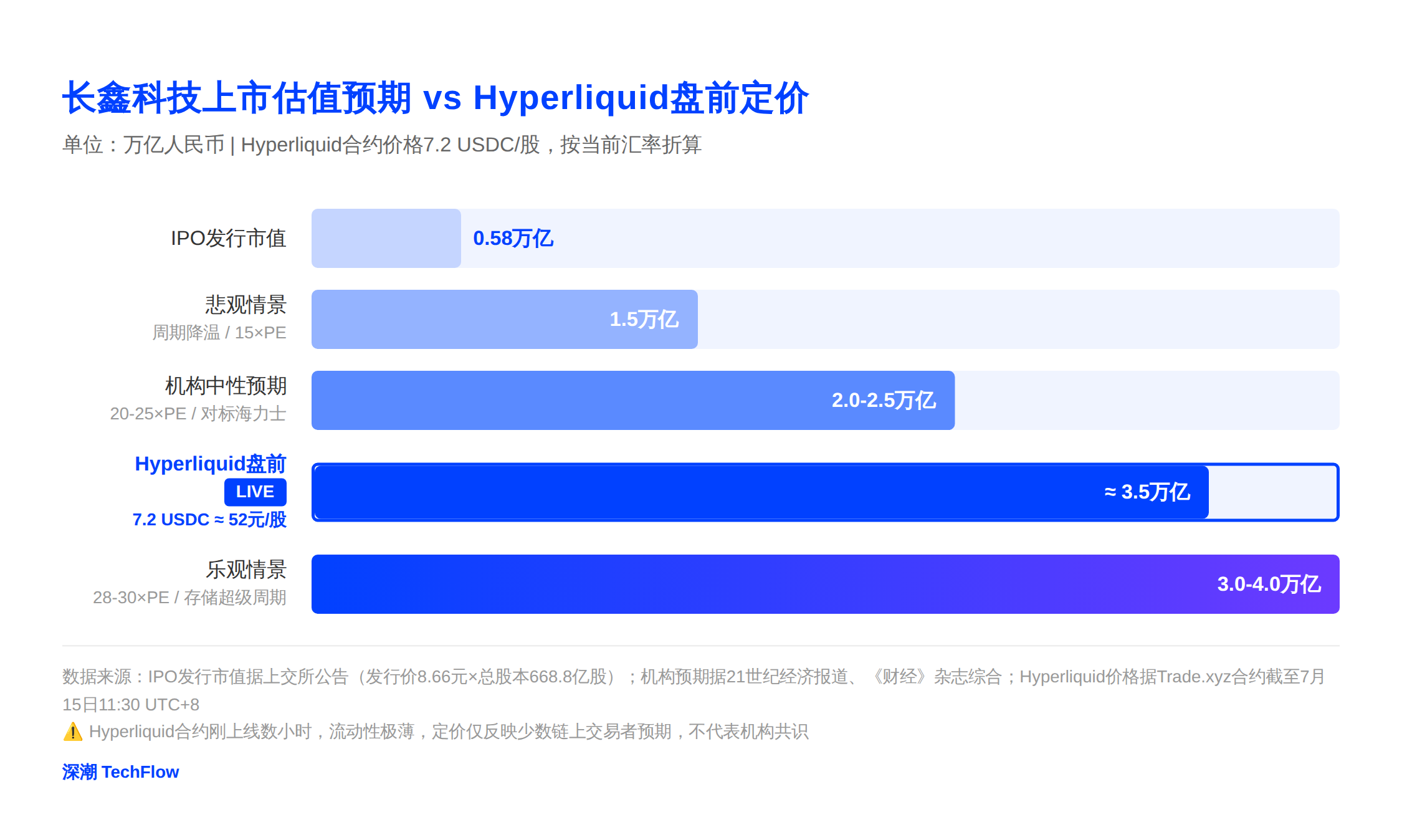
At the exchange rate referenced in the source article, $7.2 works out to roughly RMB 52 per share. Multiplied by the post-offering share count of 66.88 billion shares, the contract implies a market capitalization of about RMB 3.5 trillion. That is about six times the IPO valuation of RMB 579.2 billion.
The article places that number toward the optimistic end of sell-side expectations. It says 21st Century Business Herald cited investment bankers as expecting a post-listing valuation of RMB 2 trillion to RMB 2.5 trillion, while Caijing, drawing on estimates from multiple institutions, put an optimistic case at RMB 3 trillion to above RMB 4 trillion. Hyperliquid’s implied RMB 3.5 trillion sits between the top of the neutral range and the lower end of the optimistic range.
Read another way, the market is effectively betting that CXMT could open around RMB 50 a share on its first trading day, roughly six times its IPO price of RMB 8.66. The source article notes that the average first-day gain for STAR Market IPOs in the first half of this year was 489%, making that type of opening move less extreme in local context.
Even so, the market remains small relative to the biggest offshore pre-listing trades. The contract has been live for less than 24 hours, and its $1.32 million in volume and $2.41 million in open interest amount to early liquidity rather than institutional-scale price setting. The article explicitly describes the current print as a directional view from early participants, not a definitive institutional valuation.
A-share trading rules leave room for perpetuals
The source article argues that structural limits in the mainland market help explain why crypto traders would care about a Chinese semiconductor IPO.
A-shares settle on T+1, which means investors cannot sell on the same day they buy. STAR Market names also cannot be shorted through securities lending. For a stock such as CXMT, where large first-day swings are possible, investors in the cash market can sit on sizable paper gains but still be unable to lock them in before the close. If the stock opens high and falls back the next day, that risk remains with the holder.
Hyperliquid perpetuals do not carry those restrictions. The market trades around the clock, supports both longs and shorts, and allows adjustable leverage. In theory, an investor holding CXMT shares onshore could open a short in the Hyperliquid contract to hedge overnight exposure.
That said, the arbitrage loop is incomplete. Cerebras and SpaceX listed on Nasdaq, where global investors could move between the listed shares and the pre-IPO contract more freely, which helped prices converge. CXMT will list on Shanghai’s STAR Market, where a RMB 500,000 asset threshold and QFII quota limits mean most offshore retail investors cannot directly buy the stock.
That makes a persistent gap between the contract price and the eventual A-share price a realistic possibility. Investors have to account for that basis risk on their own.
For investors shut out of A-shares, DeFi becomes an entry point to China’s memory story
Blockchain.News, as cited in the source article, said the CXMT contract gives offshore traders a route around the STAR Market’s RMB 500,000 access threshold.
The article argues that the demand is grounded in the company’s position in the industry rather than in novelty alone. ChangXin Memory Technologies is the world’s fourth-largest DRAM supplier, with a 7.7% global market share in the first quarter. SemiAnalysis expects the company could overtake Micron by year-end and become the world’s third-largest DRAM supplier. The Financial Times reported on July 8 that Apple has begun testing CXMT DRAM chips for devices sold in China. On profitability, the company is expected to post attributable net profit of RMB 50 billion to RMB 57 billion in the first half of 2026, with a profit margin of about 70%, compared with 73% for SK Hynix and 81% for Samsung.
A company with those numbers is naturally on the radar of investors focused on the memory industry, but most of them cannot buy the underlying A-share directly. The article also says crypto research firm Citrini has repeatedly recommended Hyperliquid’s perpetual contract use cases in paid research and has been positive on CXMT.
Under those conditions, the Hyperliquid contract may be the most accessible route for offshore capital to express a view on the “China memory substitution” theme.
HIP-3 is being used to build a parallel price-discovery venue
The article frames the listing as a broader DeFi milestone: infrastructure built for perpetual markets is now being used to create a parallel pricing venue for a mainland China STAR Market target.
Under Hyperliquid’s HIP-3 framework, any entity that stakes 500,000 HYPE tokens can deploy a perpetual contract. The source article values that stake at about $28 million. Trade.xyz has already used the mechanism to list pre-IPO contracts tied to SpaceX, Cerebras, OpenAI and Anthropic, generating more than $1.46 billion in cumulative volume.
On July 2, TradingView integrated data feeds from Hyperliquid and Trade.xyz. That brought on-chain perpetual price action for these contracts into a mainstream market terminal.
On the regulatory side, the article says Hyperliquid’s policy team and TradeXYZ recently met with the U.S. Securities and Exchange Commission’s crypto task force to discuss crypto regulation. Based on the current regulatory path described in the article, U.S. compliance remains the platform’s primary focus, while potential China regulatory issues tied to an A-share reference asset are not yet central to its planning.
The source article also notes that Hyperliquid is not open to users in China.
CXMT’s IPO is already one of the year’s biggest China capital-markets events
Even without the Hyperliquid contract, the IPO itself stands out in the domestic market.
CXMT is offering shares at RMB 8.66 each. Based on an initial issue size of 6.688 billion shares, the deal is expected to raise RMB 57.9 billion, almost double the original RMB 29.5 billion plan. If the over-allotment option is fully exercised, total proceeds would reach RMB 66.6 billion, making it the largest IPO in Asia this year and the biggest semiconductor IPO in A-share history.
The issue is priced at 308.92 times earnings, far above the industry average of 76.32 times. The article says the market has not shown much concern because earnings have been growing fast enough to compress that valuation. First-quarter net profit reached RMB 33 billion, and the company expects first-half 2026 revenue of RMB 110 billion to RMB 120 billion, with attributable net profit of RMB 50 billion to RMB 57 billion, up more than 2244% year over year.
Timing is another part of the story. The global DRAM market is in an unusually strong cycle. Samsung, SK Hynix and Micron have shifted substantial capacity toward HBM memory for AI servers, tightening supply in consumer DRAM. First-quarter DRAM contract prices rose 90% to 95% quarter on quarter, the largest single-quarter increase on record. CXMT is focused on consumer DDR5 and LPDDR5X products and has monthly capacity of 200,000 to 300,000 wafers, making it one of the few producers still expanding consumer DRAM capacity while larger rivals reallocate supply.
IPO data in the A-share market has also supported enthusiasm. The article says all 71 new A-share listings in the first half of the year rose on their first trading day, while the average gain for STAR Market IPOs was 489%. Retail investors can subscribe online on July 16 using code 787825, and the shares are expected to list on July 27.
The side door is open now; convergence after listing is the next test
For onshore A-share investors, the formal entry point is the July 16 subscription. For offshore investors, the side door has already opened through Hyperliquid’s CXMT contract.
The source article says the next real test will come after the stock begins trading on July 27. If the contract price converges quickly toward the onshore market, as it did in the Cerebras case, the model may prove replicable for other A-share names. If it does not, the parallel market will still have made one point clear: global capital interest in China’s domestic memory substitution story is real enough to create an active offshore pricing venue before the stock even lists.