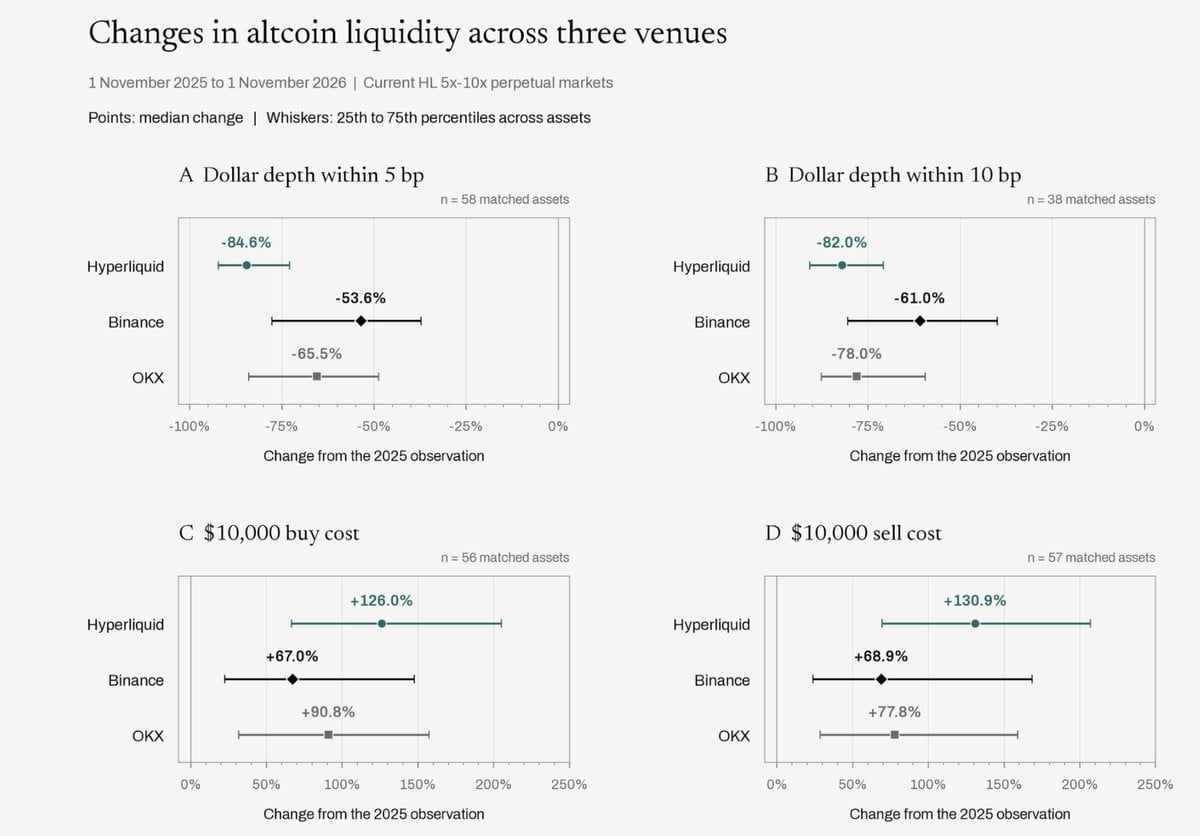
Hyperliquid’s long-tail altcoin liquidity has weakened sharply, with the decline concentrated close to the best bid and offer. An analysis by Matteo, compiled by TechFlowPost, found that dollar depth within 5 basis points fell 84.6% over the past year. Small market makers were left with an estimated 1.20-basis-point fee disadvantage, yet they still supplied almost half of the quoted depth sampled across HIP-4 markets.

Matteo said Hyperliquid built an early competitive advantage through deep liquidity in long-tail assets. In recent months, the research team spent substantial time examining liquidity across decentralized trading instruments in connection with an undisclosed product. The team used more than 18 months of complete order-book data accumulated at 0d Labs.
The data showed that liquidity across the long-tail crypto market was becoming thinner. The team had expected volatility around Oct. 10, but the broader market had apparently not fully recovered. Matteo also referred to complaints from traders close to the market, who described competition on Hyperliquid as increasingly difficult and more centralized. The analysis examined Wintermute’s dominance in read-priority fees, trading fees and the effect of Layer 1 congestion on smaller market makers.
Binance and OKX provide the benchmark
To separate a broad market decline from changes specific to Hyperliquid, the analysis used Binance as a benchmark for global altcoin liquidity. The sample contained 86 assets that traded on both Binance and OKX between Nov. 1, 2025, and Nov. 1, 2026, and offered leverage of no more than 10 times.
Among 38 comparable markets with data within a 10-basis-point range, median dollar depth fell 82% on Hyperliquid, compared with 61% on Binance and 78% on OKX. A decline in token prices can explain part of the dollar-depth reduction, so the analysis also compared each asset’s depth on Hyperliquid with its corresponding depth on Binance.
The Hyperliquid-to-Binance depth ratio was calculated separately for each market before taking the median. At 5 basis points, the median ratio fell 57.5% year over year. The comparison therefore indicates that Hyperliquid lost substantial liquidity relative to Binance even for the same tokens. It was not calculated by simply dividing the two platforms’ median figures.
In the later sample, a $10,000 purchase produced a median order-book impact cost of 5.21 basis points on Hyperliquid before fees, compared with 2.95 basis points on Binance. The corresponding costs were $5.21 and $2.95.
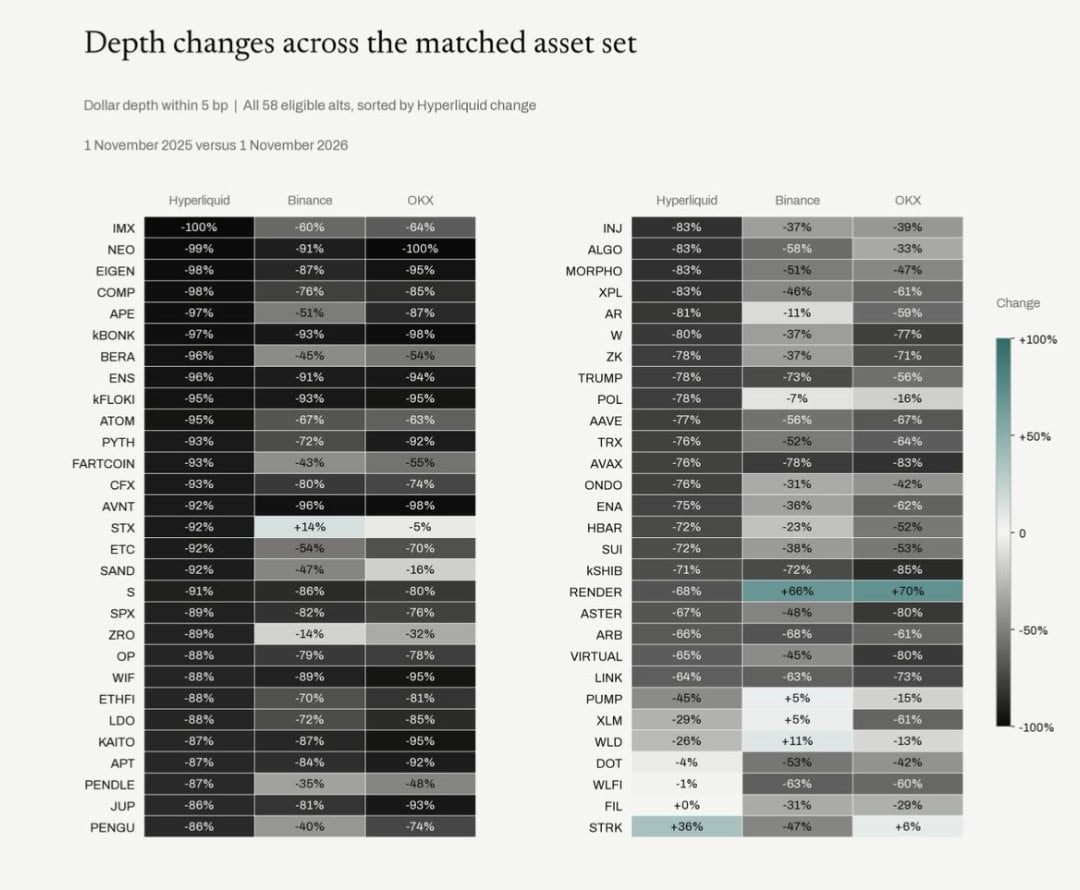
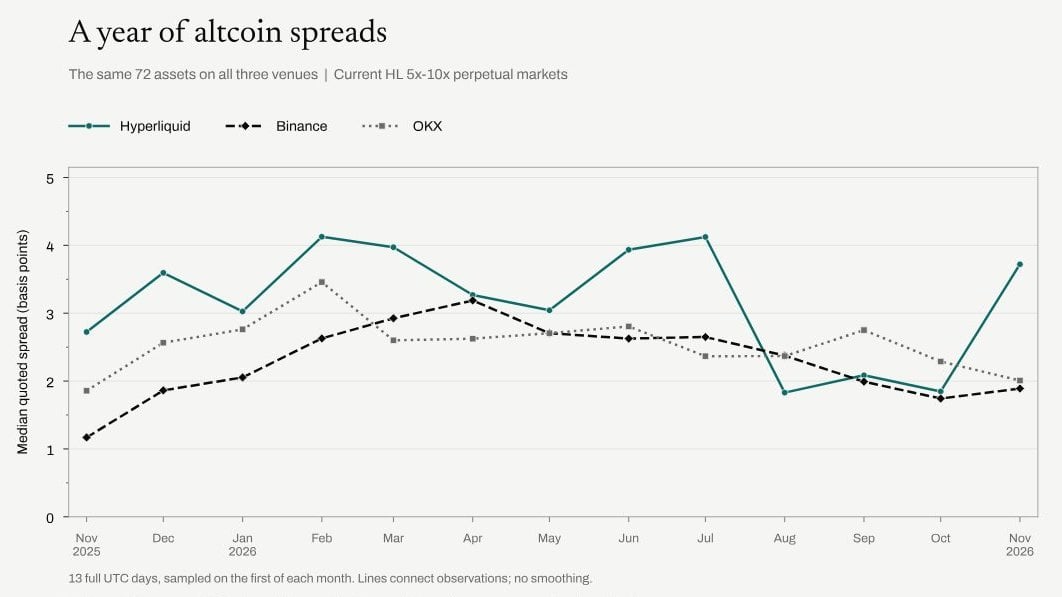
Quoted spreads offer a contrasting measure. Binance’s spread widened slightly more in percentage terms, but it started from a narrower level and still ended below Hyperliquid. The analysis also included a heat map covering 58 matched altcoins and their 5-basis-point dollar-depth changes across the three platforms.
The sharpest losses are near the midpoint
A fall in token prices can make dollar-denominated depth look smaller even if the number of tokens posted in the book remains unchanged. To remove that effect, the analysis tracked both dollar depth and the number of tokens quoted. The Hyperliquid time series used the same asset set and observation windows across 13 sampling dates. Its 5-basis-point panel covered 63 markets, while the wider two-sided top-20-level panel covered 80 markets.
The screening criteria were stricter than those used in the two-date comparison with centralized exchanges, so the final chart values cannot directly replace the earlier cross-platform figures. Each market’s November 2025 starting point was set to 100.
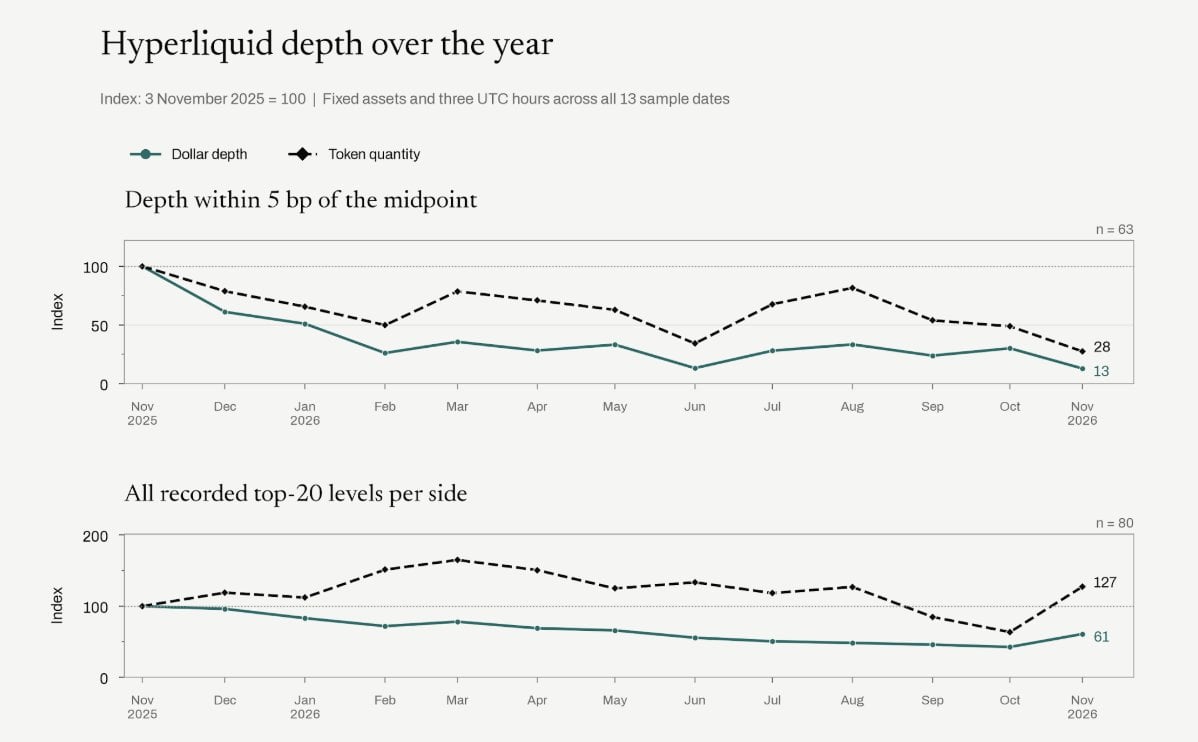
One year later, the median dollar-depth index within 5 basis points had fallen to about 13, while the token-count index had dropped to 28. That suggests most of the orders near the core of the book had disappeared even after the effect of lower token prices was removed.
The broader top-20-level measure showed a different result. Its final median dollar-depth index was 61, while the token-count index reached 127. In that wider range, the typical market had more tokens posted than a year earlier. The shortage was concentrated in the 5-basis-point area close to the best bid and offer. The order books still had size, but much less of it sat where traders most often seek execution.
Outer depth improved, while core quotes remained thin
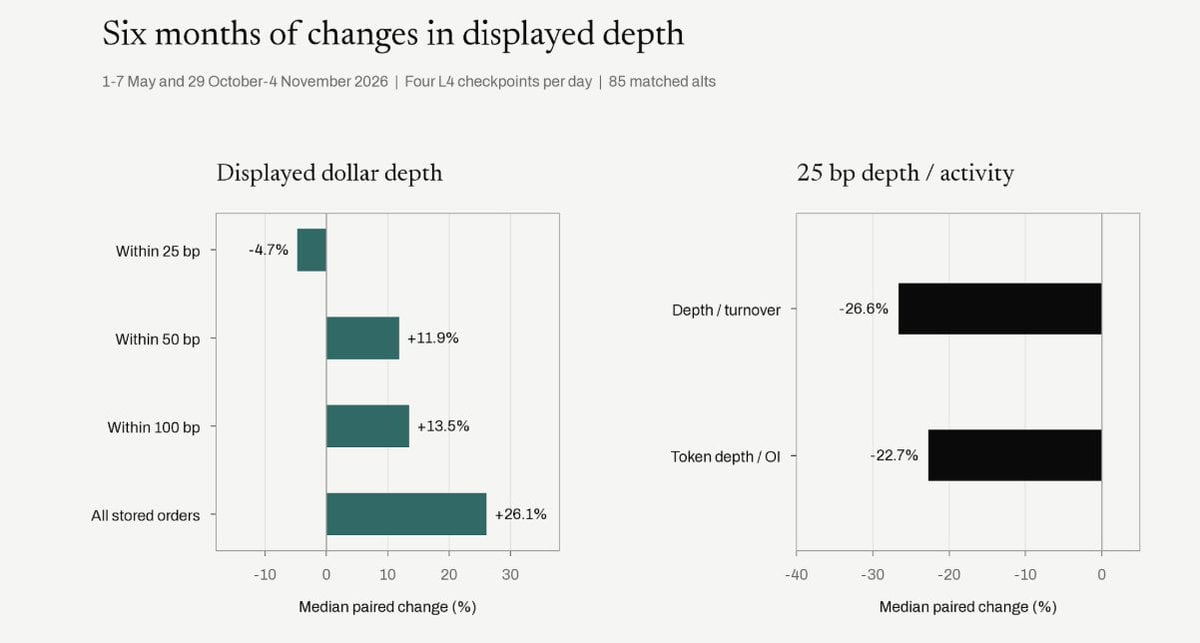
The analysis added a cross-sectional view covering the past six months. Book depth improved during that period, but the gains appeared in wider outer levels rather than close to the best bid and offer. One chart compared dollar depth for 85 matched altcoins on Hyperliquid from early May through late October and early November 2026, along with changes in the ratio of 25-basis-point depth to volume and open interest.
The one-year spread curve showed that Hyperliquid had previously been narrowing the gap with Binance and OKX. The relationship diverged only recently. Matteo said more time would be needed to determine whether the move represented a lasting trend reversal or a short-lived event. The order-book data, however, matched the recent signs of a more centralized market structure. The relevant chart covered median quoted spreads for perpetual contracts on 72 matched altcoins from November 2025 to November 2026.
Trading data does not show one market maker taking everything
To study the market-making structure, the analysis grouped a main account with explicitly linked subaccounts into one account family. This avoided counting the same organization repeatedly. The approach could identify related groups even when their institutional ownership was unknown.
Matteo initially suspected that a small number of large market makers had taken most of the trading activity. Year-over-year trading data did not support that view. Across the same 80 markets, the median share of resting-order trading volume held by the largest account family fell from 25.2% in a selected week one year earlier to 14.6% in a recent selected week.
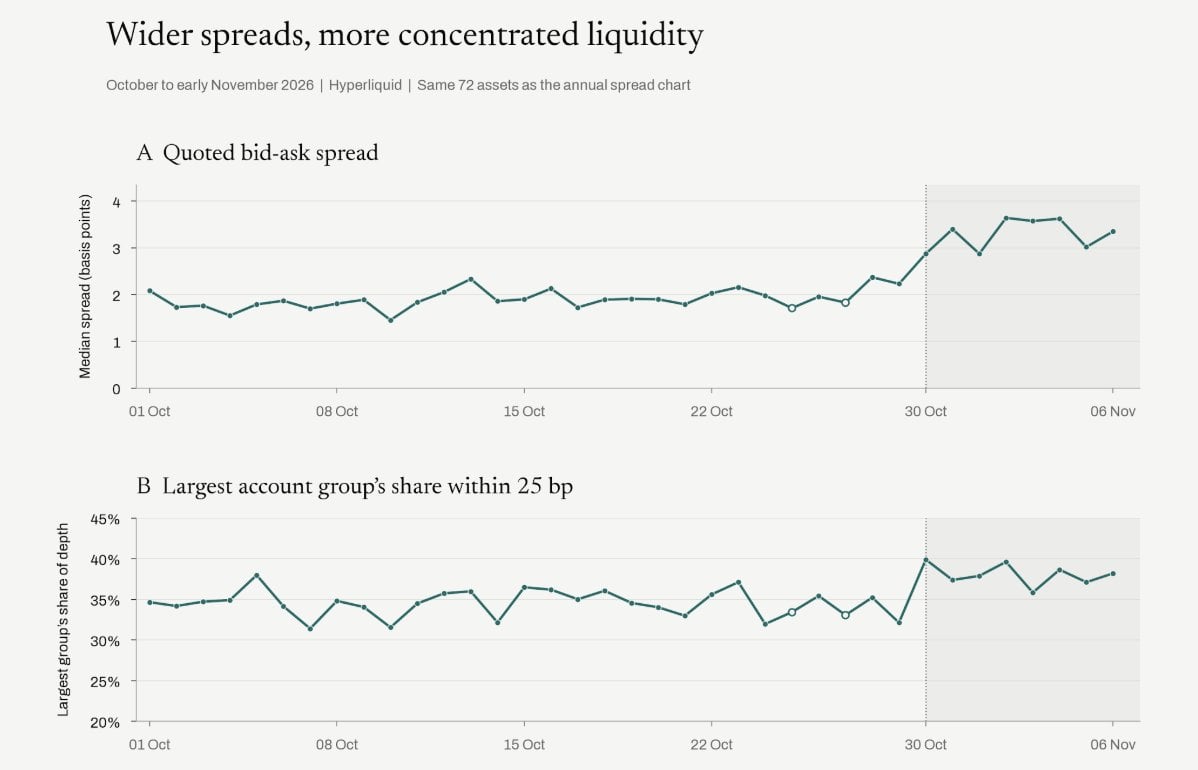
That means the full-year depth decline cannot be explained simply by one market maker controlling the market. The more recent book structure looked different. Using the same 72 matched assets and narrowing the window to one month, the analysis found that spreads began to widen around Oct. 30 as liquidity near execution prices became more concentrated.
Comparing Oct. 8-14 with Oct. 31-Nov. 6, the median share of depth within 25 basis points held by the largest account group rose from 34.5% to 38.6%. Median quoted spreads widened from 2.13 basis points to 3.55 basis points.
The time window included Binance’s Oct. 29 security incident. Matteo therefore did not attribute the move directly to priority fees or network congestion based only on the curves. Account-level data also showed that one large liquidity provider sharply reduced its quotes around Nov. 3, after which several other account families took over part of the share. Whether that change persists remains unresolved.
Fee tiers create a structural disadvantage
The analysis examined historical resting-order fees for 54 account families using volume-weighted rates. The lowest-volume quartile paid a fee of 0.961 basis points, while the highest-volume quartile received a rebate of 0.236 basis points.
Before hedging costs and adverse selection are included, smaller market makers therefore started with an approximate 1.20-basis-point disadvantage. In a market where total quoted spreads are only a few basis points, the difference is a substantial structural burden.
Order-posting data also pointed to lower participation. Across the same 72 markets, the median number of account families posting at least $1,000 on each side within 25 basis points fell from 7.64 during Oct. 8-14 to 6.39 during Oct. 31-Nov. 6.
Even after adjusting to fixed token prices, 58 of the 72 markets recorded a decline in active market-making accounts. The result indicates that fewer market makers were supplying effective quotes around key book levels, separate from the price declines caused by token selling.
HIP-4 also depends on smaller market makers
Network congestion presents another challenge. Hyperliquid’s current congestion-limiting rules allocate capacity according to an address’s weighted resting-order share during the previous UTC day. During periods of heavy congestion, an address can use block space equal to twice that share.
The system creates a feedback loop: an account needs trading volume to receive an allocation, but it needs an allocation to produce trading volume. This was the most common complaint Matteo heard from HIP-4 traders. When Hyperliquid became congested, they said they could not quote normally.
Those smaller market makers are nevertheless supporting a large portion of current liquidity. In a sample taken on Nov. 10 covering 256 HIP-4 contracts, only four professional market-making wallets supplied 47% of the depth within 25 basis points of the midpoint.
The markets remain relatively small, and most binary options begin at that scale. The analysis argues that Hyperliquid will need to keep smaller market makers able to quote if it wants a liquid long-tail prediction-market ecosystem.
Matteo’s central argument is that deep long-tail liquidity was one of the main reasons traders chose Hyperliquid, but the matched markets now show a clear loss of ground against Binance. Keeping the order book competitive requires enough market-making teams to afford the cost of quoting. If teams outside the largest market makers continue to struggle, the platform risks giving up the advantage it built around long-tail assets. For HIP-4 to compete, smaller market makers need a stable and reliable quoting environment from the start.
Author: Matteo
Compiled by: TechFlowPost