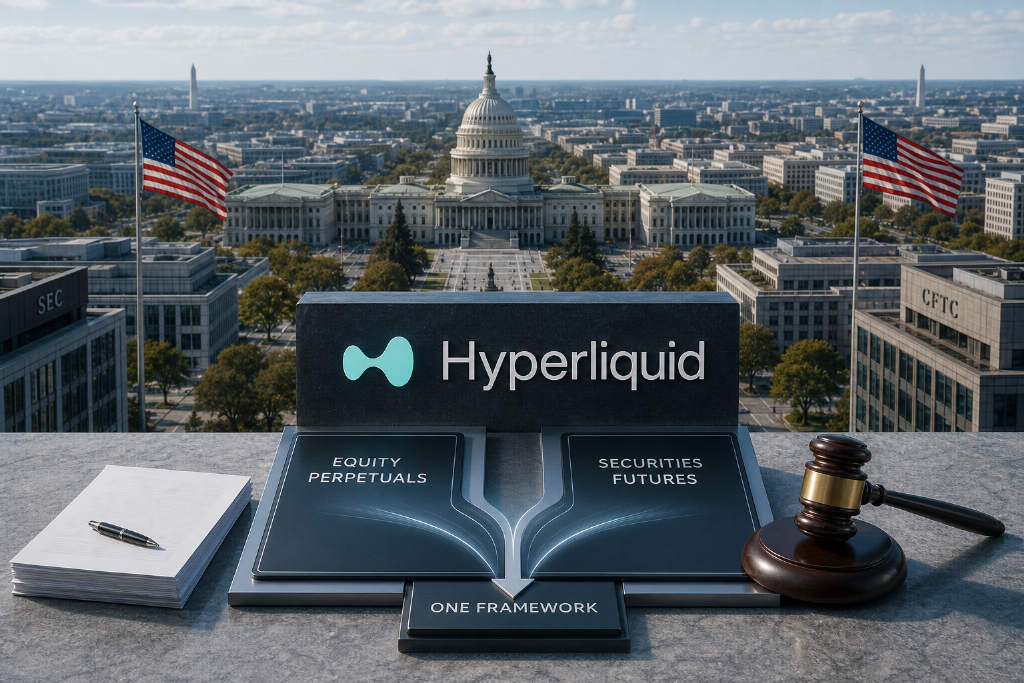
Hyperliquid Policy Center, or HPC, has submitted a comment letter to the U.S. Securities and Exchange Commission and the Commodity Futures Trading Commission arguing that eligible equity perpetual contracts can be treated as securities futures. In the filing, HPC said this category already sits within a shared regulatory structure overseen by the two agencies, which would let exchanges compete on execution quality rather than on which regulator has jurisdiction. The group also said a core legal question remains unsettled in the United States: whether perpetuals should be classified as futures or swaps. HPC argued that perpetual contracts share several futures-like traits, including standardized terms, the ability to offset positions, and forward value, even though they do not have a fixed expiration date. Instead, prices continue to converge through a funding-rate mechanism. The letter set out four recommendations, including confirming that the securities futures definition can cover cash-settled equity perpetuals with futures characteristics, preserving listing flexibility for trading venues, keeping classification consistent across both agencies, and updating the securities futures framework for newer product structures. HPC added that Hyperliquid perpetuals have recorded more than $480 billion in trading volume over the past 10 months.
Hyperliquid Policy Center (HPC) has submitted a comment letter to the U.S. Securities and Exchange Commission (SEC) and the Commodity Futures Trading Commission (CFTC), saying eligible equity perpetual contracts can be recognized as securities futures.
HPC said this category is already subject to joint oversight by the two agencies. Under that approach, exchanges would compete on execution quality rather than on jurisdictional boundaries.
Perpetuals still lack a clear legal classification in the US
In the letter, HPC said perpetual contracts still do not have a clear classification under U.S. law. The unresolved question, it wrote, is whether these products should be treated as futures or swaps.
HPC argued that perpetuals carry several futures-like features, including standardized terms, the ability to offset and close positions, and forward value. They do not have a fixed expiration date, but their prices continue to converge through a funding-rate mechanism.
Four recommendations in the letter
HPC laid out four proposals:
- Confirm that the definition of securities futures can cover cash-settled equity perpetuals that have futures characteristics;
- Preserve flexibility for trading venues in listing products;
- Keep classification consistent between the SEC and the CFTC;
- Modernize the securities futures framework so it can accommodate newer structures.
HPC cites Hyperliquid trading volume
HPC said Hyperliquid perpetual contracts have generated more than $480 billion in trading volume over the past 10 months. It added that a clearer framework would help bring related products to the U.S. market.
This article was originally published by Bit.Fan. For more cryptocurrency news and market insights, visit www.bit.fan. Disclaimer:
The market information, project data, and third-party content displayed on this platform are for industry information sharing only and do not constitute any form of investment advice or return commitment.
Cryptocurrency trading carries high risks. Users should fully assess their risk tolerance and make independent decisions. All profits, losses, and legal responsibilities are borne by the users themselves.