
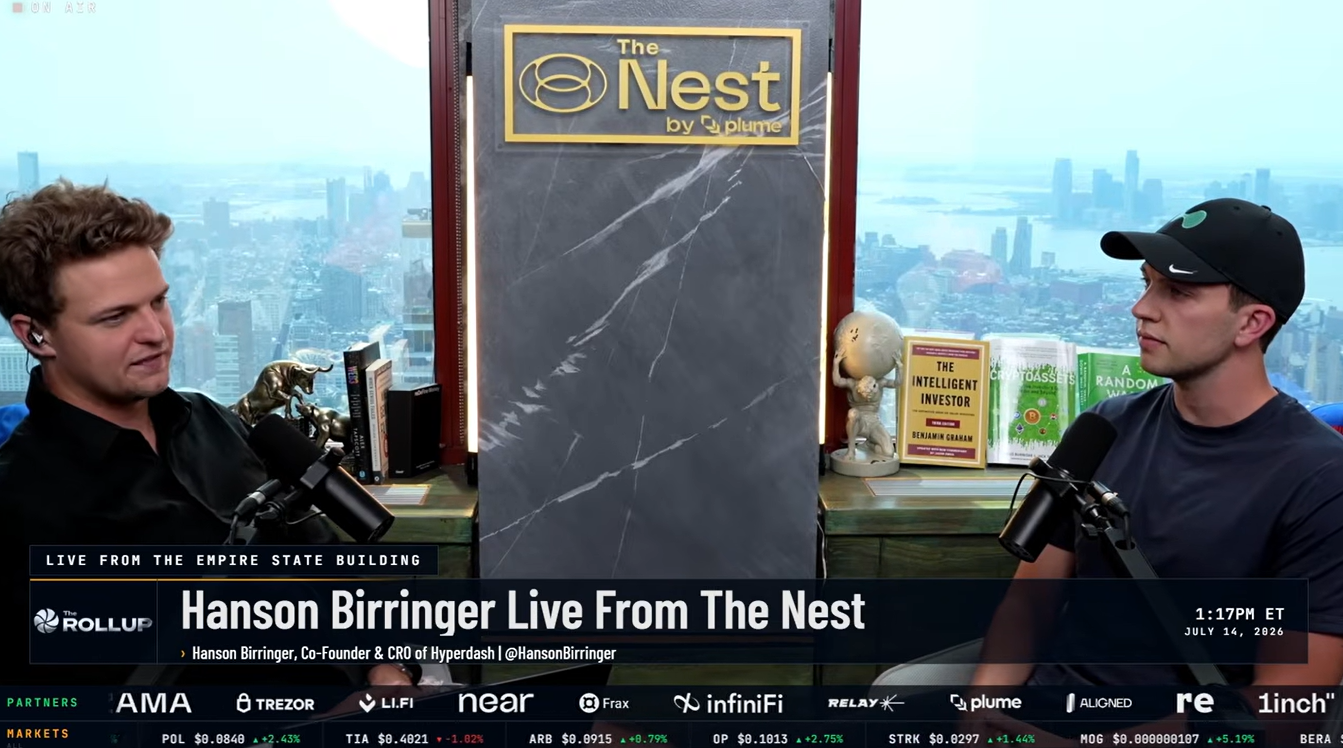
Hanson Birringer, co-founder and chief revenue officer of Hyperdash, said on The Rollup podcast that Hyperliquid is still being seriously undervalued by the market. He framed the protocol as a direct expression of three crypto trends he expects to compound over time: perpetual futures, real-world assets, and stablecoins.
The conversation also touched on Grayscale’s related ETF product. Birringer said that structure gives institutional investors a compliant way into the Hyperliquid ecosystem, while the protocol’s token buyback design creates a value-capture model that traditional allocators can understand more easily.
Recent expansion around HyperDEX and infrastructure
Birringer opened by describing the past month as a strong one. He said he had officially joined HyperDEX full time and that the team had announced the acquisition of Imperator. That, he said, means the business is now launching a full data and node infrastructure validator operation. He also pointed to the upcoming Hyperliquid summit later in the week and said it is an exciting period for builders working inside the ecosystem.
Asked how he now explains the investment case for Hyperliquid, especially in conversations with high-net-worth investors and institutional allocators while raising capital for the Grayscale ETF SPV, Birringer said the appeal goes beyond crypto-native capital markets. In his view, Hyperliquid matters to a broader financial system that is evolving alongside crypto rather than separately from it.
He said the core case starts with the protocol’s open-source, permissionless, decentralized structure. Every participant on the platform operates under the same rules. At the same time, he argued, Hyperliquid combines crypto’s original ethos with a high-performance financial system and application layer that can bring institutional capital into a decentralized environment. Over a decade in crypto, he said, he has not seen another project align those two worlds in the same way.
One protocol tied to perpetuals, RWAs, and stablecoins
When the host asked whether Hyperliquid should be viewed as a vehicle for a bullish view on perpetuals, tokenization, and stablecoins, Birringer’s answer was direct: yes.
He called Hyperliquid the purest expression of those trends. On perpetuals, he said the case is straightforward. Hypercore, in his description, is a leading perpetual DEX already competing with centralized exchanges. Whether measured by open interest share, trading volume share, or liquidity, he said Hyperliquid ranks near the top and in some pairs is already one of the top venues. He also said the rollout of HIP-3 introduced RWA perpetuals, bringing another large market theme into the same product stack.
For commodity and equity perpetuals, Birringer said Hyperliquid has effectively become a category leader among crypto exchanges. He argued that the protocol has chosen to open-source the builder layer rather than outsourcing it, a decision he described as central to the Hyperliquid approach: capable third-party builders can come in and add value to the ecosystem directly.
USDC’s quote-asset role and the buyback model
Birringer spent significant time on stablecoins. He said the market has not fully understood how important it is that USDC has become the core quote asset on Hyperliquid. In his telling, stablecoins have never participated in a trading system in this way before.
He said the relevant stablecoin issuers effectively gave up 90% of revenue in order to become part of the Hyperliquid story, and argued that this matters not only from a narrative angle but also from a revenue angle.
His numbers were specific. Hyperliquid, HyperEVM, and Hypercore together now account for roughly $10 billion in stablecoin supply, he said. If that capital earns a 4% net interest spread through U.S. Treasuries on the back end, and 90% of that income goes to the assistance fund, which then programmatically buys back HYPE on-chain, the result would be hundreds of millions of dollars in additional buying pressure for the token on top of trading fees.
That is why, in his view, HYPE as a token and Hyperliquid as an ecosystem represent a concentrated bet on perpetuals, RWAs, and stablecoins at the same time, with those three trends reinforcing one another over time.
Regulatory friction remains, but the push is underway
The host referenced Jeff’s description of Hyperliquid as an “AWS for liquidity,” with liquidity attracting more liquidity. Even so, the host said one clear obstacle remains: heavily regulated retail front ends such as Robinhood and Kalshi are not yet in a position to connect directly to this system.
Birringer said that challenge is global, but also said Hyperliquid is addressing it directly. He pointed to efforts by the Hyperliquid Policy Center and wallet provider Phantom to engage U.S. regulators, including the Commodity Futures Trading Commission, in search of clearer regulatory treatment for decentralized trading venues.
If that happens, he said, regulated brokerage front ends could route orders directly into Hyperliquid’s back-end execution layer. He tied that possibility to an older shift in traditional brokerage, where zero-commission models changed the market. Hyperliquid, he said, now offers an extremely competitive low-cost liquidity layer, and the addressable market is large.
Revenue growth thesis centers on volume and collateral expansion
The host also asked about revenue over the next one to two years, especially after open interest in HLP 3, the RWA market, reached a record high. Birringer answered by comparing the protocol’s current scale with the size of traditional finance.
He said some options and ETF markets trade in notional volumes measured in trillions and even quadrillions. If RWA perpetuals capture only a small slice of global trading volume, Hyperliquid’s revenue could grow 100x over the next decade. As volume rises, he said, margin posted on the protocol should rise as well, magnifying the stablecoin income stream and the size of token buybacks.
That makes the revenue story broader than trading fees alone. In his framing, fees, stablecoin yield, and buybacks all sit inside the same system.
Why Hyper Holdings backed the Grayscale ETF through an SPV
The interview then turned to Hyper Holdings and the launch of Grayscale’s Hyperliquid ETF. Birringer said Hyper Holdings Global is a special purpose vehicle, or SPV, that was set up to provide in-kind seed capital to the Grayscale ETF.
He said the reason is straightforward. Traditional institutional investors often do not have Coinbase accounts and face strict internal compliance and risk-control friction. An ETF gives them a one-click route into the asset, while the seed capital support helps establish early assets under management and liquidity so larger investors can move in and out with greater confidence.
Birringer added that institutions respond well to Hyperliquid’s “cash flow plus token buyback” model because it is easier to value than many other public-blockchain projects.
Hyperdash says it has processed more than $35 billion in volume
On the company side, Birringer said Hyperdash has now processed more than $35 billion in trading volume. He described the platform as a global brokerage and trading data terminal that offers tools beyond those available on the official front end.
Following the acquisition of institutional-grade data firm Imperator, he said Hyperdash became an active validator node on Hyperliquid and can process on-chain data at higher speed. He said that improves execution and data quality for retail traders, while also allowing the company to package enterprise-grade data products for traditional asset managers doing underwriting work and investment evaluation.
What needs to happen over the next 18 months
At the end of the interview, the host asked what would need to go right over the next 18 months for Hyperdash, Hyper Holdings, and the broader Hyperliquid ecosystem to reach the most optimistic outcome, and what a middle or bearish case might look like.
Birringer said the bullish case is clear. As stablecoin rails and local fiat on-ramps expand, people around the world who were previously shut out of dollar capital markets will be able to access global liquidity with only a few taps on a phone. He said that kind of access has not existed before at this scale.
On the bearish side, he said he struggles to find a convincing argument. Unless the long-term trends of global internet adoption and financial inclusion reverse, he said, there is still strong reason to stay highly optimistic.