
Hyperliquid is still geoblocked in the US because its permissionless onchain infrastructure conflicts with American market-structure laws that limit futures trading to registered venues, clearinghouses, and brokers. The article says Hyperliquid Policy Center has urged the Commodity Futures Trading Commission, or CFTC, and the Securities and Exchange Commission, or SEC, to modernize those frameworks so regulated institutions can build products on HyperCore through builder and deployer seats while carrying the compliance obligations themselves.
In the piece’s framing, a domestic US version of Hyperliquid built through permissioned HIP-3 DEX deployments has become a plausible path, especially after what it describes as backing from statements tied to Donald Trump.
From perpetuals venue to market infrastructure
Over the past year, much of the work around Hyperliquid has been to redefine it from a decentralized perpetuals exchange into what the article calls modern market infrastructure. That framing covers perpetual futures, spot trading, and prediction markets on a globally accessible and composable platform.
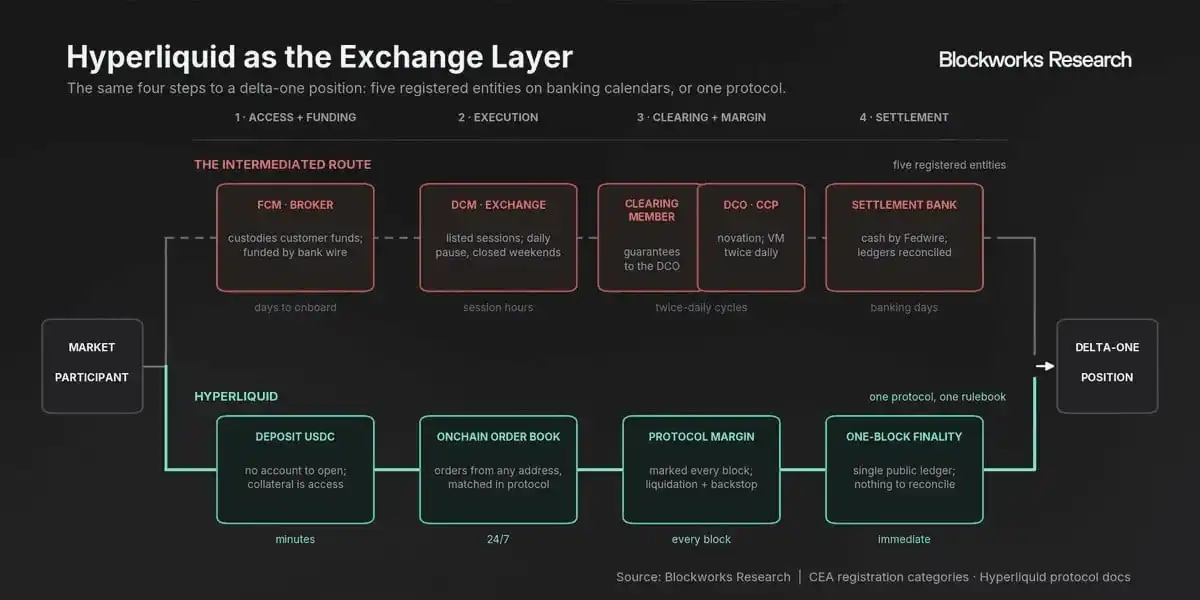
The report contrasts that model with vertically integrated crypto platforms such as Coinbase and BN, which handle user onboarding, custody, and execution inside one stack. Hyperliquid’s infrastructure layer is presented instead as closer to the split-function setup seen in traditional finance. In that structure, a designated contract market, or DCM, lists contracts and matches trades, a derivatives clearing organization, or DCO, manages margin and settlement, and a futures commission merchant, or FCM, handles customer onboarding and trading access.
Hyperliquid’s modular stack is described in similar terms. HyperCore serves as the trading and clearing layer, with matching, margin accounting, and settlement running as protocol logic. Positions are marked using validator oracles, and liquidations are carried out through a deterministic liquidation waterfall.
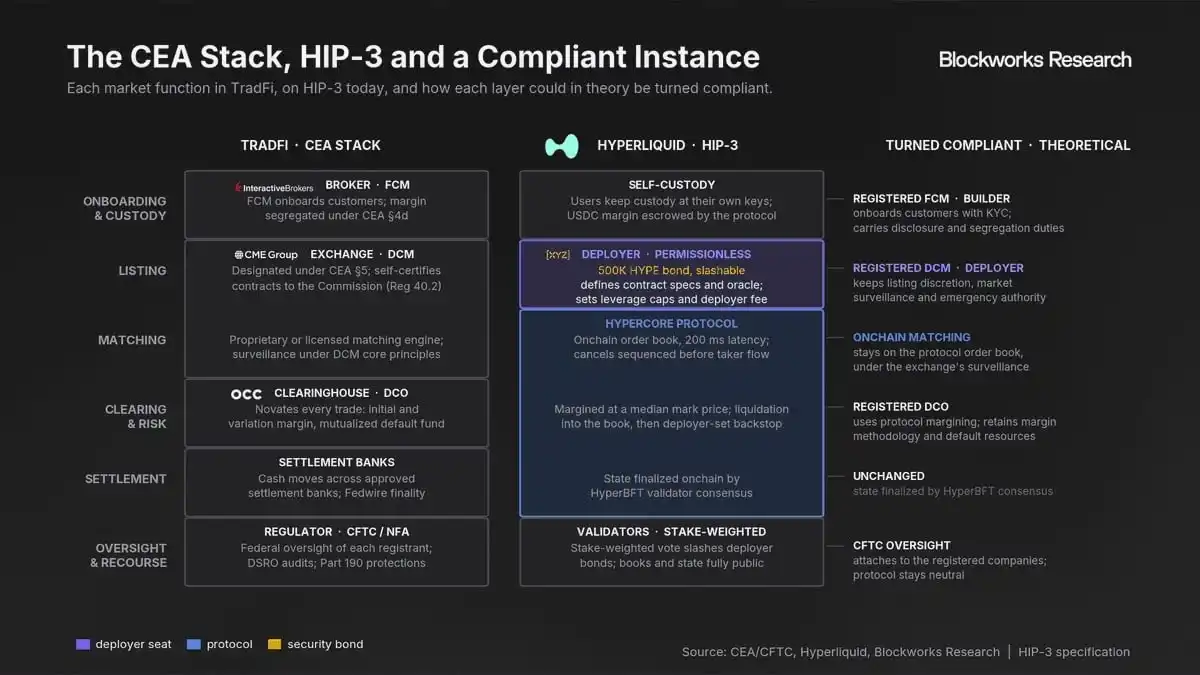
Deployers in this system must stake 500,000 HYPE as slashable collateral. They are responsible for token listings, contract specifications, leverage limits, and oracle configuration, and they can retain as much as 50% of the fees generated by their market. Builders play a broker-like role by bringing in users and routing order flow to HyperCore in return for a share of trading fees.
What changes the picture is that Hyperliquid reconstructs those layers onchain and enforces them in code. Access and market creation are permissionless, users keep custody of their own assets, other applications can build on top, and assets trade on a single global platform around the clock. The article argues that this removes the geographic and legal fragmentation built into traditional finance.
Why US rules are a problem for Hyperliquid
The article identifies regulation as the main obstacle. US market-structure law was written for the traditional architecture, and each statutory registration category sits awkwardly against Hyperliquid’s base design.
- A DCM must comply with 23 core principles under Section 5(d) of the Commodity Exchange Act, including market surveillance and customer identification. HyperCore, by contrast, can be accessed by anyone with a wallet.
- A DCO must calculate margin using a board-approved model with a 99% confidence level and settle through approved settlement banks under 17 CFR §§39.13–39.14. HyperCore calculates margin through protocol logic and settles at the consensus layer.
- An FCM must segregate customer funds under Section 4d of the Commodity Exchange Act. Hyperliquid users self-custody their assets, which does not fit the custodial FCM model.
The piece says these requirements are stringent enough that even Coinbase, which uses centralized KYC, has had to register as an FCM in its US business and acquire an existing DCM. Hyperliquid cannot simply copy that route because buying a DCM and molding itself to the current framework would cut against its stated goal of rebuilding the infrastructure layer. The result has been self-imposed geoblocking from the world’s largest capital market.
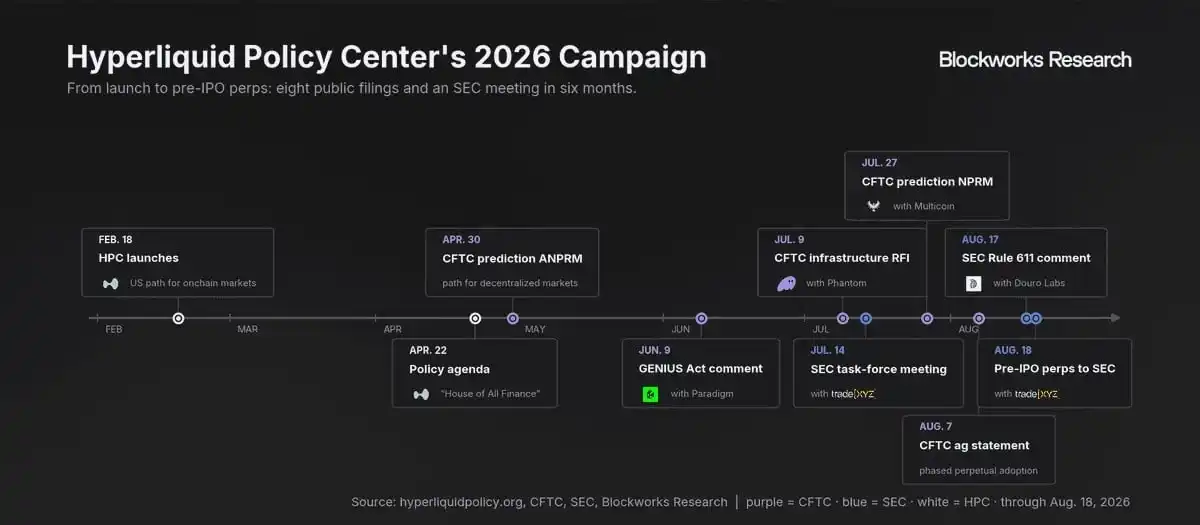
Still, the article says Hyperliquid does not intend to remain offshore forever. In February 2026, it announced the creation of Hyperliquid Policy Center, or HPC, and committed 1 million HYPE to the effort. At current prices cited in the piece, that was worth about $72.5 million. The goal was to bring this new market structure within US law.
In July, HPC and Phantom asked the CFTC to confirm that publishing onchain software by itself should not trigger licensing requirements. They also argued that already licensed firms should be allowed to run matching, settlement, and margin functions on onchain infrastructure, and that an exemption should permit non-custodial wallets to route users to regulated derivatives.
In August, HPC and TradeXYZ took the same logic to the SEC. Their submission proposed a framework for pre-IPO perpetual contracts, including names the article says are already traded on Hyperliquid, such as SpaceX and Cerebras. It also included the disclosure and investor qualification rules needed to open those products to US investors.
The article says early signs suggest the strategy is gaining traction and that the US regulatory stance appears open. It points in particular to Trump’s announcement that Chair Selig planned to push for Hyperliquid to be onshored.
HPC’s argument: regulate the firms using the rails
HPC’s strategy, as described in the article, is not to demand direct access for US users through a non-KYC front end. Its position is that Hyperliquid should be treated as neutral infrastructure. If US companies using it can meet the legal duties already required under existing rules, then Hyperliquid should be allowed to sit alongside a traditional DCM as an option.
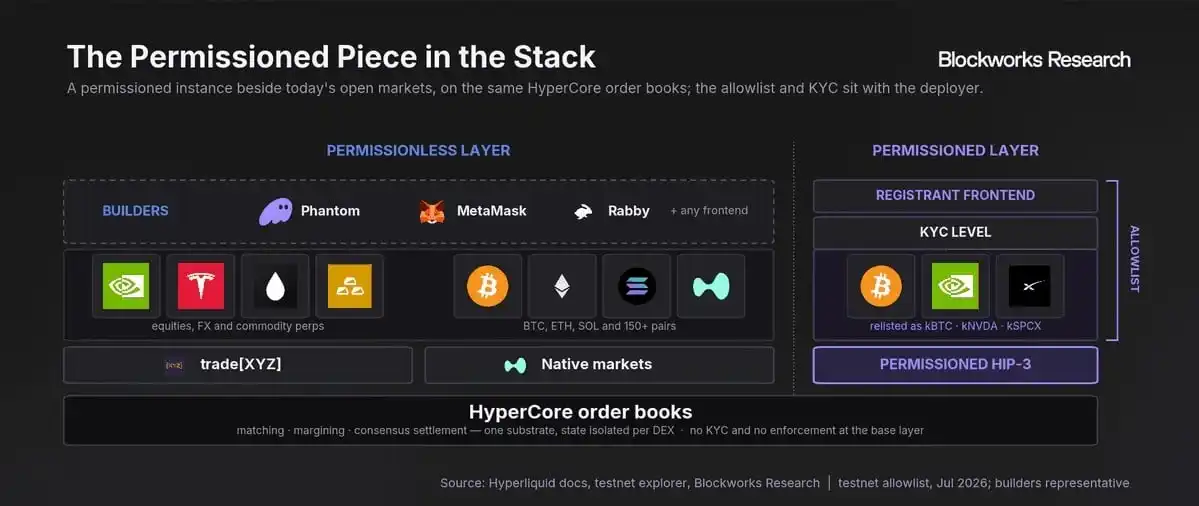
Under that model, a broker that fulfills KYC duties could route client order flow to HyperCore. A deployer could also take on functions closer to a registered venue, including listing discretion, market surveillance, and emergency intervention powers.
Testnet changes show what a compliant setup could look like
As policy work in Washington has moved ahead, Hyperliquid Labs has put testnet updates online that, in the article’s view, make this kind of compliant access technically possible. The clearest example is a permissioned HIP-3 deployer.
Unlike Hyperliquid’s native markets and the existing HIP-3 deployments that are fully open, these new deployments are only available to whitelisted users. That gives regulated entities a more concrete route to launch markets, run KYC, and whitelist compliant customers for trading.
Those compliant versions would appear as fragmented order books because every market, including BTC and RWA markets, would need to be relisted. The article says whitelisted market makers would bridge liquidity between the two books and reduce the split. That would let the new deployments keep separate order books while still drawing on Hyperliquid’s deep liquidity.
The report notes that separate-order-book structures have precedent, citing early BN US and Lighter’s deployment on Robinhood Chain. What it says makes Hyperliquid different is that both markets run on the same L1 and share collateral and margin. There is no need for bridging across chains or across trading venues, so liquidity can move between order books instead of being sealed off.
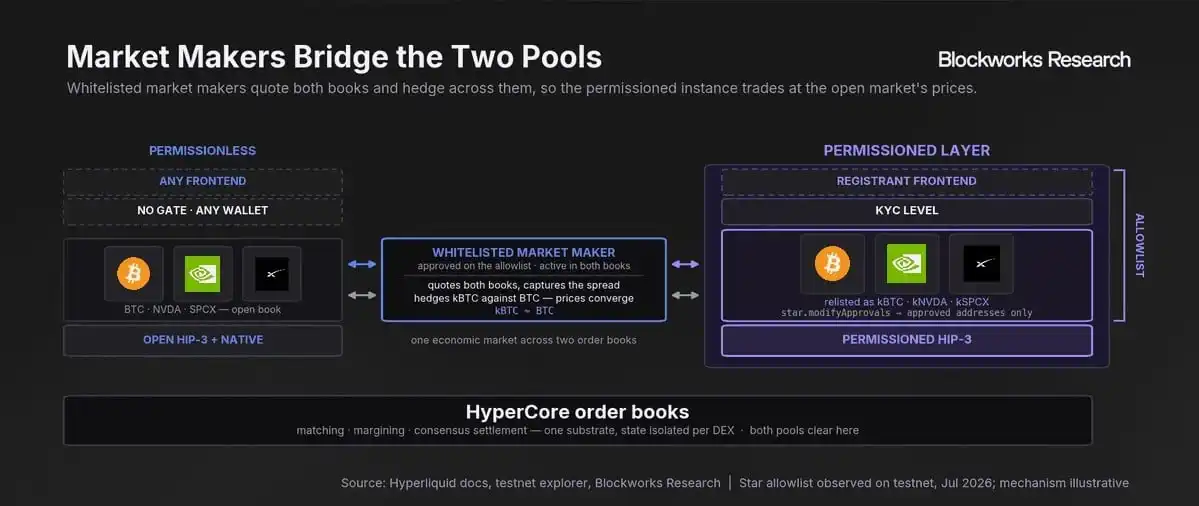
These trading venues can also include other parameters. One example in the article is the "PA" permission inside the payload, which lets a DEX take direct actions on user accounts. That includes submitting reduce-only orders, canceling orders, and moving USDC internally within the DEX. The piece compares that authority to the close-out powers an FCM holds over customer accounts.
Taken together, the article argues, those tools give US brokers and institutions what they need to build compliant Hyperliquid products on HyperCore. The model is additive rather than replacement. Hyperliquid’s native markets would remain permissionless, and its role as neutral infrastructure would stay intact.
Research view in the article
The article concludes that Hyperliquid’s recent moves in Washington show that entering the US market through a compliant route has become a top priority. It is equally clear in the piece that operating directly in the US through the native non-KYC front end would not comply with current American law.
Its stated view is that HPC’s work maps out a KYC-compliant access path: firms providing access would fully meet the regulatory requirements while using the Hyperliquid base layer underneath. With permissioned HIP-3 deployers and PA account controls now appearing on testnet, the article says this route could give US investors a compliant way into Hyperliquid markets without changing the protocol’s status as neutral infrastructure.