
DeFi researcher Ignas says traders looking at the current meme coin frenzy may be better off providing liquidity to tokenized stock pairs than buying the memes themselves.

His core argument is simple: speculative meme trading creates large fee flows, and liquidity providers can collect part of that activity without taking the same directional bet as the traders driving the volume.
In the article, Ignas writes that many degens are still chasing meme coins through FOMO and losing money, while generating millions of dollars in trading fees each day. For LPs, that fee stream is the opportunity.
Robinhood Chain data is central to the thesis
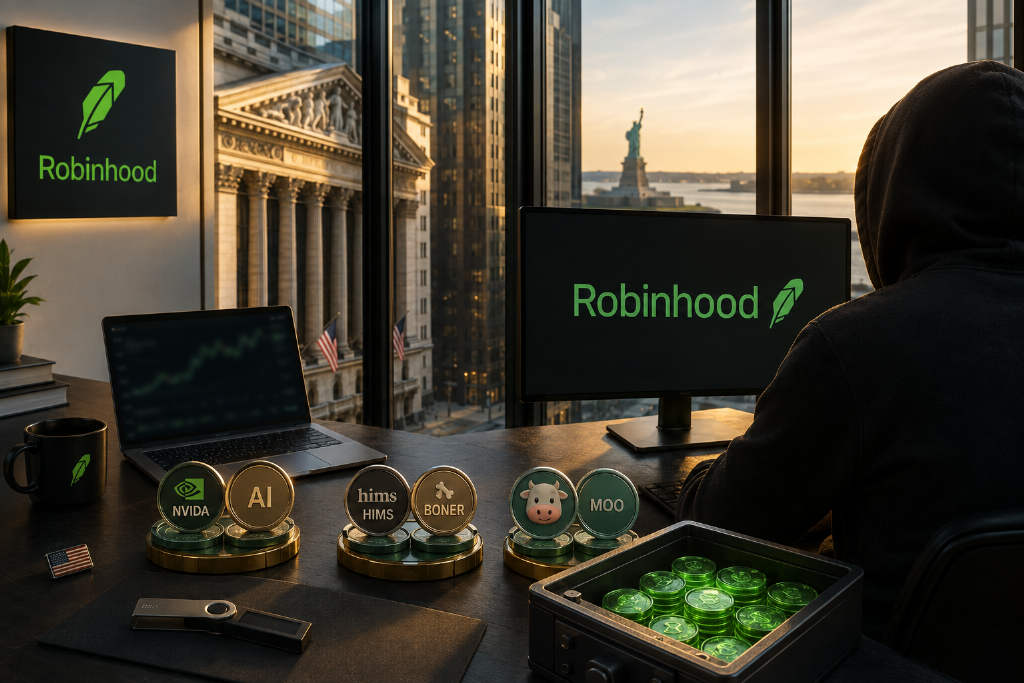
Ignas says tokenized stock memes launched through the Pons launchpad have pushed attention toward pairs such as AI/NVDA, BONER/HIMS, and MOO/MU. He describes the arbitrage between those meme-stock pools and standard stock/USDG pools as his preferred setup because repeated rebalancing and arbitrage add to fee generation.

He says users do not need to hold the meme asset itself to earn from the activity around it.
Ignas cites the following numbers for Robinhood Chain after its July launch:
- $1.66 billion in DEX trading volume, second only to Solana at $2.1 billion and above Ethereum at $1.37 billion
- $16.98 million in 24-hour app fees
- $833 million in stablecoins and $2.6 billion in cross-chain TVL
- $387 million in perpetual futures trading volume
- $757 million in TVL and roughly $17 million in app fees generated per day
Based on those figures, he says the annualized return works out to 819%, or 2.243% per day. On a compounded basis, he puts the APY at 328,000%.
Ignas also cites data shared by @0xSammy, who said tokenized stocks generated 13 million transactions in a single day and that addresses holding tokenized stocks reached 203,000, up 46% over three days.

Why he thinks yields are so high
Ignas gives two main reasons.
First, he says there are not many liquidity providers yet. Fomo launched on Robinhood Chain in July as a meme coin trading app without LP functionality. Robinhood Wallet and Fomo also let users buy meme coins with a credit card. Citing The Block, the article says JPMorgan has asked Visa to investigate the matter. Ignas argues that much of this trading volume comes from users who were never likely to provide liquidity in the first place.
Second, the pools are still small. He gives the example of the RBLX/USDG pool, which had $168,000 in TVL and $6.2 million in trading volume when he entered. According to his calculation, daily fees amounted to 11% of TVL.
He says a fund cannot realistically deploy $5 million into a pool with only $168,000 in TVL, but that the same size constraint makes these pools attractive for smaller participants.

Meme-stock pairs are generating some of the biggest fee numbers
According to the article, Sammy reviewed 27 meme/stock pairs across 22 stock tickers. Examples listed by Ignas include AI/NVDA, MOO/MU, BONER/HIMS, NUDES/SNAP, and LIGMA/FIG.
He adds that BONER alone accounts for 81% of HIMS supply on-chain. In his description, traders may think they are engineering a short squeeze, but what they are actually creating is something closer to a float squeeze.
Using data from scopl.live, Ignas says several meme/stock pools ranked among the top fee-generating pools on-chain over the past 24 hours:

- AI/NVDA: $447,000
- AI/WETH: $340,000
- UBIK/GLD: $321,000
He says the fee-only annualized return reaches 1329%.
Still, Ignas says traders do not need to own the meme token itself, because impermanent loss can be severe and sudden selling by a KOL can also hurt holders. In his view, every trade that buys AI through NVDA, and every BONER-driven move that reprices HIMS, eventually gets arbitraged back through stock/USDG pools.
His preferred pools at the moment are HOOD/USDG, NVDA/USDG, RBLX/USDG, and DJT/USDG. He notes that the full list of meme trading pairs is available through the table linked in the original post.
The tools Ignas says he uses for LP mining
On tooling, Ignas names Revert as his favorite LP tool. Rather than following degens into meme trades, he says he would rather follow the smartest LPs. Revert lets users sort LP positions by annualized return, profit and loss, and creation time, though he says the filtering process still requires trial and error.

He also says Revert supports single-asset LPing and helps with rebalancing, while likely charging a small fee.
Another tool on his list is scopl.live, which he describes as a pool discovery product with real-time fee APR. He says it can help users find new pools and serve as an alternative to Revert in some discovery workflows.
For emissions farming, Ignas mentions vfat.tools, calling it an OG mining tool, though he says it is less useful for users focused on LP mining on Uniswap.
He also points to Merkl, which he describes as a 2026 version of vfat for incentivized Uniswap positions. After filtering for Robinhood Chain, he says users can find extra rewards on Uni v4 stock-token pools such as SPY-MU and SPY-INTC, where Merkl APR can exceed 100% on top of fee income.

Using AI to track mining positions
Ignas says AI tools such as Claude, Grok, and ChatGPT can simplify the process of running LP strategies. He says they can help with bookkeeping, checking total ROI, discovering new pools, and building a unified dashboard for positions spread across different platforms.
As he puts it, in the AI era there is no reason not to know how to farm.
At the time he published the post, Ignas also said HOOD was 1.5% away from his floor price.
