
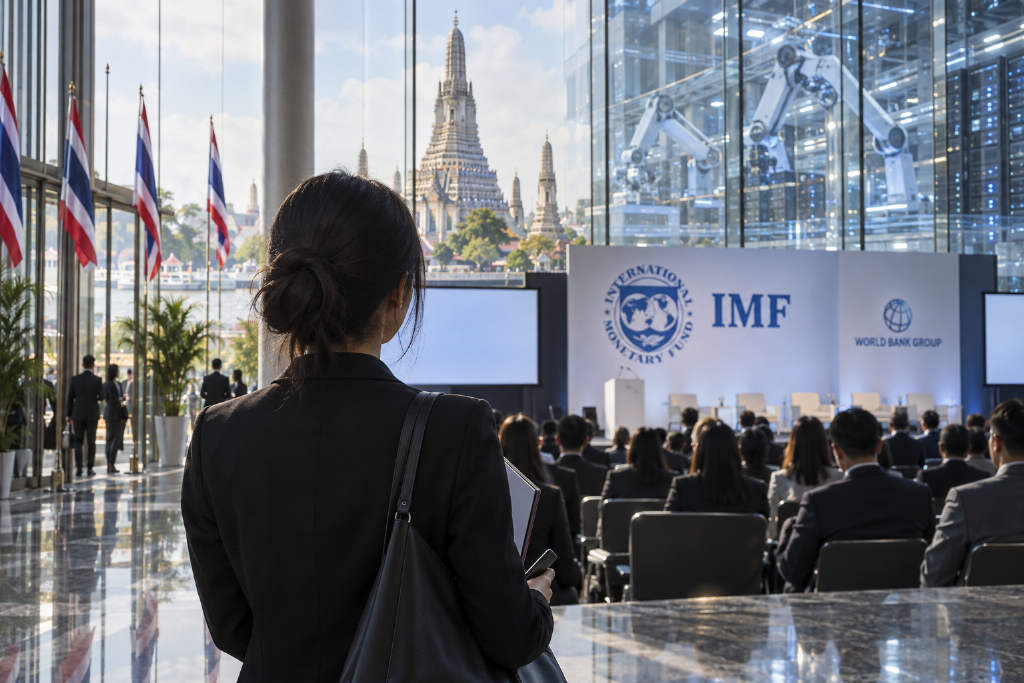
Artificial intelligence spending is helping keep the world economy growing at about 3% a year even as an energy shock continues to weigh on most countries, International Monetary Fund Managing Director Kristalina Georgieva said Monday in Bangkok.

Georgieva made the remarks on the opening day of the IMF and World Bank annual meetings in the Thai capital, which run through October 18. She said the biggest beneficiaries so far are Asian economies that make the hardware behind AI. According to her estimates, AI adoption could add 0.5 to 1 percentage point a year to growth in advanced economies and 0.2 to 0.8 percentage points in emerging economies.
At the top end of that range, she said, the boost would more than offset the drag from aging populations across the region. The report noted that a percentage point is the absolute gap between two growth rates, so an economy expanding 2% and gaining one full point would be growing at 3%.
Asian AI hardware exporters outpaced IMF forecasts
In its July outlook update, the IMF said the four biggest net exporters of AI hardware—Taiwan, South Korea, Thailand, and Malaysia—beat its first-quarter growth forecasts by an average of 4.4% on an annualized basis. South Korea grew at a 7.5% pace, well above the Fund’s 1.8% projection published in April.
In a speech delivered in Singapore last week, Georgieva said AI hardware and related technology products now account for more than one-tenth of world goods trade. She also said AI investment as a share of global GDP is likely to exceed the scale of spending once devoted to building railroads or electricity grids.
The boom is leaving many countries behind
Georgieva said the current AI boom is bypassing most countries outside that supply chain. The IMF’s July update projected global growth of 3% in 2026, down from 3.5% in 2025, as war in the Middle East pushed energy prices higher.
IMF says AI will touch about 40% of jobs
On employment, Georgieva described AI as a “slow-moving tsunami” and said the Fund expects it to eventually affect about 40% of jobs worldwide, with many roles either downgraded or eliminated.
Exposure is around 60% in advanced economies and roughly 23% in low-income countries, she said. She added that the lower figure for poorer nations mainly reflects the fact that AI has not yet reached them on the same scale.
Young people entering the workforce are first in line, according to Georgieva, because AI is absorbing the routine tasks that entry-level jobs are built around.
Singapore President Tharman Shanmugaratnam, speaking on the same panel, said demand for graduates’ first jobs is already falling. He warned that AI could widen the gap between rich and developing economies if governments do not act.
Public finance and market risks were also raised
Georgieva said AI could also squeeze public finances. If income shifts from workers to owners of capital, governments lose part of the tax base they rely on most, she said.
World Bank President Ajay Banga said the bank is supporting “small AI” tools that do not depend on large language models, with intended use cases for farmers, clinics, and classrooms in emerging markets.
Georgieva also said in Singapore that the AI build-out itself is adding to inflation. She warned that disappointing earnings could spread through markets because major AI companies have borrowed heavily to finance the build-out.
Full IMF outlook due on October 13
The IMF is scheduled to publish its full World Economic Outlook at 9 a.m. Bangkok time on October 13, which is 10 p.m. Monday in New York. That release will include the Fund’s first revision since July to its 3% global growth forecast.