
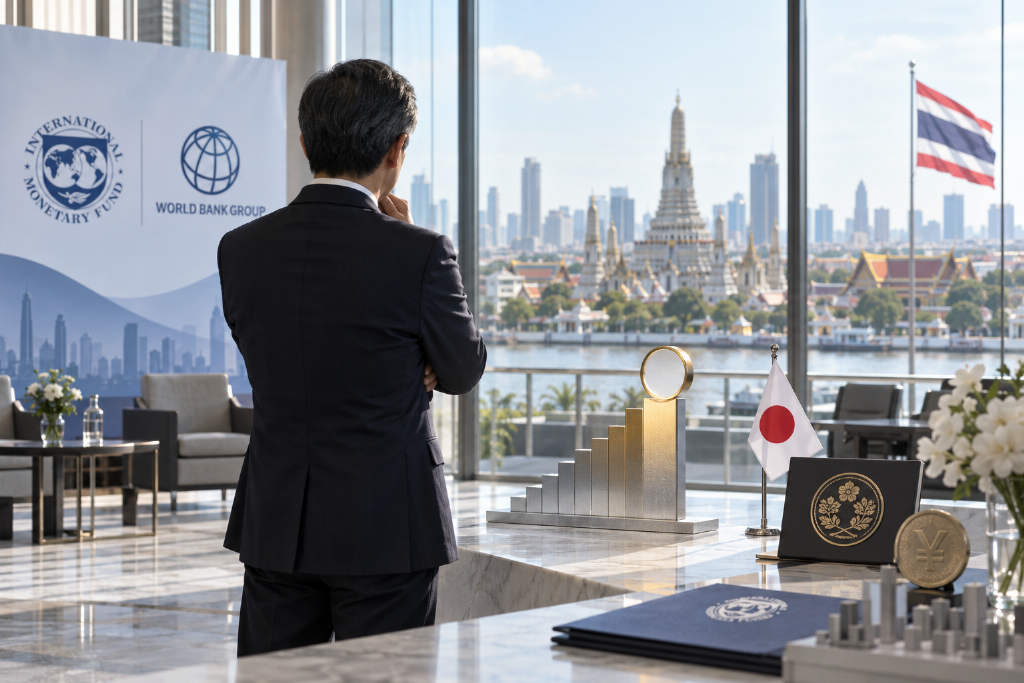
The International Monetary Fund said the Bank of Japan may need one more rate hike to move closer to a neutral policy stance, according to comments made by IMF Japan mission chief Rahul Anand in Bangkok.
Anand spoke on Oct. 16 at the IMF and World Bank annual meetings in Thailand’s capital. He said the BOJ is still moving toward neutral, but any policy adjustment after that should stay flexible because global uncertainty is rising.
IMF puts Japan’s neutral rate midpoint at 1.5%
The IMF continues to estimate Japan’s neutral interest rate in a range of 1.1% to 2.2%, with a midpoint of about 1.5%, Anand said. The BOJ’s current policy rate of 1.25% already falls within that estimated band.
Still, he added that the central bank would likely need at least one more increase to fully move beyond the neutral-rate threshold.
Inflation pressure seen staying in place
Anand said inflation pressure in Japan is expected to persist as energy prices remain elevated and companies pass rising costs on to consumers more frequently.
He expects Japan’s inflation rate to rise above 2% and then gradually return to the IMF’s 2% inflation target by the end of 2027. The report said that view is consistent with comments made in July by BOJ Governor Kazuo Ueda, who at the time said inflation had remained steadily above target and that the window for rate hikes had opened.
BOJ’s last two hikes came five months apart
The BOJ last raised rates in July 2025, lifting them from 0.75% to 1.0%. It then raised rates again by 25 basis points in December 2025 to 1.25%, the highest level in 30 years.
The gap between those two moves was about five months. Based on the IMF’s latest expectation, the report said the next hike could come around late 2026 or early 2027 if that outlook materializes.
Macro signals from the IMF-World Bank meetings
The IMF-World Bank annual meetings were held in Bangkok on Oct. 15 and Oct. 16. Alongside Japan, central bank and finance officials from several countries discussed the direction of global monetary policy during the event.
The report said South Korean Deputy Prime Minister and finance ministry official Lee Hyoung-il and central bank governor Shin Hyun-song held a “2+2” meeting during the conference with Federal Reserve Chair Warsh and U.S. Deputy Treasury Secretary Brook to strengthen cross-border coordination between fiscal and monetary authorities. The article said that points to denser communication among major economies on interest-rate policy.
Report notes earlier crypto market reaction
The article said Japan’s rate path is also worth watching for crypto markets. After the BOJ’s December 2025 rate hike, Bitcoin fell by more than 20% in three days. If the BOJ raises rates again in late 2026, the market may start pricing in expectations for yen carry trade unwinds ahead of time.