
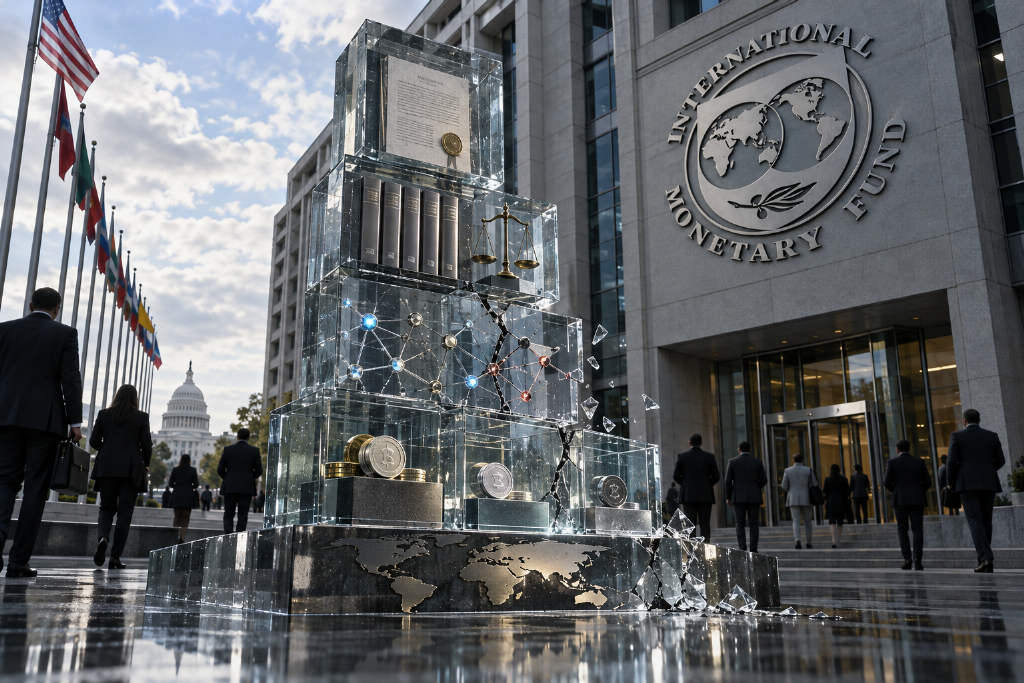
The International Monetary Fund said on Oct. 8 that tokenized markets are expanding quickly, but the sector is still small and trading remains fragmented across platforms. The post appeared on the IMF’s official blog and was signed by Athanasios Vamvakidis, deputy division chief in the Monetary and Capital Markets Department, and three co-authors.
The IMF wrote that tokenization promises faster trading and lower costs, but said the current picture is more complicated. It identified four factors holding back growth: legal certainty, regulatory clarity, interoperability, and settlement assets. The institution also warned that if the market grows much larger, risks tied to sell-offs, runs, and contagion could grow with it.
Public tokenized assets stood at about $65 billion as of July
The IMF defined tokenization as recording assets directly on programmable distributed ledgers. It said most tokenization activity is currently concentrated in repurchase agreements, or repos, which are short-term loans backed by government bonds and structured with an agreement to reverse the trade later.
According to the blog, tokenized repo volume runs at about $300 billion to $350 billion a day. Chapter 3 of the report cited a 30-day average daily trading volume of $303 billion and said activity is concentrated largely among affiliated entities. Even so, the IMF said that remains small next to traditional markets. Its blog said the U.S. repo market handles about $13 trillion in daily volume, while global capital markets hold about $300 trillion in assets.
Outside repos, the report estimated that public-market tokenized real-world assets totaled about $65 billion as of July. The figure reflects total asset value and excludes repos, stablecoins, and private markets, so it is not comparable with repo daily turnover.
Within that total, fixed-income products accounted for about $48 billion, including $30.4 billion in credit and about $17.5 billion in money market funds. The tokenized equity market was estimated at $2.3 billion. Ondo Finance and Backed Finance’s xStocks together represented more than 70% of tokenized equity value, with products targeted at investors outside the United States.
The IMF listed four constraints slowing market expansion
The fund said the four constraints reinforce one another and together weigh on broader adoption.
- Legal certainty: Investors need confidence that tokenized assets represent rights that are legally enforceable.
- Regulatory clarity: Authorities need to spell out how existing rules apply to new ledgers and new market functions.
- Interoperability: Platforms need to connect with one another rather than remain isolated pools of liquidity.
- Settlement assets: Settlement depends on a safe and widely accepted form of money.
Tokenized equities show demand, but liquidity remains thin
The IMF also ran an empirical analysis on the five most liquid tokenized U.S. equity products issued by Ondo Finance and xStocks. The underlying exposures were the S&P 500, Nasdaq 100, Tesla, Google, and NVIDIA. The sample covered 11 trading venues and 365 trading days.
Those five tokens had a reported market capitalization of about $345 million, equal to roughly 15% of the $2.3 billion tokenized equity market. The results showed that more than half of trading took place outside regular U.S. stock market hours. The report said round-the-clock trading is itself a source of demand.
Fractional trading was also common. About 80% of trades were smaller than one share, allowing participation with lower amounts of capital. The report said that points to a user base dominated by smaller retail investors.
The IMF found that price moves in tokenized equities during U.S. market closures were largely reflected in traditional stock prices within five minutes of the opening bell. For the five-name sample, estimated pass-through ranged from 87% to 99%. The fund said both markets appear to react to similar information, and that overnight on-chain signals may carry information value for traditional trading.
Still, liquidity in tokenized equities was weaker. The report said realized volatility was about 1.5 times that of the corresponding traditional stocks. It also said the same trading volume moves prices much more in tokenized venues, with decentralized exchanges showing the weakest liquidity. Part of the gap, the IMF added, comes from 24-hour trading, which pulls in low-activity overnight and weekend periods. It also stressed that the market is still at an early stage and the findings should be read with caution.
The IMF said larger scale could amplify familiar financial risks
The IMF wrote that some features of tokenization could open new channels for amplifying traditional financial risks such as sell-offs, liquidity runs, and contagion. Today’s trading process usually includes message transmission, execution, delayed settlement, and reconciliation. Those steps add cost, but they also provide buffers and space for liquidity management.
In a hypothetical fully tokenized environment, the blog said, many of those buffers would disappear. The report added that systemic risk remains limited at present. Its central question is what happens if tokenization is adopted more broadly, and whether market infrastructure, legal foundations, liquidity arrangements, and risk controls are strong enough to support a larger system.
Policy recommendations centered on technology-neutral regulation
On policy, the IMF argued for a technology-neutral approach, saying similar activities should face consistent regulation regardless of the technology used. The report recommended applying the principle of “same activity, same risk, same regulatory outcome” and setting up policy sandboxes to help draft rules.
It also recommended that tokenized securities settle in a safe and widely accepted form of money, and that tokenized trading venues include circuit breakers and liquidity protection mechanisms.
The IMF ended the blog by saying tokenization still “could transform finance,” but said its future will depend more on whether policy can ensure market depth, trust, and sound safeguards than on the technology’s possibilities alone.