
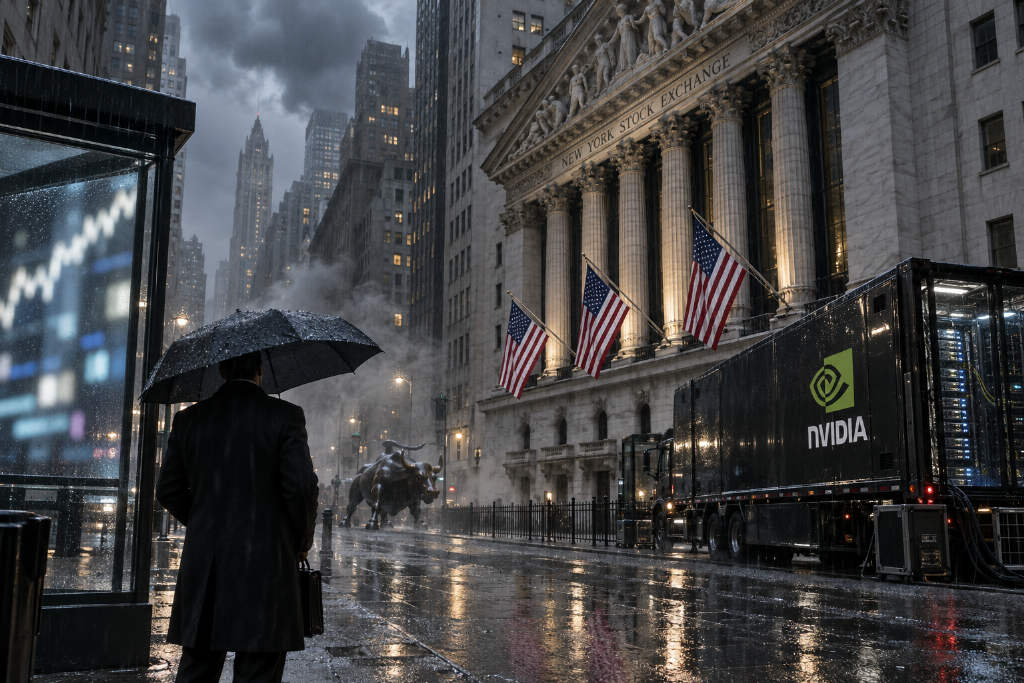
PANews said Wall Street is facing overlapping pressure from strong inflation data, worsening credit concerns around AI infrastructure, Treasury financing stress, and continued volatility in oil markets tied to Middle East tensions.
U.S. stocks staged a sharp reversal on Thursday and all three major indexes ended in the green. The Dow Jones Industrial Average rose 1.08%, the S&P 500 gained 0.33%, and the Nasdaq Composite added 0.08%. The intraday move was far more dramatic: the Nasdaq had fallen more than 1.4% at one point, while the Philadelphia Semiconductor Index was down more than 4% before recovering part of the loss.
A market near record highs, but with weak breadth underneath
The Kobeissi Letter said the U.S. market is now showing what it described as a hidden bear market coexisting with a bull market. As of Oct. 15, the S&P 500 was only about 2% below its all-time high, yet 84% of its components had fallen at least 10% from their own highs.
Within that group, 59% were down more than 20% and 17% had dropped by over 50%. Sector-level drawdowns were also steep: 97% of real estate names, 96% of materials stocks, 94% of utilities, and 92% of consumer discretionary stocks were at least 10% below their records.
Since the March 30 low, the S&P 500 has climbed about 23%, adding roughly $14 trillion in market value. PANews said that gain has been unusually concentrated. Just 10 stocks accounted for about 70% of the advance. NVIDIA contributed around 3 percentage points. Micron, Apple and Microsoft each contributed about 2 percentage points. AMD and Alphabet accounted for about 8% and 7% of the gain mix, while the other 490 stocks together made up only 30%.
The Kobeissi Letter said that kind of concentration is not automatically bearish. If the energy crisis eases and rate pressure softens, upside could spread beyond a small group of mega-cap technology names. But it also said the market remains near record levels while war involving Iran, elevated energy prices, and a renewed Federal Reserve hiking stance continue to hang over risk assets. The firm added that, without the Iran war effect, the S&P 500 might already have broken above 9,000.
Inflation ran hot in September, but Treasury yields fell
The latest U.S. inflation data came in hot across the board. September CPI rose 3.7% year over year, while PPI jumped 6.3%, the highest reading in nearly four years. Gasoline prices were up 34.2% from a year earlier, and real wages for households have now declined for six straight months, according to the report.
At the same time, U.S. manufacturing activity posted its strongest increase in nearly five years, and initial jobless claims came in at just 199,000 last week. PANews said that combination points to economic resilience, but it also deepens the policy problem for the Federal Reserve.
Several Fed officials warned that the buildout of AI data centers is driving up costs for electricity, electronic components and construction. Cleveland Fed President Beth Hammack said the central bank may be forced into more aggressive tightening if households and businesses begin to believe high inflation will last. New York Fed President John Williams said one more rate hike this year remains possible. Citibank has also revised its forecast and now expects a December hike, with no rate cuts in sight through the first half of 2027.
Normally, hotter CPI, PPI and retail sales data would push Treasury yields higher. Instead, the bond market rallied on Thursday. The 2-year yield briefly fell below 4.69%, its lowest since Sept. 18. The 10-year yield touched 5.04%, the lowest since Sept. 23. The 30-year yield dropped 9.6 basis points to 5.4275%.
PANews said the move did not reflect a real easing of inflation risk. It pointed to two main drivers: investors shifting from equities into bonds because of AI financing stress, and traders covering previously established short positions in Treasuries. TD Securities strategist Molly Brooks said demand for duration is improving and worries tied to AI-driven growth are beginning to outweigh inflation trades.
Treasury funding plans have become a market focus
The report said the U.S. Treasury is dealing with a difficult funding backdrop. Annual interest expense has now exceeded $1 trillion for the first time, putting it above the defense budget. With energy prices high, expectations for renewed Fed tightening back on the table, and a fiscal deficit near $2 trillion, long-term borrowing costs remain elevated and investors are questioning long-run fiscal sustainability.
Markets are watching the Treasury’s quarterly financing questionnaire sent to primary dealers on Oct. 16, followed by the quarterly refunding announcement due on Nov. 4. Citibank expects the Treasury could cut or even suspend 20-year Treasury issuance, citing weak institutional demand for long-dated paper. It also expects auction sizes for 20-year and 30-year bonds to be reduced by $3 billion each time.
Morgan Stanley head of fixed income Vishal Khanduja said the Treasury has already signaled concern about excessively high long-end yields, making the next financing announcement especially important. PANews added that the department faces a trade-off: shifting toward short-term bills would expose the government to more rate risk during a hiking cycle, while continued intervention in the long end through tools such as buybacks could be seen as a Treasury backstop, lowering borrowing costs in the short run but reducing predictability in issuance policy.
AI infrastructure enters a credit stress phase
Goldman Sachs’ trading desk monitoring showed institutional orders in U.S. equities were tilted heavily toward selling, with the technology sector posting a 70% sell ratio. The Philadelphia Semiconductor Index has now fallen for seven straight sessions, and chip stocks have lost more than $2 trillion in market value during that stretch.
PANews described the current stage as a Darwin moment for AI infrastructure. With inflation rising and borrowing costs higher, debt-funded data center projects are coming under cash flow pressure. Multiple bonds tied to data center projects involving Microsoft, Meta, NVIDIA, Oracle and Blackstone traded below par. Project Excalibur debt dropped below 87 cents on the dollar. Credit default swap spreads for Oracle, SoftBank and Amazon also climbed to record highs.
The Bank for International Settlements warned that the AI sector’s circular financing model, where chipmakers invest in cloud providers and cloud providers borrow to buy chips, is highly fragile. Gartner said that by 2030, AI infrastructure assets worth trillions of dollars could face impairment, and as many as 80% of new cloud providers may either go bankrupt or lose their independence. Against that backdrop, IPO plans linked to Blackstone-backed AirTrunk, NVIDIA-backed Firmus, and SoftBank-backed SB Energy have already been delayed or withdrawn.
The report also focused on Anthropic, which it described as pursuing what could become the largest IPO in history while planning to invest more than $500 billion in infrastructure over the next decade. Anthropic’s latest disclosure showed third-quarter revenue growth slowed sharply to about 45%, down from more than 140% in the second quarter. Revenue from model distillation, which accounts for 5% to 7% of total revenue, is also expected to decline this quarter. With OpenAI engaged in a price war and pressure building from Google, Meta and Chinese open-source models, the New York City Comptroller publicly urged Anthropic to pause its IPO. Some potential investors have reportedly lowered their valuation expectations from the $2 trillion level discussed privately by banks to below $1.5 trillion.
OpenAI, meanwhile, has delayed its own listing plans and is facing a joint lawsuit from eight U.S. states over allegations that it encouraged minors, according to the report.
Jensen Huang’s remarks helped CoreWeave reverse higher
As AI hardware and electrical equipment names came under heavy selling pressure, NVIDIA CEO Jensen Huang made supportive remarks about CoreWeave in Sweden. PANews said that, together with Wedbush analyst Dan Ives calling the AI selloff a buying opportunity, the comments helped technology shares stabilize.
CoreWeave ended the day up about 5.94% after falling roughly 9.5% early in the session. The report said sentiment improved after Huang said financing costs were coming down and that NVIDIA did not need to provide a backstop. Even so, CoreWeave’s five-year CDS spread hit 1,194.5 basis points intraday, implying a default probability above 60%, while its 2031 bond yield traded in a 15.6% to 16.2% range.
Other AI infrastructure names remained under pressure. Vicor fell 12%, Vertiv lost 6.1%, nVent dropped 5.8%, Dell declined 6.9%, Quantum fell 9%, Applied Materials and Seagate both lost more than 3%, and Coherent dropped more than 7%. The Philadelphia Semiconductor Index finished down 0.88%, extending its losing streak to seven sessions.
NVIDIA itself fell 1.84%. PANews said Huang’s comments did not fully calm concerns around the financing model behind AI compute expansion. NVIDIA is both a major GPU supplier to CoreWeave and one of its shareholders, meaning the risks can pass through customer financing, equipment purchases and project schedules. Huang also said that if clients develop unsafe AI software, the company will first communicate with them and may stop supplying products if necessary. He added that market concern about AI safety risks and an AI bubble is greater than the actual situation. NVIDIA also pledged $250 million over the next five years to support AI safety research in the U.K.
Big Tech and other headline stocks moved in different directions
Google rose 0.45% after the company disclosed progress on a magic-state cultivation technique using its Willow processor. According to the report, the method reduced the error rate of relevant quantum states by about 40 times and lifted logical fidelity to 99.99%. The result could lower the resource cost of fault-tolerant quantum computing, though larger-scale validation is still needed.
Meta fell 0.11% after releasing the Muse Spark Open open-weight model. The model has 816 billion total parameters and 42 billion active parameters, supports about 1 million tokens of context, and is aimed at coding, software engineering and AI agent tasks. Weights are available through several cloud platforms and Hugging Face, and the model is compatible with Apple’s MLX toolchain. Meta said this is not its strongest model; its top model, Muse Wonder, remains closed-source.
Among related megacaps, Apple fell 0.28%, Microsoft gained 1.08%, Alphabet added 0.45%, and Amazon rose 0.27%.
SpaceX fell 2.33%. Elon Musk said the Star Mind computer, jointly designed by SpaceX and NVIDIA, is expected to enter mass production in 2027. The project targets low-earth-orbit data centers and is expected to use NVIDIA’s Vera CPU and Rubin GPU combination. Each satellite would carry computing capacity equivalent to one NVL72 rack, with 36 Vera CPUs and 72 Rubin GPUs. NVIDIA said the Space-1 module offers AI computing power about 25 times greater than the previous-generation H100 GPU. The project is planned to use solar power, radiative cooling and Starlink laser inter-satellite links for data transmission.
TSMC fell 1.80% despite reporting third-quarter net profit growth of 68.7% year over year, ahead of analyst expectations, and revenue growth of 50.9%. The company lowered its gross margin guidance to 66.4%, slightly below the 66.5% expected, citing the early ramp of its 2-nanometer process.
Micron rose 1.87% after falling more than 6% intraday and then reversing on dip buying. Memory stocks were generally weak. SanDisk fell 0.61%, and Western Digital was down more than 4% at one point before paring the loss into the close.
Money rotated into healthcare, staples and other defensive trades
PANews said capital leaving AI-linked trades moved into large pharmaceutical names, consumer staples, gold miners and enterprise software. The State Street Health Care ETF (XLV) rose to a record $177.19 and is up 5.6% over the past five sessions.
The Chicago Board Options Exchange said it will extend trading hours next week for options tied to the Magnificent Seven, major chip stocks, Alibaba and TSMC, among other heavily traded names, in response to market volatility.
Coca-Cola hit a record high after KFC selected Coca-Cola as its beverage partner for U.S. stores, ending a relationship of about 40 years with PepsiCo. Coca-Cola products are expected to enter KFC’s 3,718 U.S. restaurants before spring 2027. Financial terms were not disclosed. Consumer stocks broadly advanced, with Nike rising more than 5% to lead the Dow. Walmart and others also moved higher.
Hims & Hers gained about 6% after the U.S. Department of Health and Human Services submitted a temporary policy to the White House for review that would allow compounding pharmacies to produce peptide drugs. The market read that as a potential business positive. Eli Lilly rose more than 3% and approached a record high, while AbbVie, Gilead and Amgen also advanced as healthcare emerged as a preferred defensive trade during the pullback in AI.
Tesla closed down 1.29% but rose more than 3% in after-hours trading. The company unveiled the next-generation Roadster, and during the demonstration the vehicle completed a jump and landing with the help of thrusters. Musk said flying cars had become real.
Oil remained volatile as supply disruptions and regional conflict persisted
In commodities, WTI crude rose about 3% to near $98, supported by supply disruptions in the Gulf of Mexico and a sharp drop in inventories. Brent crude edged lower and settled near $105.92. PANews said the International Energy Agency accelerated the release of the remaining roughly 100 million barrels from reserves, helping offset some of the pressure.
On geopolitics, Donald Trump said again that he would not use nuclear weapons on Iran and was not inclined to deploy ground troops. But friction in the Middle East is still spreading. The report said Houthi forces attacked the presidential palace in Aden, Yemen, killing five people and injuring 16. Airports in Saudi Arabia have also been attacked several times this month.