
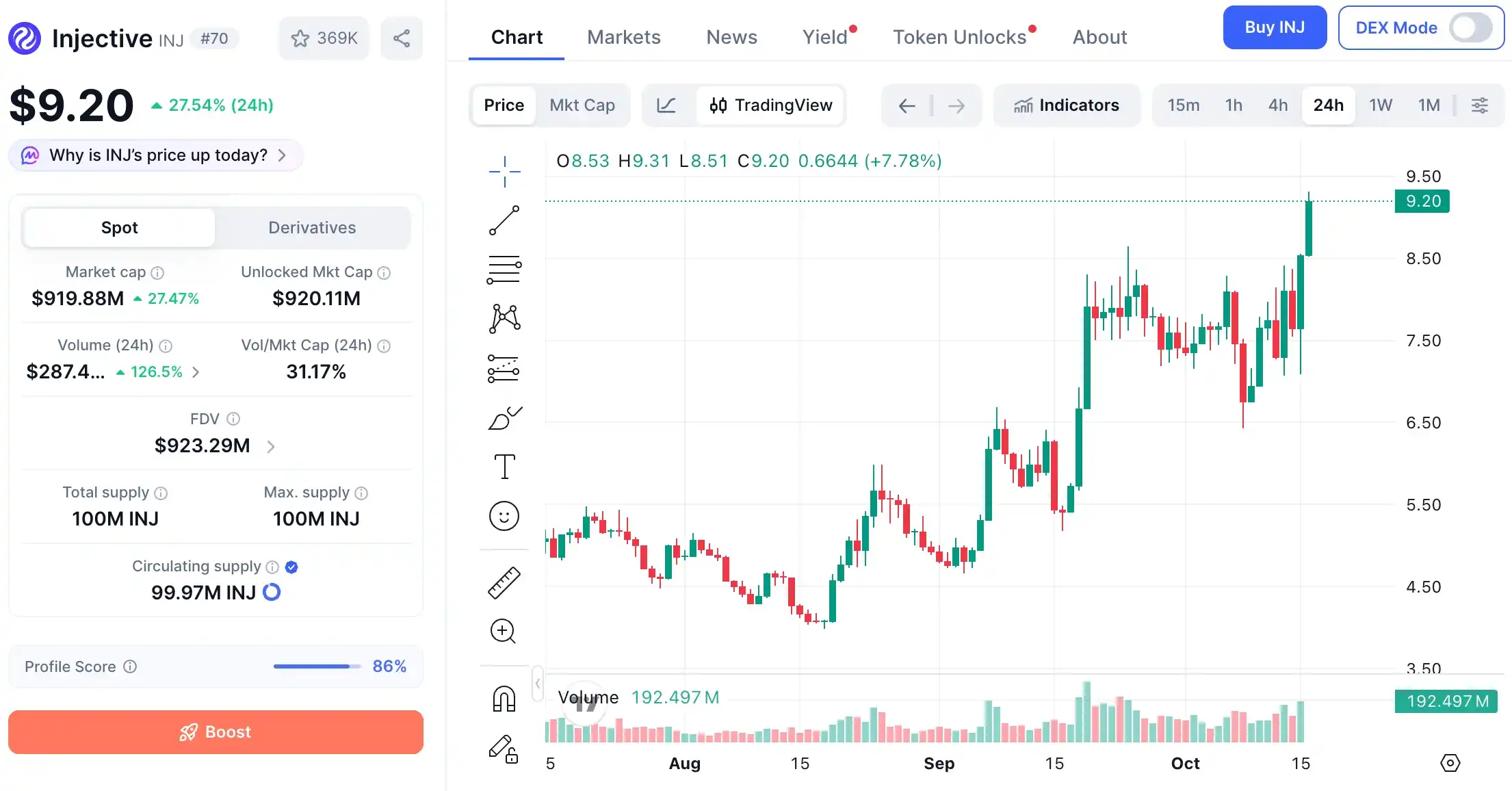
Injective’s token INJ surged more than 23% on Oct. 16, climbing to $9.16. Over the past month, the token has rebounded by nearly 70% from its lows, while perpetual futures open interest increased by $35 million within a few days.

The article frames the move as more than a simple price bounce. It ties the rally to a broader market story built around U.S. ETF filings and Injective’s shift toward institutional real-world asset, or RWA, positioning.
Washington meetings put Injective in the spotlight
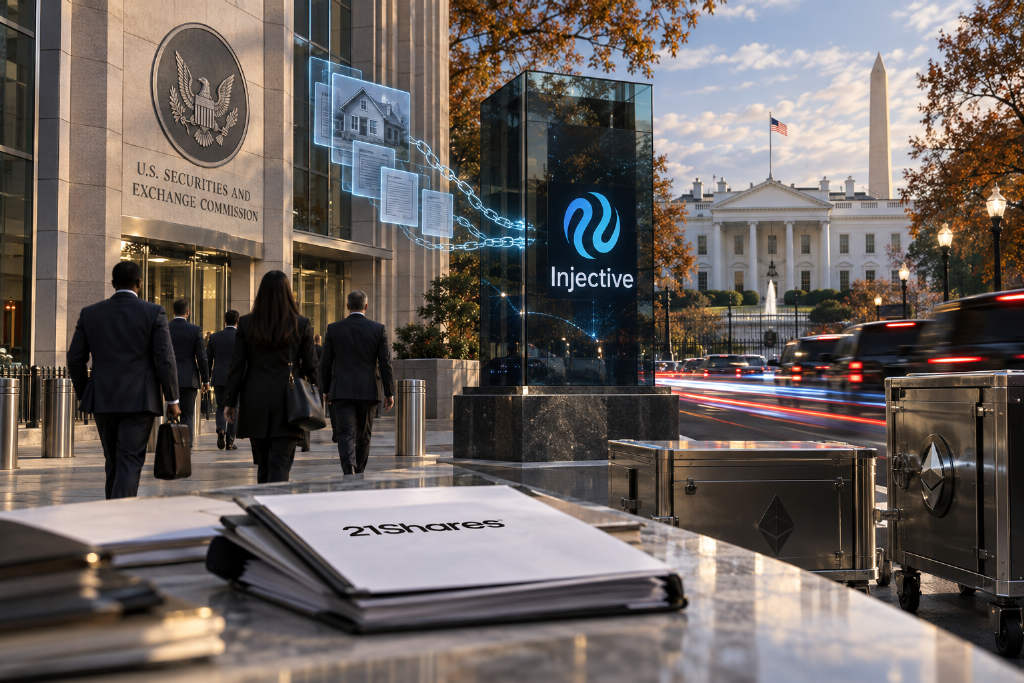
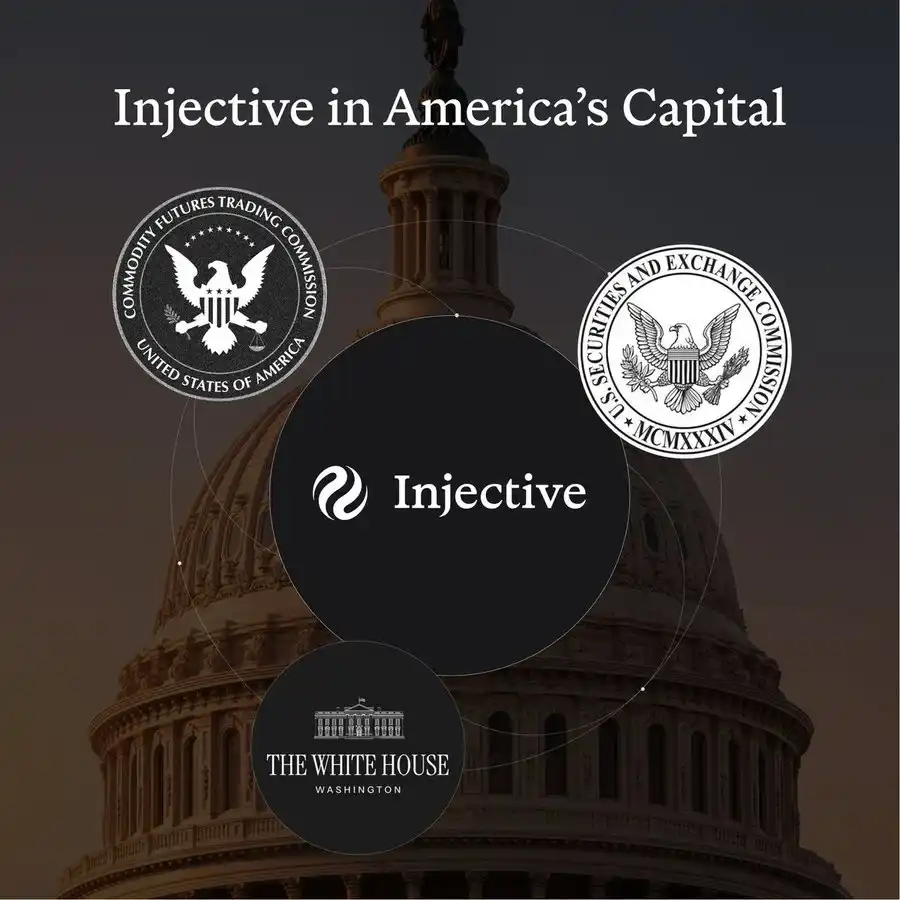
The immediate peak of the narrative came on Wednesday, Oct. 14, in Washington. According to the article, Injective co-founder and CEO Eric Chen, joined by the company’s general counsel and policy lead, visited officials at the White House, the U.S. Securities and Exchange Commission, or SEC, and the Commodity Futures Trading Commission, or CFTC.
That trip quickly drew attention in crypto circles. The piece says founders visiting Washington is not unusual, but what stood out this time was that Chen arrived with several compliance milestones already in hand.

SEC qualification, three ETF filings and a $10 billion mortgage plan
Looking back over the prior two months, the article says Injective had been working quietly to recast itself. In its telling, the team has been trying to move from a blockchain known for retail-driven perpetuals speculation toward an institution-focused chain built around U.S.-aligned compliance and tokenized assets.
- On Aug. 19, an institutional service entity under Injective obtained SEC-registered transfer agent status. The article says that qualification allows it, from a legal standpoint, to record ownership of tokenized securities on-chain and process dividend distributions.
- In September and early October, 21Shares, Canary Capital and REX-Osprey each filed for INJ spot and staking ETFs with the SEC.
- The article highlights Canary Capital’s proposal in particular, saying it would place 90% of the INJ held by the ETF into on-chain staking to generate yield.
Then on Oct. 15, one day after Chen’s White House trip, Canada-listed mortgage firm Pineapple Financial announced that it would rename itself Pentiv and said it plans to move up to $10 billion of its real estate mortgage portfolio onto the Injective blockchain.
Taken together, those steps gave traders a fresh framework for the project. The article argues that Injective is trying to replace its old identity as a chain associated with retail speculation in altcoin perpetuals with one centered on institutional RWA infrastructure.

IIP-709 would switch exchange actions to fixed gas fees
The piece says the on-chain side has been moving in parallel. This week, Injective has been voting on governance proposal IIP-709, which is expected to conclude the next day. The proposal would change exchange-module actions such as order placement and cancellation to fixed gas fees.
Retail users may not notice small swings in transaction costs. Traditional high-frequency market makers running tens of thousands of orders a day might. In the article’s reading, cutting friction at the execution layer could matter more to institutional participants than to ordinary traders.
The article treats the SEC transfer agent qualification, the three ETF applications, the mortgage portfolio migration plan, the fixed-gas proposal and Chen’s meetings in Washington as one coordinated sequence. In that sequence, the market story around INJ changes: the token is no longer being presented purely as a speculative altcoin, but as an asset wearing what the author describes as a Wall Street-style compliance suit.

Revenue-to-FDV looks strong, but absolute revenue remains modest
The article then turns to a chart shared by Injective on Oct. 15. The chart, described as covering the period from the start of 2026 to date, showed Injective with a protocol Revenue-to-FDV ratio of 0.95, the highest among major public chains. Solana was listed at 0.83 and Arbitrum at 0.78.
On the surface, that ratio can be read as a sign that the token’s valuation is low relative to the protocol’s income. The article notes that INJ also has a buyback mechanism, making the metric easy to package as a bullish signal.
But the author argues that the ratio says more about the denominator than the numerator. A project can top that ranking either because revenue is exceptionally high or because fully diluted valuation has fallen sharply. In Injective’s case, the article says the second explanation is doing the real work.
Citing Token Terminal and LunarCrush, the piece says Injective generated only about $6 million in real on-chain protocol revenue over the past year. It also says cumulative fees over the past three years totaled $5.9 million. On an absolute earnings basis among major Layer 1 chains, the project sits outside the top ten, according to the article. It compares that with Ethereum at $3.8 billion and Solana at $1.6 billion.
The article says Injective’s standout Revenue-to-FDV figure is largely a consequence of an 85% price decline over the prior two years, which pushed its FDV down to roughly $800 million to $900 million. In that context, comparing the payback profile of a sub-$1 billion token with networks valued in the hundreds of billions naturally makes the smaller asset look more efficient on paper.
Supply questions also surfaced
The piece points to another issue raised in the comment section under a CoinGecko post about INJ’s gains. There, a user shared a screenshot from the Cosmos block explorer Mintscan and asked why many market data sites list INJ’s maximum supply as 100 million and fully circulating, while Mintscan showed actual total supply at 123 million.
The article uses that question to highlight what it calls the less discussed side of token deflation stories. Injective may be promoting regular buybacks and burns, but as a proof-of-stake chain it also issues new tokens through a dynamic inflation model to maintain validator security and support staking yields.
If that is the case, the article says, then using roughly $6 million in annual protocol revenue for burns may not be enough to outpace the release of newly minted tokens.
Short-term trading focus shifts to positioning and flow
Putting the narrative and the data side by side, the article argues that INJ’s near-70% monthly jump is best understood as a rally in a deeply beaten-down, relatively small-cap token amplified by a compliance-driven story.

Even if real on-chain income remains thin, speculative capital and derivatives traders chasing the move may still keep pushing the token higher in the short run. With the IIP-709 fixed-gas vote set to conclude soon, the article says bullish positioning may continue to battle around levels above $9.
Its closing point is not that the compliance push is irrelevant. Rather, the warning is that investors should not treat the Revenue-to-FDV ratio alone as a reason to chase momentum. In the absence of additional valuation catalysts, the article says the more important short-term indicators are position structure, funding or fee changes, and large-holder deposit and withdrawal activity around INJ.
The piece adds that in a market where old tokens are being repriced under fresh narratives, INJ may be one example rather than the only one.