
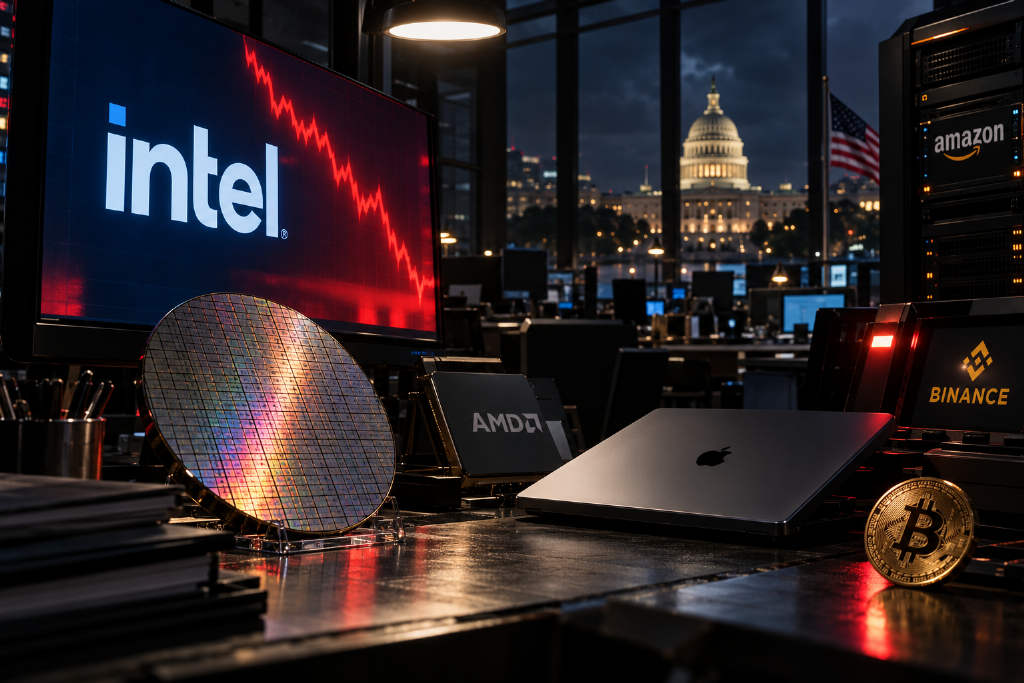
Intel’s weak fourth-quarter outlook set off a broad sell-off in technology shares on Friday, with the stock tumbling 29% in its worst one-day decline since 1974. The drop pulled the Philadelphia Semiconductor Index down more than 7% for the session. Amazon added to the pressure: Amazon Web Services posted 39.3% year-over-year revenue growth, but the company’s $77.3 billion in quarterly capital expenditures ran well above its $42.4 billion in operating cash flow, keeping free cash flow under strain. Crypto markets were shaken at the same time after Binance confirmed a major security breach with estimated losses of about $6.3 billion, sending Bitcoin briefly below $76,000.
Attention now shifts to this week’s key events, including Apple and Palantir earnings on Monday after the close, the U.S. midterm elections on Tuesday, AMD’s earnings later that day, and the U.S. October nonfarm payrolls report on Friday.
Nasdaq posts its biggest one-day drop since June
U.S. stocks closed sharply lower on Friday. The S&P 500 fell 1.82% to 7,580.07, the Nasdaq dropped 2.86% to 25,437.00, and the Dow Jones Industrial Average lost 1.09% to 51,770.31. For the Nasdaq, it was the largest single-day decline since June.
Volatility jumped as well. The VIX briefly climbed to 23.93 intraday before ending at 19.42, up 12.91% on the day. Of the 11 S&P sector ETFs, only energy, consumer staples, and utilities finished higher. Information technology fell nearly 5%, the weakest sector of the day, while healthcare and real estate rose 2.4% and 2.2%, showing a move into defensive areas.
Among the so-called Magnificent Seven, Tesla stood out with a 7.41% gain and was the only one to rise. Alphabet Class A shares fell 12.61%, extending a two-day slide that the article described as the biggest since Alphabet went public, after last week’s earnings. Meta fell 4.30%, Amazon lost 3.08%, Nvidia dropped 3.00%, Apple slipped 0.89%, and Microsoft edged down 0.50%.
Semiconductor shares were hit even harder. The Philadelphia Semiconductor Index sank more than 7.2% and ended October down more than 15.3%. Intel fell 29%, AMD lost 8.6%, Lumentum dropped 8.57%, and Arista Networks fell 8.34%.
For the week, the S&P 500 lost 0.58%, the Nasdaq fell 2%, and the Dow dropped 0.85%. All three major indexes declined for a third straight week, the longest losing streak since March. For October, the S&P 500 fell 0.94%, the Nasdaq lost 5.3%, and the Dow gained 1.7%.
Intel beats on Q3 results but misses badly on guidance
Intel reported third-quarter results after the close on Thursday. Revenue came in at $16.51 billion, up 21% from a year earlier, and earnings per share were $0.52. Both figures topped expectations. Data center revenue rose 78% year over year, which the company tied to expanding AI-related demand.
The problem was the fourth-quarter forecast. Intel said it expects Q4 revenue of $15 billion to $16 billion, well below market expectations of about $17 billion. The company also said PC shipments are expected to fall 25% to 30% quarter over quarter in the fourth quarter. Its longer-range view was also weak: Intel expects the PC market to shrink 12% in 2026 and another 10% in 2027.
After the earnings release, Intel fell more than 20% in after-hours trading. The losses deepened after Friday’s open, and the stock finished down about 29%. Bank of America analysts cut the stock to neutral from buy and lowered their price target to $100 from $145. Intel ended October down 45%, making it the worst-performing S&P 500 component for the month.
Amazon’s AWS growth stays strong, but spending remains the issue
Amazon also reported third-quarter results after Thursday’s close. Revenue reached $201.9 billion, up 12% year over year. Operating income rose 61% to $28.1 billion, and the operating margin hit a record 13.9%.
AWS was the standout. Revenue rose 39.3% from a year earlier to $46 billion, its fastest growth rate in nearly five years, bringing its annualized revenue run rate to $184 billion. AWS backlog reached $578 billion, more than double from a year earlier. Chief Executive Officer Andy Jassy said AWS revenue growth is expected to exceed 40% in both 2027 and 2028.
Investors focused on cash flow instead. Amazon spent $77.3 billion on capital expenditures in the third quarter, far above its $42.4 billion in operating cash flow. Free cash flow over the past 12 months was negative $42.4 billion. The company expects about $220 billion in capital expenditures for full-year 2026, and Jassy indicated that spending will increase “significantly” in 2027.
There were also misses against expectations. Earnings per share came in at $1.89, below the market estimate of $1.96, while revenue was also slightly below expectations. The stock fell as much as 6% after hours and closed Friday down about 3%.
Placed alongside earlier results from Google Cloud and Microsoft Azure, the quarter pointed to the same theme. Google Cloud revenue had doubled while free cash flow remained negative, and Azure posted 48% growth while capital expenditures doubled. The common message from the three cloud giants was that AI is generating revenue, but spending is rising even faster and eroding free cash flow.
Binance confirms security breach with estimated losses of $6.3 billion
On Thursday night, Binance confirmed a large-scale security breach with estimated losses of about $6.3 billion. The article described it as the largest hack by dollar value in the history of the crypto industry, surpassing the $1.5 billion Bybit incident in February 2025. The attackers were reportedly linked to North Korea.
Binance then suspended deposits and withdrawals and worked with multiple industry institutions to freeze transferred funds. About $3 billion had been frozen, according to the article. Companies involved in the freeze effort included Ripple and Circle.
The market reaction was immediate. Bitcoin fell to about $76,300, a six-week low, before recovering modestly to around $77,300. Ether dropped to about $2,237, and BNB fell 5.6% to around $679. More than $1.6 billion in positions were liquidated across the market over 24 hours, including $1.35 billion in long positions. The Crypto Fear and Greed Index fell from 51 to 30.
The article said the market quickly drew comparisons with the collapse of FTX in 2022. It also noted one key difference: Binance said it would fully cover user losses. Co-founder He Yi thanked partners that helped freeze assets. The situation is still developing.
Oil rises, gold falls, Treasury yields move lower
Commodities and bonds moved in a different direction from technology stocks. WTI crude for December delivery rose 2.08% to $104.12 a barrel, the highest close since Sept. 15. It gained more than 15% in October and marked a fourth straight monthly increase. Brent crude rose 2.4% to $117.64 a barrel, close to its late-March high.
The article said an attack on tankers in the Strait of Hormuz added to supply concerns and helped support oil prices even as technology shares sold off.
Gold moved the other way. December gold fell 3.29% to $3,898.90 an ounce, the lowest level in a year. The article tied the decline to firmer inflation data and expectations for further Federal Reserve rate hikes.
In the Treasury market, the 10-year yield fell 6 basis points to 4.929%, a seven-week low, while the 2-year yield dropped 8.7 basis points to 4.569%. For October, the 10-year yield declined by about 36 basis points, its biggest monthly drop since December 2023. The U.S. Dollar Index ended at 101.96 and was little changed for the week.
What markets are watching this week
Monday after the close: Apple and Palantir
Apple and Palantir are scheduled to report after the U.S. market closes on Monday. Apple is expected to post earnings per share of about $2.02 for its September quarter. The article said Apple’s results will directly shape confidence in the AI spending theme after last week’s sell-off in technology shares. Options markets imply a move of about 13.3% for Palantir.
Tuesday: U.S. midterm elections
Tuesday is Election Day for the U.S. midterms. All 435 seats in the House of Representatives and 35 Senate seats are up for election. The article said the result will determine control of Congress for the second half of President Donald Trump’s term and will have implications for fiscal policy, regulation, and market style preferences. Historical data cited in the article showed that since 1938, the S&P 500 has risen over the following 12 months 95% of the time after midterm elections.
Tuesday after the close: AMD earnings
AMD is due to report after the close on Tuesday. Market expectations are for revenue of about $13.1 billion, up 42% year over year, and earnings per share of about $1.94, up 62%. After Intel’s plunge, AMD’s data center and AI chip performance will be a key read for semiconductor sentiment.
Wednesday to Thursday: Qualcomm, Arm, and Arista Networks
Qualcomm, Arm, Arista Networks, and others are set to report from Wednesday through Thursday. The article said more data points from the AI infrastructure chain will help determine whether technology stocks remain under pressure or begin to stabilize.
Friday: U.S. October nonfarm payrolls
The U.S. October jobs report is due at 21:30 Beijing time on Friday. September nonfarm payrolls increased by only 29,000, and the three-month average fell to about 50,000. The article said any further cooling in the labor market would directly affect expectations for the Federal Reserve’s December rate decision.
All week: ISM manufacturing and services PMI
Markets will also watch ISM manufacturing PMI on Monday and non-manufacturing PMI on Wednesday. September manufacturing PMI was 54.5, while the prices paid index stood at 77.9, showing that supply-side inflation pressure remained in place.


