
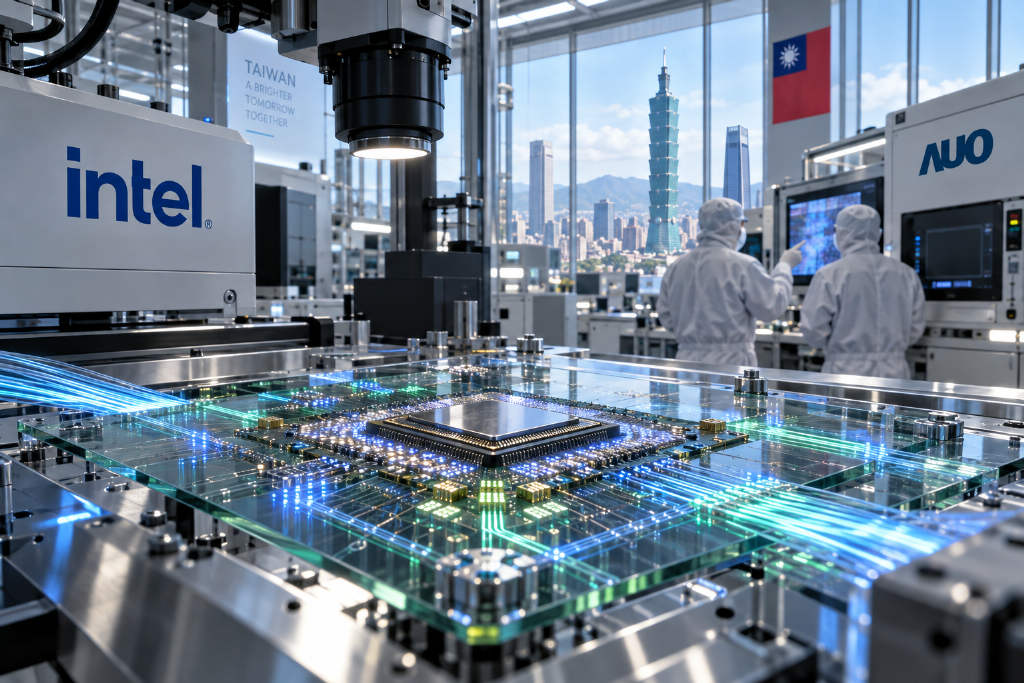
Intel has entered the advanced Micro LED substrate packaging field and is in talks with AUO on cooperation tied to co-packaged optics, or CPO, and high-density compute chip integration, according to an industry report from ABMedia. The report says the effort would deepen Intel’s position in heterogeneous integration packaging.
Intel expands beyond EMIB into glass substrate applications
Intel has been pushing its advanced packaging business in recent years. ABMedia said the company has continued to develop its EMIB family of technologies while also seeking packaging orders spilling over from Taiwan Semiconductor Manufacturing Co.’s (TSMC, 2330) CoWoS capacity constraints. At the same time, it has been advancing work around glass substrates.
The report says glass substrates are viewed as a key material for next-generation high-performance packaging because they offer four advantages over traditional organic substrates: high flatness, high heat resistance, a low coefficient of thermal expansion, and low signal loss.
Against that backdrop, Intel is now trying to move into advanced Micro LED substrate packaging. Sources cited in the report said Intel is actively seeking cooperation with AUO and that the two sides are discussing overlap in their technology roadmaps.
Patent outlines Micro LED and IC packaging integration
ABMedia said Intel recently announced that it had obtained a U.S. patent titled "IC Package with Micro LEDs," offering a clearer view of its technical direction in combining Micro LED technology with IC packaging.
The core concept described in the patent is a structure in which a semiconductor chip is at least partly embedded in a glass substrate. The substrate includes through-glass vias, or TGVs, and those TGVs provide electrical connections to the chip so that power can be delivered to the Micro LEDs.
According to the report, the architecture enables three functions inside the package:
- visualization of chip operating status
- customized lighting effects
- in-situ optoelectronic testing
ABMedia described the third item as the most technically valuable. It would allow real-time optoelectronic testing of the chip during packaging without requiring additional external components. On that basis, the report says Intel is trying to merge advanced packaging with Micro LED technology to build a full optoelectronic heterogeneous integration solution for CPO and dense compute packaging.
The report also notes that this route differs sharply from the single-sided backplane process used in current display glass substrate manufacturing. Traditional display production typically uses chip-on-glass, or COG, to attach driver ICs to the front edge of the glass and does not require TGVs. Intel’s patented approach, by contrast, makes TGVs central to electrical interconnects and carries a higher level of application complexity.
AUO seen as a strong fit for the project
ABMedia says AUO has become a preferred counterpart for Intel because of the technology matrix it has built over years of work in the field. Industry sources cited by the report said AUO has established a roadmap covering "Micro LED CPO + glass substrate + RDL (redistribution layer) + optical interconnect," a lineup that closely matches Intel’s direction in CPO and high-compute packaging.
AUO Chairman Paul Peng previously said on an earnings call that the company had established positions in advanced packaging and glass substrates and was co-developing projects with partners, though it could not disclose the names of those partners because of confidentiality agreements.
Peng also said AUO’s nearly 30 years of experience in glass processing had given it strong technical capabilities in RDL and TGV, along with research capacity in heterogeneous integration. He added that the company’s technology applications extend beyond IC packaging to higher-value areas such as glass antennas for low-Earth-orbit satellites.
He also said the number of products using Micro LED technology this year would exceed last year’s level, and that AUO was increasing investment in pilot production lines for emerging platforms including TGV, RDL, and CPO.
CPO remains a focus as AI compute demand rises
The report says CPO has drawn attention because of surging demand for AI computing power. As data traffic between GPUs and AI accelerators keeps rising, bandwidth limits and power consumption issues in conventional electrical interfaces have become harder to ignore.
In that setting, a CPO architecture that integrates optical transceiver modules directly into the chip package is seen as one of the key ways to address those constraints.
ABMedia says Intel’s combination of glass-substrate TGVs, Micro LED light sources, and IC packaging technology represents an important step on its path toward CPO commercialization. AUO, in turn, could be among the first to enter the core supply chain if the effort moves ahead.