


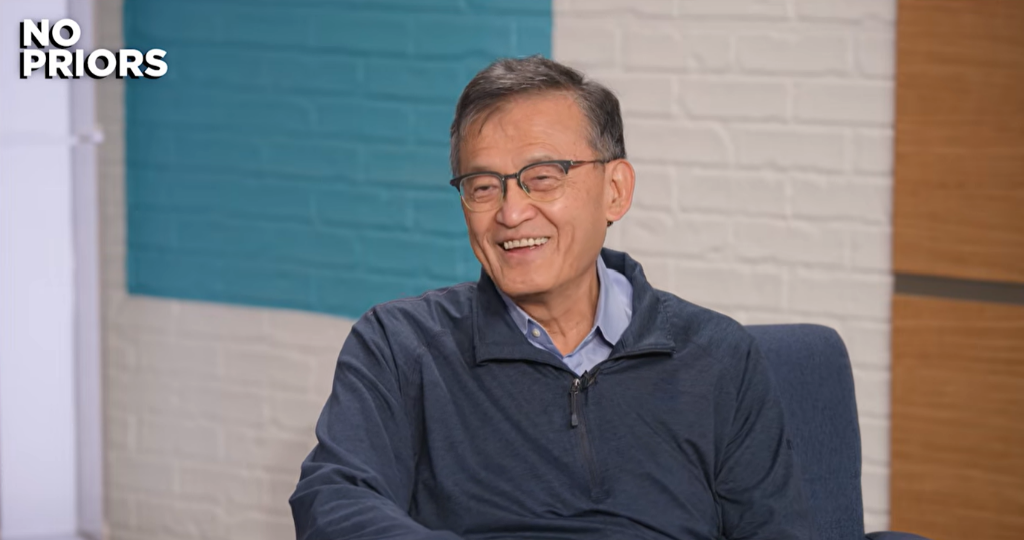
Intel CEO Lip-Bu Tan used his first No Priors podcast appearance to lay out a wide-ranging plan for reshaping Intel. His stated long-term target is a 10x return over five to ten years, and he said Intel has already delivered roughly a 6x return to shareholders over the past 14 months. Tan framed that performance as only the beginning, arguing that Intel’s future should not be defined only by its traditional PC client base, but also by data center servers, edge computing, physical AI, agentic AI, foundry services, advanced packaging, and new semiconductor materials.
Tan, 66, is known as a longtime investor at Walden and as the former CEO of Cadence. Asked why he accepted what the hosts described as one of the hardest jobs in the semiconductor industry, he gave two reasons: Intel is an iconic company that matters to the semiconductor ecosystem and to the United States, and after Cadence he wanted to take on one more major challenge. He also recalled a difficult episode in which President Donald Trump asked him to resign over alleged conflicts of interest. Tan said he later secured meetings, explained that he was born in Malaysia, grew up in Singapore, graduated from MIT, and had lived in the United States since then, and was given the opportunity to continue leading the company.
Balance sheet repair, product focus, and the crawl-walk-run framework
Tan repeatedly returned to his “crawl, walk, run” management framework. In his view, Intel is still in the crawl phase. That stage includes changing the culture, creating clearer accountability, speeding up decisions, reducing layers of meetings, listening to customers, and putting engineering teams in direct reporting lines to him. Tan said he is an engineer by training and wants to know firsthand where problems exist, what needs correction, and how the product roadmap should evolve over the next five to ten years.
The first part of the turnaround, according to Tan, was stabilizing Intel’s balance sheet. He described the company’s balance sheet at the time as “quite bad” and said he was pleased that the U.S. government became a major shareholder. He told President Trump that Japan and Singapore treat this kind of capability as infrastructure and that government support is appropriate at that level. Tan also thanked Nvidia CEO Jensen Huang, saying Huang invested $5 billion in Intel and that the investment had grown to $25 billion or more. SoftBank’s Masayoshi Son, whose board Tan previously served on, also helped. With the balance sheet strengthened, Tan said the next task is to focus products, simplify the product line, and bring forward stronger next-generation offerings.
One shift he highlighted is the rise of agentic AI and inference workloads. Tan said that during the training era, the CPU-to-GPU ratio was about one to eight, but he now sees it moving toward one to four and even lower. Some AI model developers told him that CPUs can perform better in reinforcement learning and in orchestrating the speed of multiple agents. As a result, he said CPU demand is strong again, particularly within data center server products. He also said customers are asking for more than silicon, including full racks, which pushes Intel toward system-level solutions that combine chips, software, and broader infrastructure.
Foundry execution depends on yield, defects, cycle time, and trust
Intel’s foundry business remains one of the hardest parts of the transformation. Tan acknowledged that there were many voices arguing that the business was too expensive or not feasible, and that Intel should consider leaving it. He decided to continue because he sees domestic advanced manufacturing in the United States as strategically important for supply-chain security and for the industry. In his view, large semiconductor companies cannot depend entirely on suppliers concentrated in one or two geographies; they need resilient supply chains.
Tan said the practical priorities for the foundry business are yield, defect density, and cycle time. He described foundry as both a service business and a trust business: before customers hand over wafers, they must trust the manufacturer. If yield is not good enough, customers lose revenue and can leave permanently. Intel has already put 18A into production and is moving 14A toward production, while also planning for 1 nanometer and 0.7 nanometer processes. Tan also referred to paths he can see toward 10 nanometer and 7 nanometer, while emphasizing that each step becomes more expensive and more difficult as dimensions shrink.
Tan did not present TSMC purely as a rival. He said Intel respects TSMC and views it as a strong partner, and that the industry needs more capacity to serve customers. At the same time, he said Intel still has a large gap to close in foundry, which requires humility and disciplined work on IP, yield, defect density, and cycle time. His expectation is that between 2030 and 2032, the market will begin to recognize the scale of Intel’s true potential.
Terafab with Elon Musk and the AI infrastructure bottleneck
Tan also discussed the Terafab project with Elon Musk. He said both sides share the same judgment: semiconductor infrastructure has not kept pace with AI growth, whether in capacity, production efficiency, or power efficiency. Musk’s robots and cars require large numbers of chips, so he chose to build his own fab, while Intel is providing technology and process support to help accelerate production. Tan said he meets with Musk’s team every week and described the collaboration as energizing.
He portrayed Musk as someone who challenges conventions at every step and asks why things must be done in the traditional way. Tan said he enjoys hearing different views and then working toward the best path. He also mentioned that Musk had raised unconventional operational ideas, including whether smoking could be allowed in some areas of a cleanroom. Tan said he would not go that far, but that some areas might allow more flexibility, and that the important point is to keep an open mind while listening and evaluating carefully.
On the global semiconductor supply chain, Tan said AI’s impact will be greater and deeper than the impact of the internet. AI can make companies more efficient across forecasting, design, and many other workloads, but its growth faces several bottlenecks. He listed electricity constraints, the impact of helium on the semiconductor industry, memory shortages, and shortages of CPUs and GPUs. Even when capacity expansion begins, new supply can take years to come online, while higher prices and costs eventually flow through to clients.
Advanced packaging, glass substrates, and synthetic diamond wafers
As traditional node scaling moves closer to physical limits, Tan is turning to materials science and advanced packaging. He noted that TSMC has CoWoS, while Intel is pushing EMIB as its next-generation advanced packaging approach. The key, he said, is ensuring that EMIB can reach the yield customers require at production scale. Intel has also announced advanced packaging manufacturing cooperation projects in India and in New Mexico in the United States.
Tan said he has invested in gallium nitride, silicon carbide, and indium phosphide, and that some of those investments have already been acquired by large semiconductor companies such as ADI. In packaging materials, he is focused on glass and has invested in 3DGS, a glass substrate company. He described glass as a strong thermal-insulating material. Intel holds about 1,000 patents in modules, and Tan said one important engineering question is how to integrate substrates and modules effectively. He has also invested in a synthetic diamond wafer company, viewing diamond as another strong insulating material for chip packaging.
Tan explained that the essence of Moore’s Law is doubling transistor density, but power consumption and cost do not fall in the same proportion. Performance can improve, but area and cost do not necessarily improve at the same pace unless new materials or new design methods are introduced. That is why he is increasing recruitment of materials science talent. He summarized the engineering mindset with the line: “You constantly encounter bottlenecks, and then you find ways to cross them or go around them.”
From Cadence and EDA to physical AI and Intel’s long-term role
Tan’s investing background is central to how he describes Intel’s future. He said he has a record of 159 IPOs and 126 M&A exits, with more than 200 semiconductor investments, 38% of them in the United States. His framework begins with the question of where the bottleneck is and what problem a company is solving. He invested in Cradle Semiconductor because interconnect became a bottleneck, and in Celestial AI because optical interconnect is increasingly important inside clusters. He also noted that Jensen Huang has invested in nearly every photonics-related company, saying that is not a coincidence.
In EDA and chip design, Tan sees AI and machine learning as tools to reduce complexity and improve design quality. He spent nearly 15 years at Cadence and said one of the achievements he is most proud of is finding and training his successor, who is now embracing AI and bringing agentic AI into tools to improve efficiency. He said Synopsys’s Sassine is doing similar work, supported by Nvidia’s $2 billion investment, and that Synopsys’s acquisition of Ansys expands it toward full-system design.
Inside Intel, Tan said he is trying to move the company away from being an old-school, spreadsheet-heavy organization toward becoming an AI-enabled enterprise. He has recruited top semiconductor talent, is thinking about the kind of software talent needed to build full-stack capabilities, and wants to add younger people to a workforce whose average age he described as being in the 40s to 50s. He also said his son has become his teacher on AI and machine learning, and that he tries to convert those lessons into investment judgment and hiring decisions.
When asked what investors misunderstand most about Intel, Tan returned to the crawl-walk-run idea. He said the company is still building foundations, but people are beginning to see its potential. PC client remains the base, but performance must improve substantially. Intel is quietly building CPU architecture, GPU architecture, and software architecture teams, aiming to move with the speed of a large startup. On foundry, he said the company must remain humble because the gap with TSMC is still large, and must focus on IP, yield, defect density, and cycle time.
Tan said Intel’s opportunity extends from PCs to the edge, physical AI, and agentic AI. In the past, servers and PCs primarily served humans; now, millions of agents will need access to compute and software stacks. He also discussed where compute will reside, saying the current large-scale AI infrastructure buildout is justified and that any slowdown he sees is caused by supply-side constraints rather than demand. The key question, in his view, is which applications will run on that infrastructure. He compared the coming AI application cycle with the internet era, when Amazon and Netflix emerged while others disappeared or were acquired. Robots and defense are examples of workloads where edge or client-side compute can be critical. For Intel, Tan said the strategic direction is to integrate XPU, advanced packaging, and foundry capabilities to create custom chips for different workloads.