
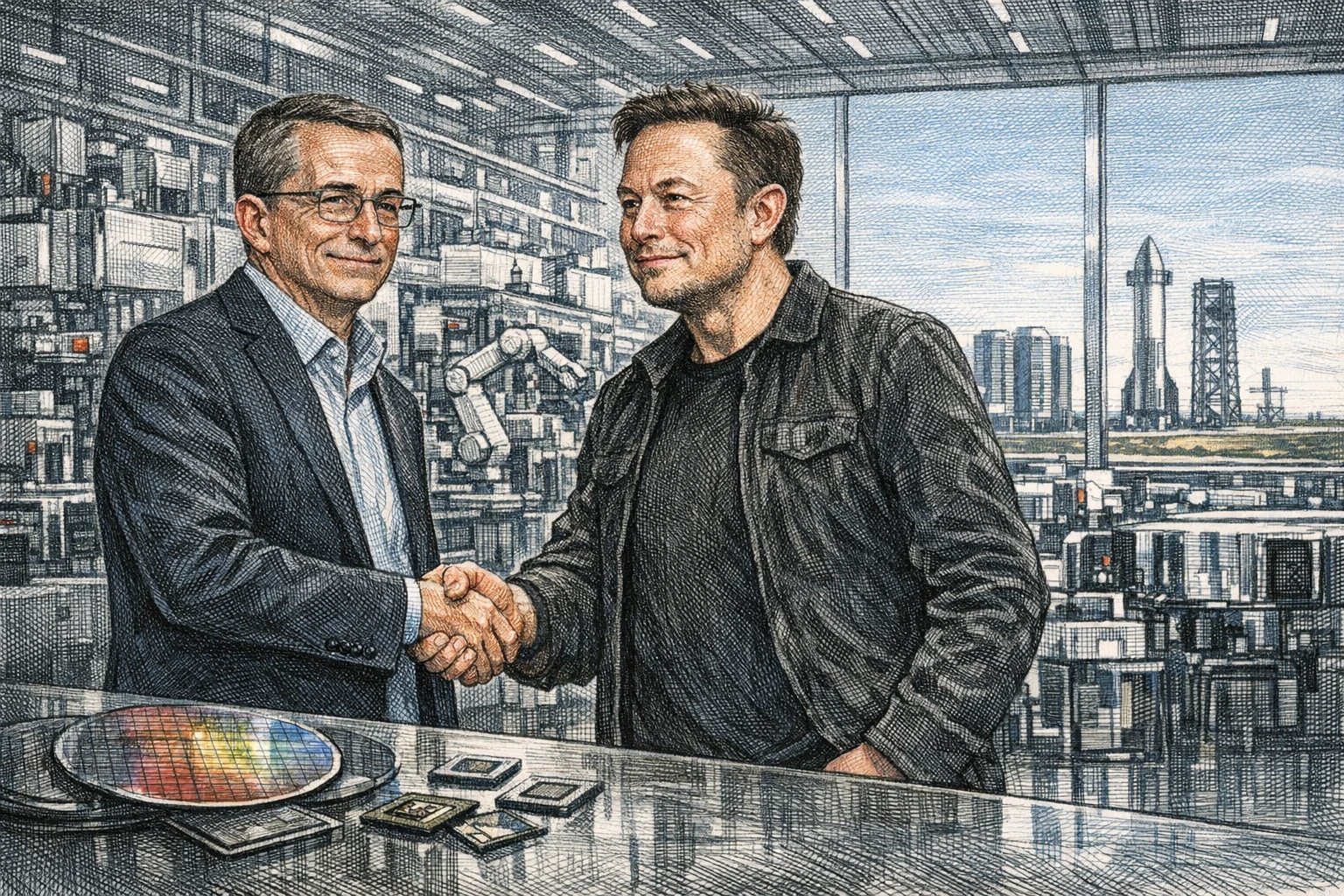
Intel said on the 7th that it is joining Elon Musk’s Terafab AI chip campus project, working alongside SpaceX, xAI, and Tesla to produce processors for Musk’s robotics and data center push. The plan centers on a tightly integrated manufacturing base that combines logic, memory, advanced packaging, lithography, fabrication, and testing in one campus, with a stated target of up to 1 terawatt of compute output per year.
Two Austin fabs are planned for separate chip lines
According to the source material, Musk announced in March that SpaceX, which has merged with xAI, and Tesla would invest $25 billion in Austin, Texas, to build two high-end chip factories. One facility is intended for mass-production chips used in vehicles and humanoid robots. The other is focused on R&D and manufacturing for space-oriented AI data centers. Musk described Terafab as the most epic chip manufacturing effort in history, built around consolidating major production steps inside one industrial zone.
Intel later confirmed the partnership on X and said its technical capabilities would help speed up the project’s goals. CEO Lip-Bu Tan also backed the move publicly, saying Musk has a strong track record of redefining industries and calling Terafab a step-change in how silicon logic, memory, and packaging technologies are manufactured.
Intel Foundry needs a customer of this size
The deal matters because Intel’s foundry business has been under heavy strain. The source says Intel Foundry recorded $10.3 billion in cumulative losses in 2025, while its contract manufacturing turnaround has struggled to gain momentum. Intel has also faced sustained pressure from TSMC, and SoftBank reportedly shifted toward TSMC after an AI chip partnership plan with Intel ran into problems.
At the same time, Intel received multi-billion-dollar investment from Nvidia and the U.S. government during its restructuring period, and the U.S. government has become Intel’s largest shareholder, according to the report. It also says the Trump administration’s “Made in America” strategy has given Intel a larger role in domestic semiconductor policy. By entering Terafab, Intel Foundry gains a customer large enough to match the scale of its manufacturing ambitions.
Execution remains the hard part
Musk’s AI hardware footprint spans xAI’s Colossus cluster and edge inference chips for Tesla’s Optimus robot, both of which require large volumes of customized silicon. If Terafab is delivered on schedule, Intel could carve out a position centered on U.S.-based manufacturing, vertical integration, and the Musk corporate network.
The constraints are also clear. The report notes that Intel’s process technology has trailed TSMC by one to two generations for an extended period. Whether it can meet Terafab’s demands on yield and specifications has yet to be shown. For Intel, the strategic value of the partnership is already visible. The harder test comes when production has to meet the promised standard.