
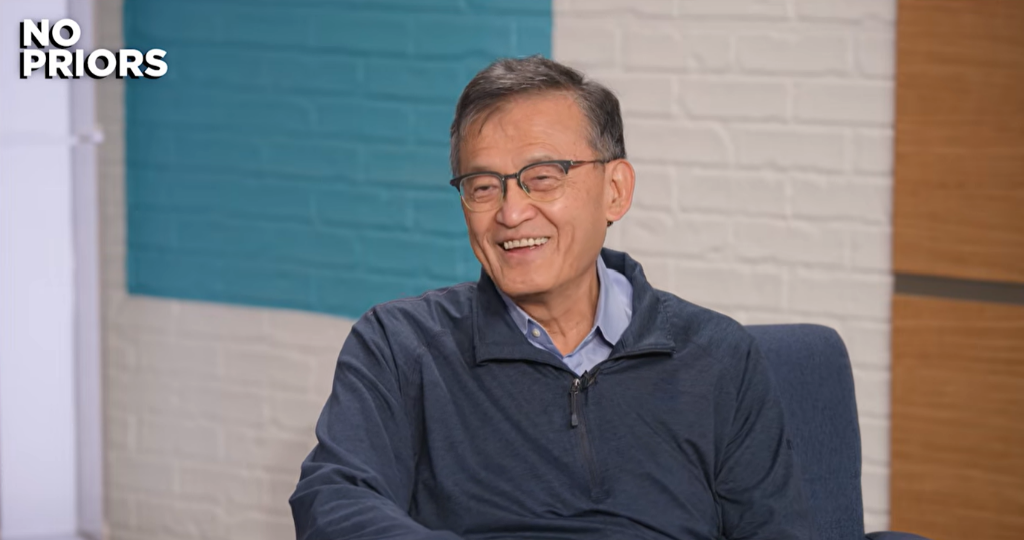
TechFlowPost, citing Wall Street News, reported that Intel CEO Lip-Bu Tan used his first appearance on the No Priors podcast to give a detailed account of how he intends to reshape Intel. Tan said his target for Intel is a “10x” return over “five to ten years.” He also said shareholders have already seen roughly a sixfold return over the past 14 months, but described that as only the beginning. In his view, Intel’s broader value will become clearer around 2030 to 2032, not only through its traditional PC client base, but also through edge computing, physical AI and agentic AI.
The podcast hosts introduced Tan as a legendary investor from Walden, the former CEO of Cadence, and the current CEO of Intel. Asked why he accepted what the host described as one of the most difficult jobs in the U.S. semiconductor industry, Tan said he is 66 and that many people had expected him to retire. He gave two reasons for taking the role: Intel is an iconic company that is important to the semiconductor ecosystem and to the United States, and after Cadence he wanted to do one more major thing. He also described an unexpected episode in which President Trump asked him to resign early one morning, citing conflicts of interest with no exception. Tan said he set aside personal emotion, explained that he was born in Malaysia, grew up in Singapore, graduated from MIT and had lived in the United States ever since, and ultimately received an opportunity to continue.
Repairing the balance sheet and rebuilding product focus
Tan framed Intel’s transformation with his “crawl-walk-run” model. In the crawl phase, he said he is focused on humility, listening to customers and fixing basic execution. Since taking the job, he has tried to change Intel’s culture, clarify accountability and accelerate decision-making. He said he is accustomed to startup speed, while Intel had layers of meetings and bureaucracy that needed to be simplified. From his first day, he decided that all engineering teams would report directly to him because he wanted to know where problems existed and what needed to be corrected.
On the financial side, Tan said the balance sheet was in poor condition when he arrived. He welcomed the U.S. government becoming a major shareholder and said he explained to President Trump that countries such as Japan and Singapore treat this kind of capability as infrastructure that deserves government support. He also thanked Nvidia CEO Jensen Huang for investing $5 billion in Intel, adding that the investment had risen to $25 billion or more. SoftBank’s Masayoshi Son, whom Tan knew from his time on SoftBank’s board, also offered support. These moves, in Tan’s account, helped stabilize Intel’s balance sheet before he moved to product simplification and customer-driven execution.
Tan said agentic AI and inference are now driving strong CPU demand. During training, the CPU-to-GPU ratio had been roughly one to eight, but he now sees that shifting toward one to four or even lower. He said some AI model developers told him CPUs perform better in reinforcement learning and in coordinating the speed of multiple agents. After building a stronger data-center server product line, he described Intel Foundry as the next major business. Foundry is capital-intensive and difficult, he said, and requires the right IP portfolio, especially low-power IP for mobile customers. It is also a service business and a trust business: if yield is not good enough, customers lose revenue and can leave.
Advanced packaging, new materials and the limits of scaling
Tan said conventional process scaling is approaching physical limits. Intel has 18A today, is moving 14A into volume production, and can see a path toward 10 nanometers and 7 nanometers, but he warned that the path will become increasingly expensive and difficult. He also referred to 18A as a 1.4-nanometer-class process and said Intel is planning for 1 nanometer and 0.7 nanometer. As features become thinner than a strand of hair, any mistake in manufacturing can ruin the result, making precision a central bottleneck.
Advanced packaging is another focus. Tan compared TSMC’s CoWoS with Intel’s next-generation EMIB approach and said he must make sure EMIB can meet customers’ yield requirements at volume production. When traditional scaling encounters bottlenecks, he said he goes back to materials. He has invested in gallium nitride, silicon carbide and indium phosphide companies, and some of those investments have been acquired by large semiconductor companies such as ADI. In packaging materials, he has turned to glass, investing in a company called 3DGS because glass can serve as a strong thermal insulating material. Intel has about 1,000 patents in modules, and integrating substrates with modules is one of the core engineering questions he highlighted.
Intel has also announced advanced packaging manufacturing cooperation projects in India and New Mexico in the United States. Tan said he is looking at synthetic diamond as another excellent insulating material and has invested in a diamond wafer company. “That is the spirit of engineers,” he said: engineers continually encounter bottlenecks and then find a way to cross them or go around them. He connected this materials roadmap with his own experience across the semiconductor lifecycle, from EDA tools to design and manufacturing.
Foundry execution and the Terafab project with Elon Musk
Intel’s foundry business has been questioned externally, but Tan said he chose to keep investing in it. He described the logic as strategic: U.S.-based advanced manufacturing is important for supply-chain security, and no large semiconductor company should rely entirely on one or two geographically concentrated suppliers. The key operating metrics, he said, are yield, defect density and cycle time. Before a customer hands over wafers, the customer must first trust the foundry. If yield misses the target and the customer loses revenue, winning that customer back is difficult. Tan also said Intel and TSMC are good partners, not just competitors, and that the industry needs more capacity to serve growing demand.
Tan also discussed Terafab, the collaboration with Elon Musk. He said both sides agree that semiconductor infrastructure has not kept pace with AI growth in capacity, production efficiency or power efficiency. Under the collaboration, Musk decided to build his own fab, while Intel will provide technology and process support to help accelerate production. Tan said he meets with Musk’s team every week and described the collaboration as exciting. He also said Musk challenges conventions at the operating level, including discussions about whether smoking could be allowed in certain cleanroom areas. Tan said he would not go that far, but the point is to keep an open mind while listening and evaluating carefully.
AI supply chains, investment discipline and the next Intel
From a global supply-chain perspective, Tan said AI will affect the landscape even more deeply than the internet. He listed several bottlenecks: power limits in some countries, the impact of helium on the semiconductor industry, and memory shortages. Even if capacity is expanded now, new capacity takes years to come online. CPUs and GPUs are also in short supply, and higher prices will eventually be passed to clients. The companies most affected, he said, will be those that do not embrace AI. Inside Intel, he wants to turn what he described as an old-school, spreadsheet-dependent organization into an AI-enabled company, not only in design but across the whole enterprise.
Tan also reviewed his investing record: 159 IPOs, 126 M&A exits and more than 200 semiconductor investments, 38% of them in the United States. His framework begins with a simple question: where is the bottleneck, and what problem is being solved? He invested in Cradle Semiconductor because interconnect had become a bottleneck, and in Celestial AI because optical interconnect is becoming increasingly important inside clusters. He sees opportunities in EDA where AI and machine learning can reduce complexity and improve design quality. Power management is another bottleneck he highlighted, especially the loss involved in converting from 40V to 1V.
He contrasted today’s semiconductor enthusiasm with the situation 18 years ago, when many top-tier VCs had little interest in the sector. Fifteen to twenty years ago, he said, few investors wanted to invest in semiconductors with him aside from major institutions such as Samsung, ARM and SoftBank. Now, Nvidia under Jensen Huang has a market value of $5.3 trillion, Broadcom and TSMC are each around $2 trillion, AMD under Lisa Su is near $800 billion, and Intel is close to $600 billion. He said he is pleased that semiconductors have again become recognized as indispensable infrastructure.
Tan spent nearly 15 years at Cadence and said one of his proudest achievements was finding and developing his successor. He said Cadence is now actively embracing AI agents inside tools, while Synopsys CEO Sassine is doing similar work, backed by Nvidia’s $2 billion investment and the Ansys acquisition to expand toward full-system design. He believes large companies are moving, but startups still have room to do more disruptive work, whether through IPOs or acquisitions by the two large EDA players.
On capital, Tan said capital-intensive infrastructure projects require access to government funds, sovereign wealth funds and large infrastructure funds. Some VCs are now willing to invest $1 billion into a single company, a scale he said was once unimaginable, but Series A valuations above $1 billion make early investing harder. As a public-company CEO, he said he wants shareholders with a long-term growth orientation, not only investors asking every quarter when buybacks will resume.
Asked about the biggest misunderstanding investors have about Intel, Tan returned to the crawl-walk-run model. He said Intel is still in the crawl phase, even though people are beginning to see its potential. The PC client business remains the base, but performance must improve sharply. Quietly, he said, Intel is building CPU architecture, GPU architecture and software architecture teams to move at the speed of a large startup. In foundry, Intel still has a large gap with TSMC and must stay humble while improving IP, yield, defect density and cycle time. He said these changes take time, but by 2030 to 2032 the market should begin to see Intel’s true potential.
Tan compared that ambition with his Cadence record. From his time as interim CEO to retirement, Cadence’s share price rose from $2.40 and delivered about a 76x return for shareholders; by the end of his term as executive chairman, the return was around 85x. Intel is larger and harder to transform, he acknowledged, but he said the target remains a 10x return over five to ten years. For Intel, the long-term plan is to combine XPU, advanced packaging and foundry capabilities to deliver custom chips for different workloads. He also discussed where compute will live: large AI infrastructure is still being built because workloads keep growing, but robotics, defense and other use cases can require edge or client compute. He compared the search for AI applications with the internet era, when Amazon and Netflix emerged as real scaled applications while others disappeared or were acquired.