
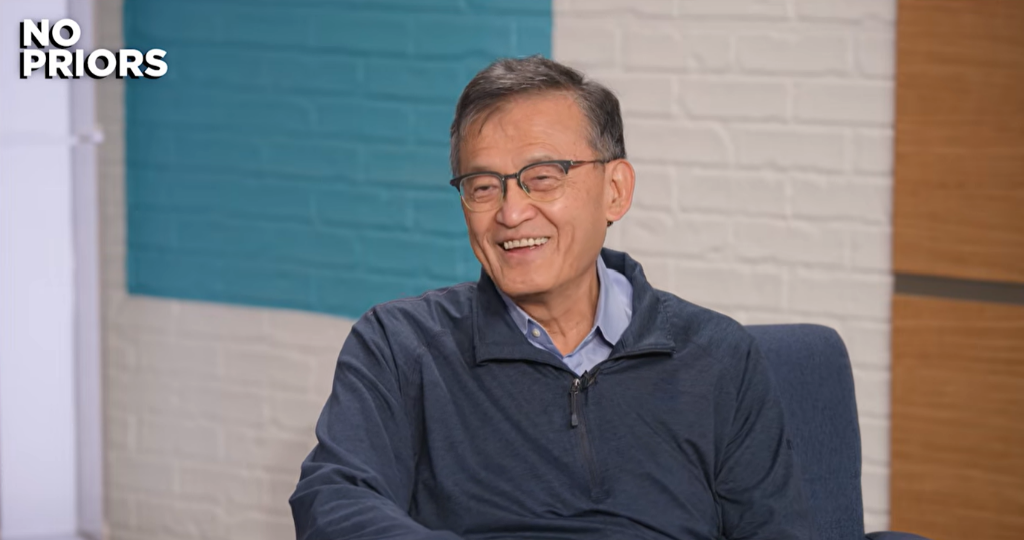
Intel CEO Lip-Bu Tan said in an interview on the No Priors podcast that his return target for Intel is to achieve “10x” over a five-to-10-year period. He said Intel has already created roughly 6x returns for shareholders over the past 14 months, but added that “this is just the beginning.” Tan framed Intel’s longer-term direction around combining XPU, advanced packaging and foundry capabilities to offer customized chip solutions for different workloads, extending beyond the company’s traditional PC client base into data centers, edge computing, physical AI and agentic AI.
Tan explained that he accepted the Intel role because the company is an iconic institution that matters deeply to the semiconductor ecosystem and to the United States, and because after Cadence he decided to “do one more big thing.” He also recounted an early-morning episode in which President Trump asked him to resign over alleged conflicts of interest. Tan said he first set aside his own emotions, told himself he did not need the job and was doing it to save Intel, and then secured a meeting. He told Trump that he was born in Malaysia, raised in Singapore, graduated from MIT and had lived in the United States ever since. Tan said Trump listened and gave him the chance to continue.
Balance sheet repair, product focus and the crawl-walk-run framework
Tan described Intel’s transformation through his familiar “crawl, walk, run” framework. In the early phase, he said, the company needed to change its culture, make accountability clear and speed up decision-making. Coming from a startup and engineering background, he also decided from day one that all engineering teams would report directly to him, so he could understand where problems were and what needed to be corrected. He said the company must listen to customers, solve their problems, simplify its product line and build a clear roadmap and vision for the next five to 10 years.
The first major task, Tan said, was strengthening a balance sheet that he described as being in poor condition. He said he was pleased that the U.S. government became a major shareholder, and that he explained to President Trump that, as in Japan and Singapore, this was an infrastructure-level matter where government support was appropriate. He also thanked Nvidia CEO Jensen Huang, who invested $5 billion in Intel. Tan said that investment is now worth $25 billion or more. SoftBank’s Masayoshi Son, with whom Tan had worked while serving on SoftBank’s board, also helped support Intel. Tan said these steps helped stabilize the balance sheet.
On the product side, Tan said Intel has benefited from a surge in CPU demand driven by agentic AI and inference workloads. During the training era, the CPU-to-GPU ratio in servers was roughly one to eight; he now sees it moving to one to four, and even lower. Tan said several AI model developers told him that CPUs perform better in reinforcement learning and in coordinating and scheduling many agents quickly. After building a stronger data center server line, he said the other major business is foundry, a capital-intensive operation that requires the right IP portfolio, including low-power IP for mobile customers, and a service-oriented approach built on trust.
Advanced packaging, glass substrates and new materials
Tan said traditional process-node scaling is nearing physical limits, even though Intel has 18A, is moving 14A into volume production, and can see paths toward 10 nanometers and 7 nanometers. That path, he said, will become increasingly expensive and difficult. This is why Intel must work closely with substrate suppliers and equipment makers to improve yield and performance. Advanced packaging is another growing bottleneck: TSMC has CoWoS, while Intel is pushing its next-generation EMIB technology. Tan said Intel must ensure EMIB meets customer yield requirements at the production stage.
Tan pointed to materials science as a route around the constraints of traditional scaling. He said he has invested in gallium nitride, silicon carbide and indium phosphide companies, some of which have been acquired by large semiconductor firms such as ADI. In packaging materials, he has focused on glass because it works as a strong thermal insulating material, and he invested in a company called 3DGS. Intel holds about 1,000 patents in modules, and Tan said integrating substrates with modules is a central engineering challenge. Intel has also announced advanced-packaging manufacturing cooperation projects in India and New Mexico in the United States.
He also described interest in synthetic diamond. Tan said he invested in a synthetic diamond wafer company because diamond is another strong insulating material for chip packaging. “That is the spirit of engineers — you keep encountering bottlenecks, then you find ways to cross them or go around them,” he said. Tan connected this approach to his own background across the semiconductor lifecycle, from EDA tools to design and manufacturing, saying he is now glad to apply that experience to help the industry.
Foundry strategy: trust, yield and cycle time
Intel’s foundry business has faced skepticism, but Tan said he decided to keep investing in it. He said many outside voices argued that foundry was too expensive or unworkable, but his judgment was that domestic advanced manufacturing is extremely important for the United States and for the broader industry. After recent supply-chain challenges, he said every major semiconductor company must think carefully about resilience and cannot rely completely on one or two geographically concentrated suppliers.
Tan said Intel respects TSMC and sees it as a strong partner rather than merely a competitor. The industry needs more capacity to serve customers, he said, which is why Intel decided to persist. At the execution level, he is focused on yield, defect density and cycle time. Foundry, in his words, is both a service business and a trust business: “Before customers give you wafers, they have to trust you.” If yields miss the target and customers lose revenue, they will leave and be hard to win back.
Tan said Intel must also build the right IP base to serve customers, including low-power IP for mobile customers. In his view, the foundry business will take longer to show its full results because the foundations must be laid carefully. He said that by 2030 to 2032, people will start to see the real potential of Intel’s foundry business. In the meantime, the company has to remain humble about the gap with TSMC and keep improving IP, yield, defect density and cycle time.
Terafab, Elon Musk and AI supply-chain constraints
Tan also discussed Terafab and Intel’s cooperation with Elon Musk. He said both he and Musk agree that semiconductor infrastructure has not kept up with the growth of AI, whether in capacity, production efficiency or power efficiency. Under the Terafab framework, Musk decided to build his own wafer fab, while Intel will provide technology and process support to help accelerate production. Tan said he meets with Musk’s team every week and described the cooperation as exciting.
Tan said he enjoys working with Musk because Musk challenges assumptions at every stage and asks why things must be done in the traditional way. He said Musk has a clear vision, including the large number of chips needed for his robots and cars. Tan also mentioned unconventional operational ideas, including a discussion about whether smoking could be allowed in some areas of a cleanroom. “I probably would not go that far, but maybe in some areas,” Tan said, adding that the key is to keep an open mind while listening and evaluating.
Looking at global semiconductor supply chains, Tan said AI’s impact on the overall landscape will exceed that of the internet and go deeper. AI can make work more efficient, including in semiconductor design, where timing optimization, time to market and costs can all improve. But he listed several bottlenecks: electricity shortages in some countries, the impact of helium on the semiconductor industry, memory shortages, and insufficient supply of CPUs and GPUs. He said price increases from these shortages eventually pass through to clients. Companies that do not embrace AI, he added, will be the most affected.
Investor framework, Cadence experience and Intel after 2030
Tan also spoke as a long-time investor. He said his record includes 159 IPOs and 126 M&A exits, with more than 200 semiconductor investments, 38% of them in the United States. His investment method starts with a simple question: where is the bottleneck, and what problem is being solved? He cited Cradle Semiconductor as an investment tied to interconnect bottlenecks and Celestial AI as an example of the growing importance of optical interconnect inside clusters. He also said AI and machine learning can help reduce design complexity and improve design quality, making EDA a rich area for new companies.
In materials, Tan again cited gallium nitride, silicon carbide and indium phosphide, noting that some companies in these areas had been acquired by large firms such as ADI. He also named power management as a bottleneck, pointing to the significant loss involved in converting from 40V to 1V. His framework is to determine whether the problem is real, whether customers are struggling with it, and who the first target customer will be. He said he tends to prefer hyperscale customers because they have the resources and willingness to pay millions over several years or provide support if they like the technology.
Talent, Tan said, is also critical. He named the United States, Silicon Valley, Austin and Israel as areas he watches closely. He praised Israeli entrepreneurs for disruptive innovation, hard work and resilience, describing wartime meetings where founders would continue after moving to a basement during an alarm and switching to voice because connectivity was poor. Beyond agentic AI, he described physical AI as the next major frontier and said he remains deeply involved in investments related to frontier models and open-source technologies for physical AI.
Tan reflected on his nearly 15 years at Cadence, saying one of the things he is proudest of is identifying and personally training his successor, who is now embracing AI and introducing agentic AI into tools to raise efficiency. He said Synopsys CEO Sassine is doing similar work, supported by Nvidia’s $2 billion investment, and that Synopsys has expanded toward full-system design by acquiring Ansys. Tan said large companies are moving in this direction, while startups still have room to do more disruptive work, whether they ultimately IPO or are acquired.
On scaling companies and making investment decisions, Tan said that among 10 companies he has backed, nine changed their business plans along the way because markets changed. That is why he prefers founders with teams, open minds and the ability to listen to advice while forming their own judgments. Looking 10 years ahead, he said the winners will be companies that can focus on a specific area, find the right partners and scale. Full-stack solutions matter. Large companies can build platforms, as Jensen Huang did around CUDA, while startups such as Anthropic and OpenAI can move quickly and change the game.
Inside Intel, Tan is also rebuilding teams for the AI era. He said he has recruited top semiconductor talent and is now thinking about the software talent needed to build full-stack capabilities. Because many team members are in their 40s and 50s, he wants to bring in younger people who understand workloads and frontier open-source models. He said his son has become his teacher on AI and machine learning, and that he learns from those conversations before turning the lessons into investment judgments and hiring decisions. Intel, he said, used to be an old-school, spreadsheet-dependent company; he is trying to make it AI-enabled across the organization, not only in design but also beyond sales and marketing.
On capital sources for infrastructure-like businesses, Tan said access to capital is essential for capital-intensive companies. Some venture investors now put $1 billion into a single company, something he said was previously unimaginable. For AI factories and foundries, he said government funding, sovereign wealth funds and large infrastructure funds are necessary. As the CEO of a public company, he is also consciously focusing on investors with a longer-term growth orientation rather than only short-term investors who ask every quarter when buybacks will happen, while acknowledging that shareholder returns are a legitimate concern.
Asked about the biggest misunderstanding investors have about Intel, Tan returned to the crawl-walk-run framework. He said Intel is still crawling, although people have begun to see its potential. In PC clients, Intel still has share but must improve performance substantially. He is quietly building CPU architecture, GPU architecture and software architecture teams to prepare for leapfrog innovation and move like a large startup. In foundry, Intel must remain humble about its gap with TSMC and focus on the foundations. He said by 2030 to 2032, people will begin to see how large Intel’s real potential is.
Tan also addressed where computing power will reside. He said the current buildout of large-scale AI infrastructure is correct and that he sees no reason for it to slow, because workloads keep growing. Any slowdown, in his view, would come from supply-side constraints rather than demand. Still, he emphasized the need to identify applications that can run at scale, just as Amazon and Netflix became true applications in the internet era while others disappeared or were acquired. Some applications, including robotics and defense, are better suited for edge or client-side computing, where assumptions about connectivity and on-device capability determine what can be done.
For Intel, Tan said the direction is to integrate XPU, advanced packaging and foundry capabilities to build specialized chips for different workloads. He compared his current goal with his history at Cadence, where he said the stock rose from $2.4 during his path from interim CEO to retirement, delivering about 76x for shareholders, and roughly 85x by the time he finished as executive chairman. Intel is larger and harder to replicate, he said, but as someone who is “a VC in my bones,” his goal remains 10x over five to 10 years.