


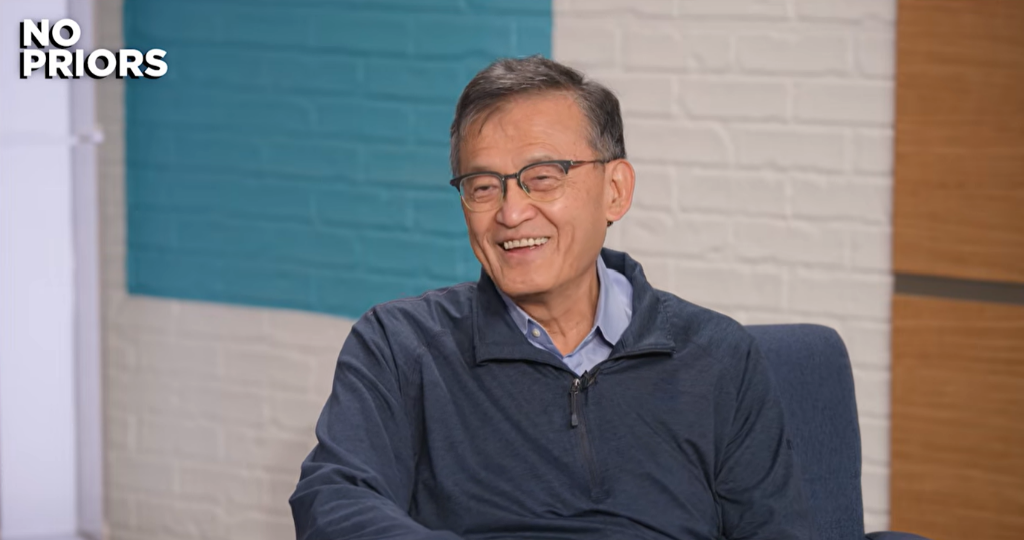
Intel CEO Lip-Bu Tan used his first extended podcast interview on No Priors to outline a far-reaching reset of Intel’s technology, product and capital strategy. Tan said his goal for Intel is to achieve a “10x” return over a five-to-ten-year horizon, while noting that the company has already created roughly a sixfold return for shareholders over the past 14 months. In his words, “this is just the beginning.” The plan he described is not limited to Intel’s traditional PC client franchise. It extends into data center servers, edge computing, physical AI, agentic AI, foundry services, advanced packaging and new semiconductor materials.
Tan said he is 66 and that many people had asked why he would take on what he called one of the toughest jobs in the industry. His answer was that Intel is an iconic company, important to the entire semiconductor ecosystem and to the United States. After his time at Cadence, he wanted to do one more major thing. He also recalled an unexpected episode after taking the job: President Donald Trump asked him to resign, citing conflicts of interest. Tan said he first reminded himself that he did not need the job and was doing it to save Intel. He then secured meetings, explained that he was born in Malaysia, grew up in Singapore, graduated from MIT and had lived in the United States ever since, and was given the opportunity to continue.
From balance sheet repair to a faster product culture
Tan framed the Intel turnaround through his familiar “crawl, walk, run” model. The first step, he said, was repairing the balance sheet, which he described as being in very poor condition when he arrived. He welcomed the U.S. government becoming a major shareholder and said he explained to President Trump that countries such as Japan and Singapore support semiconductor capacity at the infrastructure level. He also thanked Nvidia CEO Jensen Huang, who invested $5 billion in Intel. Tan said that investment has now increased in value to $25 billion or more. SoftBank’s Masayoshi Son, whose board Tan previously served on, also helped stabilize the balance sheet.
Once the balance sheet was on firmer ground, Tan turned to product focus. He said Intel has been simplifying its product lines, listening more closely to customers and working on next-generation products. A shift in AI workloads is also changing demand for CPUs. In earlier training-heavy environments, the CPU-to-GPU ratio was roughly one to eight, according to Tan. He now sees that ratio moving toward one to four, and even lower. He said some AI model developers have told him that CPUs perform better in reinforcement learning and in coordinating the speed of many agents, which is helping drive strong CPU demand.
Tan also described a cultural reset inside Intel. From his first day, he decided that all engineering teams would report directly to him because he is an engineer by background and wants to know exactly where problems are and what needs to be fixed. He contrasted the pace of startups with Intel’s previous layers of meetings and bureaucracy, saying he wants more accountability and faster decisions. He also said he personally recruits talent and does not rely on search firms for those hires.
Foundry as a trust business and the Terafab collaboration with Elon Musk
Intel’s foundry business was a major topic in the interview. Tan acknowledged that foundry is capital-intensive and difficult, but said he chose to keep investing in it because advanced manufacturing in the United States is strategically important for supply-chain resilience. In his view, no large semiconductor company should depend entirely on one or two geographically concentrated suppliers. For execution, he is focused on yield, defect density and cycle time. He described foundry as both a service business and a trust business: customers must trust Intel before handing over wafers, and if yield is not good enough, the revenue loss can cause customers to leave.
Tan emphasized that Intel and TSMC are partners, not simply competitors. He said Intel respects TSMC and that the industry needs more capacity to serve customers. On leading-edge manufacturing, he referred to Intel’s 18A process as a 1.4-nanometer-class node and said the company is planning for 1 nanometer and 0.7 nanometer. As nodes shrink, line widths become extremely small and the precision required in manufacturing rises sharply; a mistake at any step can derail the result.
The interview also covered Intel’s Terafab project with Elon Musk. Tan said he and Musk share the view that semiconductor infrastructure has not kept pace with AI growth in capacity, production efficiency or power efficiency. Under the collaboration, Musk decided to build his own wafer fab, while Intel will provide technology and process support to help accelerate production. Tan said he meets with Musk’s team every week and described the cooperation as energizing. Musk’s robots and cars require large numbers of chips, and his team also brings unconventional operational ideas, including a discussion about whether smoking could be allowed in some cleanroom areas. Tan said he would not go that far, but that staying open-minded matters.
Advanced packaging, glass substrates and materials beyond conventional scaling
Tan said traditional process scaling is approaching physical limits, so Intel must search for breakthroughs in advanced packaging and materials science. Intel has already put 18A into production and is pushing 14A toward production. Tan said he can see paths to 10 nanometers and 7 nanometers, but that those paths become increasingly expensive and difficult. As a result, Intel needs closer cooperation with substrate suppliers and equipment vendors to improve yield and performance.
On packaging, Tan compared TSMC’s CoWoS with Intel’s next-generation EMIB approach. His priority is to make sure EMIB can reach customer-required yield levels at volume production. Intel has also announced advanced packaging manufacturing cooperation projects in India and New Mexico in the United States. Tan noted that Intel holds roughly 1,000 patents in modules, and that integrating substrates and modules is a core engineering challenge.
Materials science is another pillar of Tan’s roadmap. He said he has invested in gallium nitride, silicon carbide and indium phosphide, and that some of the companies in those areas have been acquired by large semiconductor companies such as ADI. He also invested in glass substrate company 3DGS because of glass’s properties as a thermal and insulating material. In addition, he is looking at synthetic diamond and has invested in a diamond wafer company, citing diamond as another strong insulating material. “That is the spirit of engineers — you keep running into bottlenecks, and then you find a way to cross them or go around them,” he said.
Tan also discussed how Moore’s Law is changing. The original idea is that transistor density doubles, but power and cost do not automatically fall at the same rate. Performance can improve, while area and cost may not decline proportionally unless new materials and new design methods are found. This is why he has been hiring more materials science talent, calling it a core area of innovation.
AI’s pressure on the semiconductor supply chain
Looking at the global semiconductor supply chain, Tan said AI’s impact will exceed that of the internet and will reach deeper into the industrial base. He listed several bottlenecks created by AI demand. One is power: some countries do not have enough electricity. Another is helium, whose impact on the semiconductor industry he said many people do not fully recognize. Memory shortages are the most urgent problem now, because even if companies expand production, new capacity takes years to come online. CPUs and GPUs are also in short supply, driving prices higher and eventually passing costs to customers.
Tan argued that the companies most affected will be those that do not embrace AI. AI can help improve efficiency across almost every corporate function, from forecasting and design to many types of workloads. He said Intel itself was once an old-fashioned company that relied heavily on spreadsheets, and that he is now pushing it to become an AI-enabled organization. That shift is not limited to design; he wants the entire company to use AI more deeply and reduce spreadsheet dependence.
The organizational changes extend to hiring. Tan said he has recruited top semiconductor talent during Intel’s “crawl” stage and is now thinking about what software talent is needed to build full-stack capability. He also wants to bring in younger people who understand workloads and frontier open-source models. He said his son has become one of his teachers on AI and machine learning, and that he learns from him during family visits before translating those lessons into investment and hiring judgment.
Tan’s investment lens: bottlenecks, customers and full-stack outcomes
Tan’s background as a venture investor shaped much of the interview. He said he has a record of 159 IPOs and 126 M&A exits, with more than 200 semiconductor investments, 38% of them in the United States. His investment method starts with a simple question: where is the bottleneck, and what problem is being solved? He cited Cradle Semiconductor as an investment tied to interconnect bottlenecks, and Celestial AI as an investment based on the growing importance of optical interconnects inside clusters. He also noted that Jensen Huang has invested broadly across photonics-related companies.
In design, Tan sees major opportunity in using AI and machine learning to reduce complexity and improve quality. He described EDA as a “gold mine” and said several startups are moving in that direction. He also highlighted new materials such as gallium nitride, silicon carbide and indium phosphide, as well as power management. In particular, he pointed to the heavy losses involved in converting 40 volts down to 1 volt as a bottleneck area he follows closely.
Tan said the first target customer is critical. He prefers startups that can win hyperscale customers, because they have the capability and willingness to pay millions of dollars or provide certain assurances over several years if they like a product. Once a large customer is secured, a company can scale. He also stressed the importance of talent in the United States, Silicon Valley, Austin and Israel, praising Israeli entrepreneurs for their disruptive ideas, hard work and resilience even during wartime.
He also drew from his nearly 15 years at Cadence. One of the achievements he is proudest of is identifying and training his successor, who is now actively bringing agentic AI into Cadence tools to improve efficiency. He said Synopsys CEO Sassine is also doing similar work, supported by a $2 billion investment from Nvidia and the acquisition of Ansys to expand into full-system design. Tan believes large companies are moving quickly, while startups still have room to do more disruptive work and eventually either go public or be acquired.
On scaling and investment decisions, Tan said capital intensity, unpredictability and cyclicality all have to be considered. He usually likes to enter early, build the team, find investors who can support difficult periods and add strategic investors in manufacturing, memory, interconnect or other areas. He said nine out of ten companies he has invested in changed their business plans along the way because markets changed. For that reason, he prefers teams over solo founders, and founders who are open-minded enough to listen while still reaching their own conclusions.
Industrial policy, investor expectations and Intel’s 2030–2032 horizon
Capital access was another recurring theme. Tan said capital is crucial for capital-intensive businesses and infrastructure projects. Some venture investors are now willing to put $1 billion into a single company, something he said would have been unimaginable in the past. For very large projects such as AI factories and foundries, he said companies must seek support from government funds, sovereign wealth funds or large infrastructure funds. As a public company CEO, he is also deliberately focusing on investors with a longer-term growth orientation, rather than only short-term shareholders asking about stock buybacks every quarter.
Asked what investors misunderstand most about Intel, Tan returned to the “crawl, walk, run” model. He said Intel has still been in the crawl stage during recent months, though people are beginning to see the company’s potential. The PC client business remains a foundation, but Intel must materially improve performance. Tan said he is quietly building CPU architecture, GPU architecture and software architecture teams to prepare for leapfrogging improvements, moving with the speed of a large startup.
In foundry, Tan acknowledged that Intel remains far behind TSMC and must stay humble. The foundation must be built around IP, yield, defect density and cycle time so the foundry business can become more efficient and reliable. Because foundry is a trust business, customers must trust Intel before they place wafers with it. Tan said these efforts take time, but he believes that from 2030 to 2032 people will begin to see how large Intel’s real opportunity is.
Intel’s opportunity, as Tan described it, is no longer limited to servers and PCs for human users. A new dimension is emerging: millions of agents will need access to compute and to software stacks. He believes Intel has opportunities in both agentic AI and physical AI, alongside edge computing. He compared his current goal with his Cadence experience, where he said the share price rose from $2.40 and generated roughly 76x shareholder returns by the time he moved from interim CEO to retirement, and about 85x by the end of his executive chairman term. Intel is much larger and harder to transform, but Tan said a 10x return in five to ten years is the goal he has set as someone who is a venture capitalist at heart.
On where compute will live, Tan said today’s large AI infrastructure buildout is correct and he sees no reason for it to slow, because workloads are still growing. The constraints are mostly on the supply side, not the demand side. His bigger question is what applications will run on all that infrastructure once it is built. He compared the coming AI application cycle to the internet era, when Amazon and Netflix emerged as real applications while others disappeared or were acquired. Some applications, including robotics and defense, are better suited to edge or client-side compute, making device capability and connectivity assumptions central to system design. For Intel, Tan said the long-term direction is to integrate XPU, advanced packaging and foundry capabilities to deliver customized chips for different workloads.