
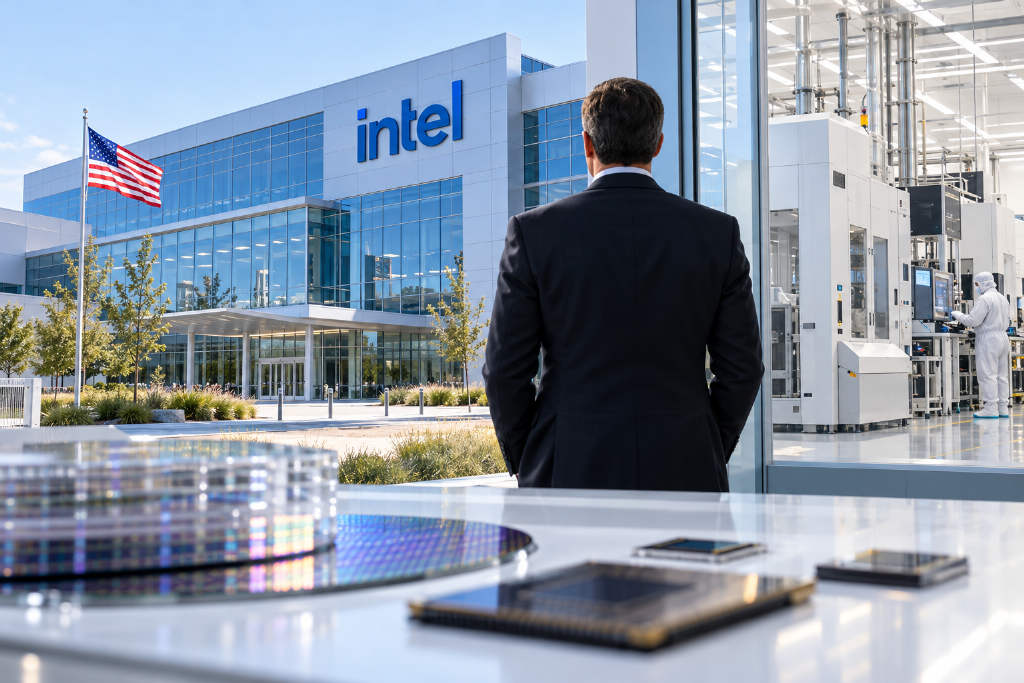
Intel Chief Executive Officer Lip-Bu Tan said in an interview with Nikkei that the Trump administration holds a minority stake in Intel but is not seeking to influence the company’s business strategy through that position. He also said Intel will still need strong government support if it wants to expand its foundry business.
U.S. government investment stands at $8.9 billion
According to the report, the U.S. government last year converted previously allocated federal funding for Intel into an $8.9 billion investment, taking a 9.9% stake. After Intel issued new shares in August, the government’s holding was diluted to about 8.2%. The Trump administration acquired 433.3 million passive shares in August last year and does not have a board seat. The report said the investment was intended to support Intel’s expansion of advanced chip manufacturing in the United States.
Intel has fallen behind Taiwan Semiconductor Manufacturing Co. (TSMC) in advanced semiconductor manufacturing, and its AI chip business has also lost ground to U.S. rivals including NVIDIA. The company is now trying to rebuild its position. Under former CEO Pat Gelsinger, Intel invested heavily to expand foundry capacity, but the cost of that restructuring led the company to post a net loss of $16.6 billion in the third quarter of 2024. Gelsinger resigned in December that year.
Tan says government backing is needed for long-term investment
Tan said U.S. government support would help Intel make the long-term investments needed to build a competitive foundry business. He pointed to TSMC as an example, saying it took the company 10 to 20 years to become the world’s largest contract chipmaker. Intel, he said, will need both time and strong government participation if it wants to build that business over the long run.
Intel has also received about $7 billion in combined investment from Japan’s SoftBank Group and NVIDIA, with both companies receiving equity in return. Tan said those investments would also benefit the investors themselves because they 「可以赚很多钱」. He said returns could reach five to six times. Intel shares are currently around $91, about four times the level when Tan took office in March 2025.
Foundry market should not be dominated by one or two companies
According to The Chosun Ilbo, Tan said he is concerned that global advanced semiconductor capacity is concentrated in too few companies. He said, "The foundry market should not be monopolized by one or two companies. TSMC, Intel, Samsung Electronics and Japan’s Rapidus all need to expand their production footprints."
He said chip designers such as NVIDIA depend on manufacturing capacity from foundries, which is why the supply chain needs to be more diversified.
Restructuring is 80% complete
Tan said Intel’s restructuring is now 80% complete. He identified AI-related advanced chip packaging and application-specific integrated circuits, or ASICs, as other possible growth areas. Since taking over, he has replaced most of the company’s senior executives. New hires include former SK hynix CEO Seok-Hee Lee.
Asked about the competitive threat from China’s semiconductor industry, Tan gave a restrained answer. He said U.S. and Chinese companies each have strengths and weaknesses. When asked whether China’s chip capabilities could catch up with the United States within five to 10 years, he replied briefly: "Today, I don’t think they are that far behind."
Tan also said research capabilities at Chinese institutions such as Tsinghua University and Peking University are on par with those at the Massachusetts Institute of Technology and Stanford University. He cited Moonshot AI’s Kimi, Z.ai’s GLM and DeepSeek as examples, saying they are not behind U.S. companies such as Anthropic or OpenAI in technical terms, and that Chinese AI models are more competitive on price than U.S. models.



