
Intel posted its fastest revenue growth in more than a decade in the second quarter of 2026, according to the latest U.S. stock and RWA daily note published by MSX Research Institute, which described the result as an early sign that the company’s transition is beginning to gain traction.
The report said the headline GAAP net loss did not reflect a deterioration in Intel’s underlying business. Instead, it was largely caused by a non-cash accounting item. MSX wrote that shares placed in trust for the U.S. government under the CHIPS and Science Act created a book obligation that expanded as Intel’s stock price rose, and that increase was recognized in current earnings. In practical terms, the stronger the stock price, the larger the accounting loss tied to that item. Excluding the effect, the company was profitable and its operating profit returned to positive territory.
Data center and AI drive the quarter
MSX said the more important takeaway was the rebound in Intel’s data center and AI business. Management said demand for server CPUs had moved above supply, and Intel signed 10 long-term supply contracts during the quarter. In MSX’s reading, the current AI cycle is no longer lifting only GPUs. It is also pulling traditional CPU demand higher, which goes directly to Intel’s core market.
The company’s guidance for the next quarter also came in ahead of market expectations, the report said.
Key figures from the quarter
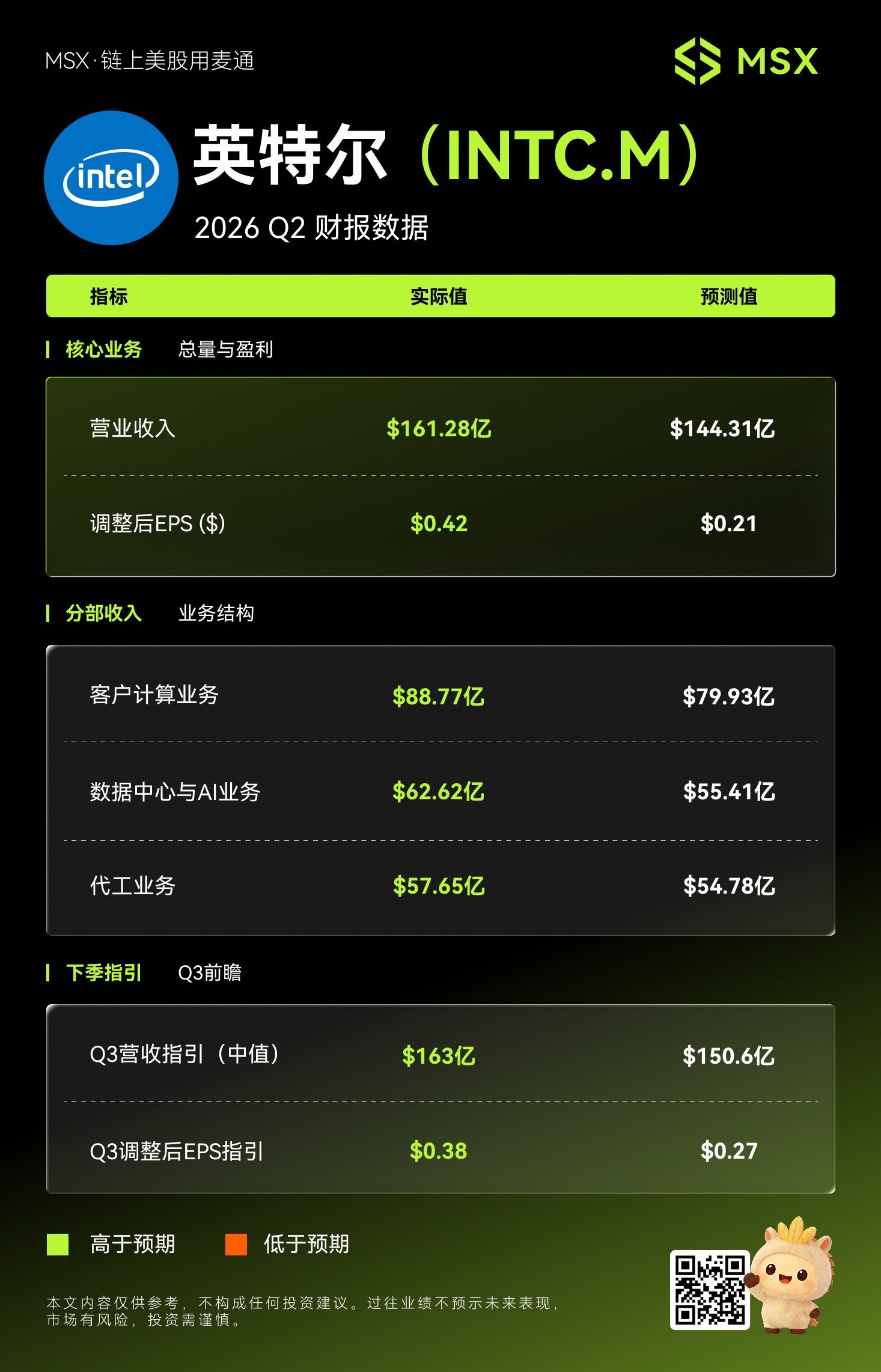
- Revenue was $16.128 billion, up 25% year over year and above the $14.431 billion expectation, marking the fastest growth since Q3 2011.
- Adjusted EPS came in at $0.42, ahead of the $0.21 expectation.
- GAAP net loss was $11.033 billion, almost entirely due to a $12.529 billion non-cash remeasurement related to the trust shares.
- Data center and AI revenue rose 59% year over year, the strongest highlight of the quarter.
- Client computing revenue reached $8.877 billion, up 13% year over year.
- Foundry revenue was $5.765 billion, up 31% year over year.
- For Q3, Intel guided to midpoint revenue of $16.3 billion and adjusted EPS of $0.38, both well above expectations.
- The foundry operation still posted a $2.089 billion operating loss.
- Adjusted free cash flow turned negative at -$8.419 billion.
- Management expects 2027 capital expenditure to be higher than 2026.
Improvement in direction, but foundry losses remain in focus
In its own assessment, MSX said the real story in the quarter was not the GAAP loss. The more meaningful indicators were the return to profitability on a non-GAAP basis, the move back to positive GAAP operating profit, and the acceleration in data center and AI.
The report quoted management as saying server CPU demand had “exceeded supply,” while the 10 long-term agreements signed during the quarter suggested that AI-related demand is spreading from GPUs into CPUs as well.
Still, the other side of Intel’s transition remains unchanged. The foundry business lost $2.089 billion in the quarter, adjusted free cash flow was about negative $8.4 billion, and capital expenditure is expected to rise again in 2027. MSX said that means the heavy-investment phase of Intel’s transformation is far from over.
Overall, the institute said the direction of travel has improved, but two signals will matter most from here: whether the foundry unit can move toward break-even, and when cash burn begins to narrow.
About MSX
The original article described MSX as an RWA trading platform focused on secure, efficient and transparent access to global financial markets. It said MSX is among the earlier platforms to offer on-chain U.S. equities trading and currently provides spot and derivatives trading for nearly 400 tokenized stocks and Pre-IPO assets.
The article also said MSX offers a broader digital financial services system covering U.S. stock spot and perpetual contracts, crypto-to-crypto trading, Pre-IPO products and research content. Its website is https://msx.com/, and its app is available on the App Store and Google Play.
The original piece included a risk reminder, saying macroeconomic conditions and the U.S. equity market can be highly volatile and that the content is for research observation only, not investment advice.