
Intel reported third-quarter 2026 revenue of $16.51 billion, up 21% from a year earlier, and said it beat its own guidance for the eighth consecutive quarter. GAAP net income came in at $3.32 billion, down 18% year over year, while non-GAAP net income rose 169% to $2.8 billion.

GAAP operating income was $2.52 billion, with an operating margin of 15.3%. On a non-GAAP basis, operating income reached $3.2 billion and operating margin was 19.6%.
Chief Executive Officer Lip-Bu Tan said execution improved during the quarter, supply expanded, and process technology made progress. He said the company’s top priority is to unlock capacity to meet demand for Xeon server processors. Intel 18A yields have improved by double digits, he said, and 18AP remains on schedule for launch by the end of the year.
Tan also said strong momentum in the Data Center and AI business pushed results above expectations and delivered the segment’s strongest revenue growth in 15 years.
Gross margin improved in Q3, but Q4 guidance points lower
Intel posted a third-quarter GAAP gross margin of 43.0%, up 4.8 percentage points from a year earlier. Non-GAAP gross margin was 44.1%, up 4.1 percentage points.
Chief Financial Officer David Zinsner said fourth-quarter non-GAAP gross margin is expected to fall to 38.0%. He attributed that to the shutdown of Israel Fab 28, PC client inventory adjustments, and continued investment in the foundry business.
Zinsner said the third quarter of 2026 was a weak one for the PC industry by recent standards, and inventory digestion is likely to continue at least through the first quarter of 2027. Intel expects total PC shipments to decline about 12% in 2026 and another roughly 10% in 2027. He said a sustained recovery is unlikely before memory supply and pricing normalize.
Tan said 2027 will be an “investment year” for Intel, with capital expenditures set to rise sharply and positive free cash flow out of reach for the full year.
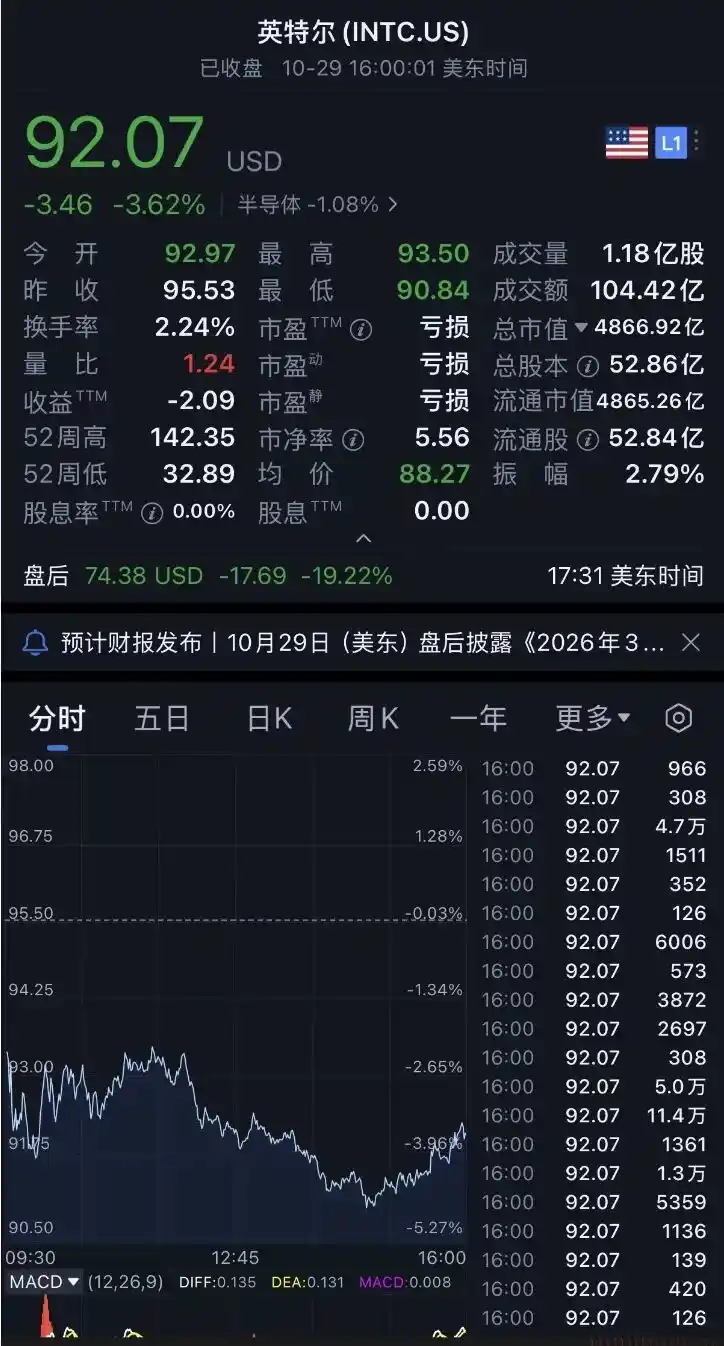
As of 5:31 p.m. Eastern Time on Oct. 29 in after-hours trading, Intel shares were down 19.22% at $74.38. Based on that price, Intel’s after-hours market capitalization was about $393.228 billion, compared with $486.692 billion at the close, a drop of about $93.464 billion.
Data Center and AI revenue rose 78% while PC demand was hit by memory shortages
Intel’s core operations are organized around two product groups and one foundry segment: Client Computing and Physical AI, Data Center and AI, and Intel Foundry.
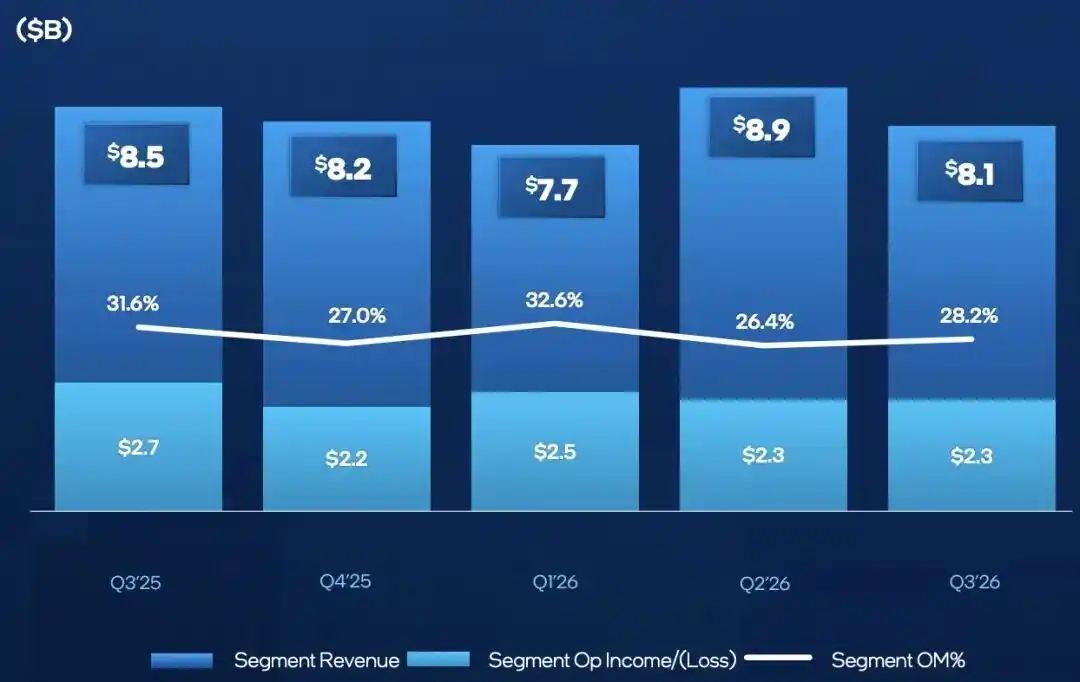
The Client Computing and Physical AI business generated $8.10 billion in third-quarter revenue, down 9% sequentially and down 5% from a year earlier, with an operating margin of 28.2%. That segment includes PC processors, including Core and Core Ultra products, as well as edge and AI PC chips.
The Data Center and AI segment posted $7.32 billion in revenue, up 78% year over year, with an operating margin of 41.5%. The business includes Xeon server CPUs, AI-focused server products, and GPUs.
Zinsner said demand in Data Center and AI was driven by hyperscale cloud providers, enterprise customers, and emerging cloud companies. Revenue from purpose-built silicon more than doubled from a year earlier. On the client side, he said the revenue decline mainly reflected industry-wide memory shortages that constrained the size of the PC market.
Intel said AI PC demand still grew year over year. Demand for Wildcat Lake chips built on the 18A process was strong, shipments rose 70% from the prior quarter, and the products are now sold out.
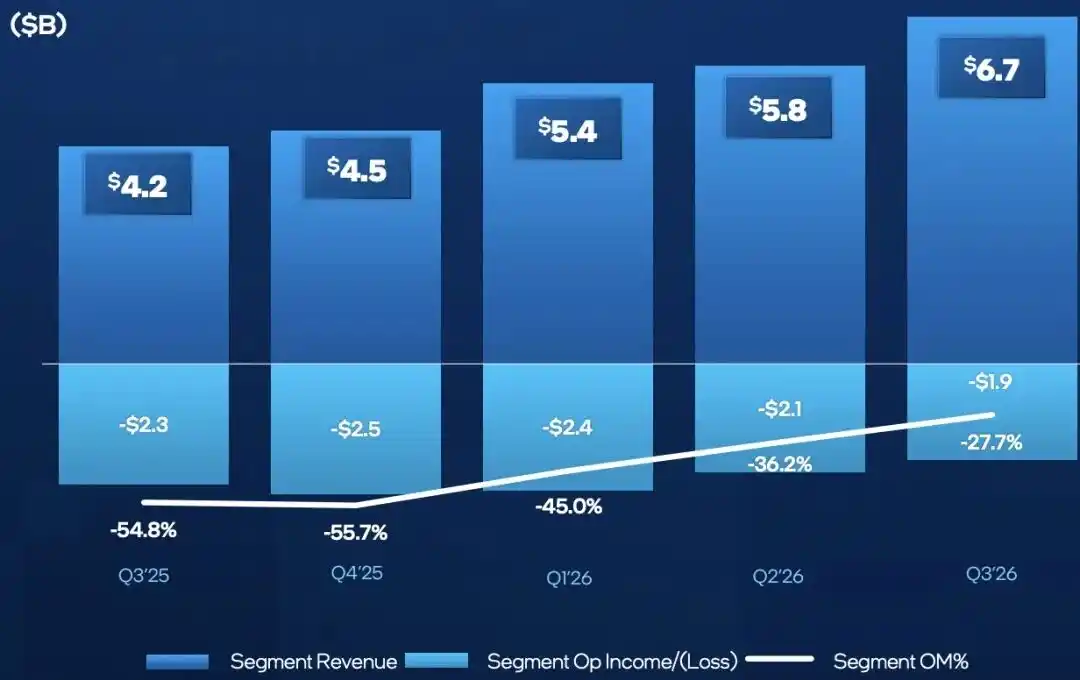
Intel Foundry reported $6.70 billion in revenue, up 58% from a year earlier, and an operating loss of $1.85 billion. Its loss margin narrowed to -27.7% from -54.8% a year earlier. The company said better yields and shorter production cycles are lowering wafer costs.
On a GAAP basis, cash flow from operations was $5.1 billion in the third quarter, up about 100% from $2.546 billion a year earlier. Intel said the increase was mainly driven by rapid growth in Data Center and AI revenue and better operating efficiency. After adjustments including partner contributions, free cash flow was $1.6 billion, up about 83% year over year.
At the end of the quarter, Intel held about $54 billion in cash, cash equivalents, and short-term investments. The company also completed a $23 billion public equity offering, bringing in new sovereign funds and long-term growth investors, and had another $15 billion in expanded revolving credit capacity.
For the fourth quarter, Intel guided for revenue of $15 billion to $16 billion, non-GAAP gross margin of 38.0%, and earnings per share of $0.25. Full-year 2026 capital expenditures are expected to remain at $20 billion.
Intel also said the server CPU market could expand from $40 billion to more than $200 billion over the next five years.
Israel Fab 28 shutdown is set to weigh on Q4, with server supply constraints lasting into 2027 and 2028
In discussing fourth-quarter guidance and its 2027 plan, Intel pointed to three main pressures behind the expected drop in Q4 gross margin to 38% and negative free cash flow in 2027: the shutdown of Israel Fab 28, tight supply of EMIB advanced organic substrates, and PC client inventory adjustments.

The company said it plans to offset those pressures through capacity reallocation, product ramps, and new capacity coming online in the second half, while directing capital spending toward advanced process equipment and expansion of external foundry customers.
On the earnings call, Zinsner said the long-term shutdown of Israel Fab 28 will reduce fourth-quarter revenue by about $300 million. He said the revenue impact in the first quarter of 2027 is expected to be similar.
Tan said Intel will shift some wafer capacity from client products to server chip production lines to ease supply tightness in data centers. Intel 3 capacity at the company’s Oregon site in the United States is scheduled to come online in the second half of 2027.
Asked about server market share next year under supply constraints, Tan said the outcome will mainly depend on available capacity and that Intel’s product roadmap is competitive against rivals.
He said demand for AI server CPUs remains strong, with industry server CPU shipment growth above 30% in both 2026 and 2027. Supply tightness is expected to continue into 2027 and 2028. Many customers want to sign long-term agreements to lock in capacity, he said, but Intel cannot fully meet current demand. Supply will remain tight in the first half of 2027 and ease in the second half as new capacity comes online, while growth in the Data Center and AI business is expected to continue through the year.
Nova Lake fills a high-end PC gap as foundry and packaging plans move ahead
On the product side, Tan said Nova Lake will fill a gap in Intel’s high-end desktop lineup. He described a split PC market: demand for the high-end AI PC Panther Lake has held up even as the broader market weakens, while the value-focused Wildcat Lake has posted clear growth. Intel is counting on Nova Lake to improve product mix and lift PC market share.
In foundry, Tan said multiple external customers are evaluating Intel 18AP and 14A. He said the company expects to announce several partnership updates over the next two quarters. Intel released version 0.9 of its 14A PDK to key customers in October and plans to release version 1.0 in the first quarter of 2027.
In advanced packaging, Intel said its EMIB and EMIB-T technologies for internal products have attracted strong interest from external customers. The company also reached a cooperation agreement with Lens Technology in TGV glass via advanced packaging, is working with ASML to speed preparation for High-NA EUV mass production, and is partnering with Lam Research and Applied Materials on capacity expansion and joint research and development.
On the structure of 2027 capital spending, Zinsner said equipment spending rose significantly this quarter and will increase more in the next one. Most of the new capital spending will go toward equipment purchases. He added that only the Ohio site in the United States remains in a large-scale construction phase.
Zinsner repeated that 2027 will be a heavy investment year and that Intel will not generate positive free cash flow for the full year. He said that was the core reason behind the equity financing completed in August. Over the long term, he said these advanced process nodes are expected to deliver a minimum return on investment of 20%.
Server chips have become Intel’s main growth engine
The original article said AI workloads are shifting from training to inference and Agentic AI, while cloud providers continue to expand capital spending. At the same time, data centers are demanding more from CPU scheduling, memory, and network coordination, making server CPUs another critical part of AI infrastructure alongside GPUs.
It said Intel’s latest growth cycle is centered on x86 server CPUs. As AI inference and Agentic AI workloads scale, that demand is translating directly into x86 server CPU orders. Combined with the emergence of custom silicon orders, the server business has taken over from PCs as Intel’s main growth engine.
This article was originally published by the WeChat account Xinzhidongxi. The author was Cui Yuanwei and the editor was Chen Junda.



