
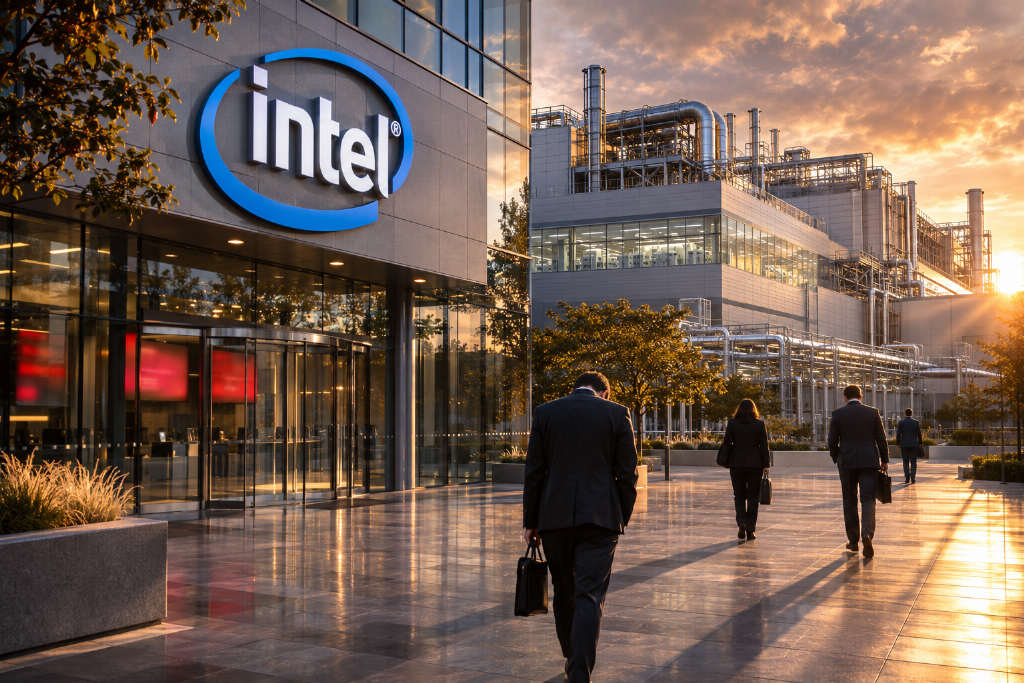
Intel shares fell another 8.80% on Monday, closing at $59.97. Including Friday’s plunge, the stock has dropped 34.9% over two trading days, wiping out about $170 billion in market value. From late September, the shares have now been cut in half.
October decline sets a record
Monday’s selloff stood out even against a weak tape. The Philadelphia Semiconductor Index fell 3.37%, while the Nasdaq Composite lost 1.07%. Nvidia slipped 1.3% and Qualcomm fell 1.6%. AMD, Intel’s direct rival in CPUs, dropped 7.52% to close at $466.84, a decline close to Intel’s own.
Over a longer stretch, Intel fell about 45% in October, its worst monthly performance on FactSet record. Friday’s 28.6% drop was also its biggest one-day decline since the 1970s.
Earlier rally drivers have come under pressure
Before this reversal, the U.S. government had taken roughly a 10% stake in August 2025, and Nvidia later invested $5 billion. Those moves helped send Intel shares up about sixfold in 10 months, with the stock peaking in June this year.
At the time, the market had two main narratives. One was that agentic AI would require large amounts of CPU capacity, giving Intel a place in the AI boom. The other was that foundry services could become a second growth engine.
Last Thursday’s guidance shifted that view. Intel’s PC business, which accounts for about half of revenue, is weighing on overall performance. Data center demand remains strong, but the company has not been able to produce enough chips to fill the gap. Wall Street has also started to lose patience with the foundry story.
Foundry spending has yet to produce a flagship external customer
Over the past five years, Intel has spent $108 billion in capital expenditures, with factory construction a major part of its effort to catch up with Taiwan Semiconductor Manufacturing Co. So far, though, no marquee outside customer has formally announced orders for Intel’s most advanced process technology. Production at those facilities is still centered on Intel’s own chips.
Media reports this year said Apple and Google could place orders, but neither company has made a formal announcement.
Capacity shifts have raised questions
Another problem is capacity. Data center demand is strong, yet Intel is still short on supply. The company said it would shift part of the Oregon factory capacity originally planned for 18A to the older Intel 3 process.
18A is Intel’s most advanced node and the main process it is using to pitch foundry services to outside customers. Intel 3 is the previous-generation process and is used for data center processors.
Former Intel director Yoffie said in an interview with CNBC that the move is not friendly to potential foundry customers. In his words, customers will worry that “if Intel does not actually have excess capacity beyond its own needs, then it is not a very credible supplier.” He also said that if Intel cannot find a large foundry customer within a year, “the financial pressure on Intel will become more visible.”
Ohio and Arizona projects remain behind schedule
Intel is still spending heavily, but progress has been slow. Its new Ohio plant has only just installed its first steel truss, and the project is running nearly five years behind schedule. In Arizona, 18A is currently being used only for volume production of Intel’s own products, while a second fab is still in planning.
Yoffie says a spinoff is the answer
Yoffie’s prescription was direct. He said, “The right solution is for Intel to spin off the foundry business,” adding that it is “not just the best solution, but possibly the only solution.”
This is not the first time he has made that case. In October 2024, he and three other former directors co-authored an article in Fortune arguing that Intel’s fabs should be separated into an independent company.
Customer hesitation versus manufacturing control
His argument centers on customer concerns. Chip design companies such as Broadcom and Qualcomm may be reluctant to hand products to a manufacturer that also competes with them.
Mizuho Securities analyst Jordan Klein made a similar point. He said AMD is probably the one major chip company that would not consider using Intel foundry services because the two compete head-on in CPUs. He described the issue as one of “competition, confidentiality and privacy.”
Klein also pointed to the other side of the equation. Intel is one of the few companies in the world that can both manufacture and package advanced chips on its own. That gives it more control over its own fate than most peers. If capacity falls short, revenue is simply lost. In that sense, owning fabs is both a burden and an advantage, and any breakup would need a clear accounting of what is being given up.
Intel says execution will determine customer confidence
An Intel spokesperson said in a statement that customer confidence in Intel Foundry rests on execution. The company said it is moving ahead on its technology roadmap, that 18A is performing strongly, and that next-generation 14A is also making progress.
Chen Liwu said last Thursday that the company would announce “several” customers over the next two quarters.
Yoffie also said TSMC can place at most about 20% to 25% of global capacity in the United States, and that doing so will still take years. Without a domestic foundry base, the U.S. would be at a disadvantage in the event of geopolitical or supply-chain disruptions.



