
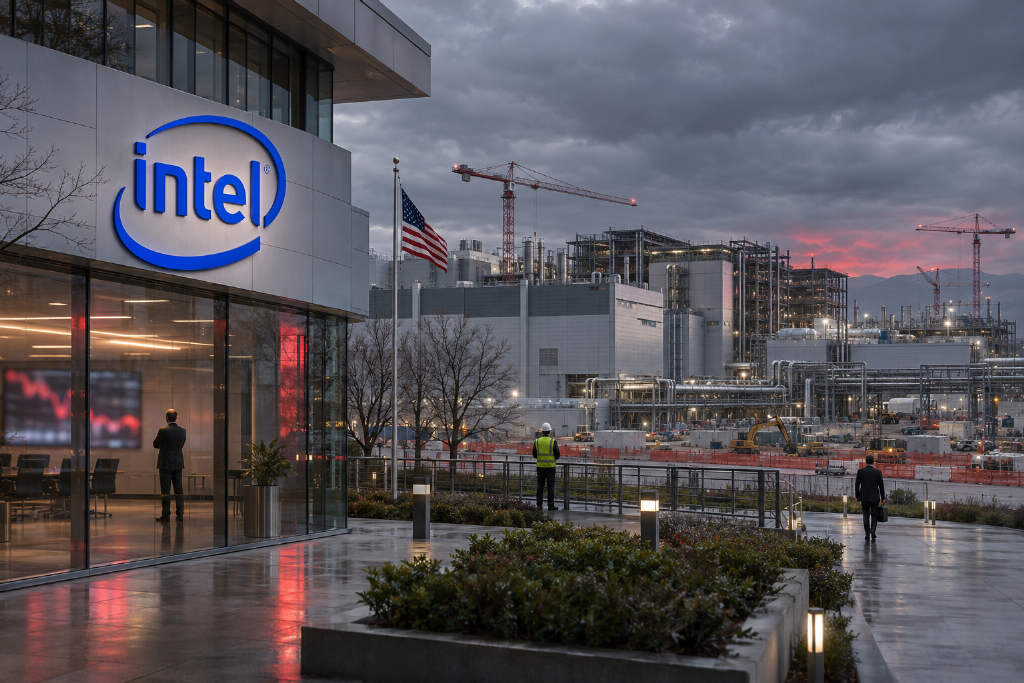
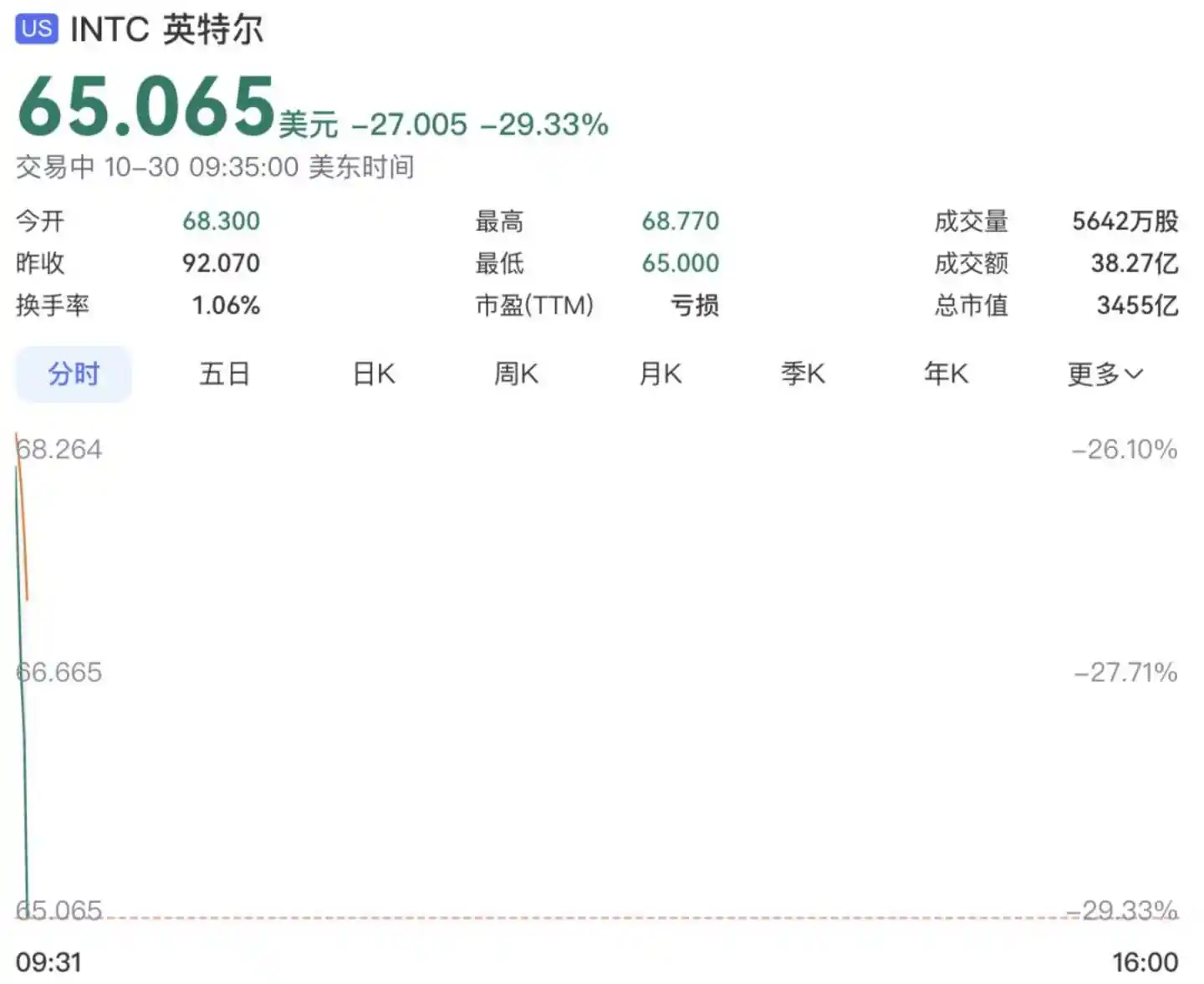
Intel shares fell 28.58% at the close on Oct. 30, after dropping more than 30% during the session, to finish at $65.76. Dow Jones market data showed it was Intel’s second-worst one-day performance since 1974, behind only the 29.9% decline recorded on July 5, 1974.
The move came a day after the company released its third-quarter results. Revenue was $16.5 billion, up 21% year over year. The data center and AI business rose 78%, which the report described as the strongest growth in 15 years. Adjusted earnings per share came in at $0.52, well above market expectations.
Investors focused less on the quarter itself and more on what came next. On the earnings call, a Wall Street analyst asked why Intel’s fourth-quarter revenue guidance was $1.8 billion below market expectations. Intel’s chief financial officer paused, then replied, “Okay, so — Israel, client, what was the third one?” After a few seconds of silence, the analyst answered directly: “Execution. How much of the guidance cut is execution?”
The CFO then shifted the discussion to 2027, calling it an “investment year.” Intel expects capital spending to increase significantly, does not expect to generate positive free cash flow, and still plans to deleverage.
Price targets were cut within 48 hours
Research notes from Wall Street followed quickly. JPMorgan cut its price target to $80 from $85. BofA Securities downgraded the stock to neutral from buy and lowered its target to $100 from $145. Roth Capital cut its target to $70 from $120.
According to the report, 50 analysts had targets ranging from $50 to $200, with an average of $97.86.
Intel has changed chief executives twice in less than two years. One leader pushed aggressive expansion. His successor came in as a critic, promising to shrink the cost base and stop the bleeding, yet ended up facing the same spending problem a year and a half later.
Pat Gelsinger’s bet on factories
The first figure at the center of that strategy was Pat Gelsinger. The report describes him as an Intel insider through and through: he joined the company at 18, rose to become its first chief technology officer, left in 2009, and was brought back by the board in 2021 at age 59.
The backdrop was clear. Apple had just announced it would stop using Intel chips in Macs, and Taiwan Semiconductor Manufacturing Co. had already moved ahead of Intel in process technology.
Intel had once dominated chip manufacturing, but it stumbled badly at the 10 nm node. Products originally scheduled for 2016 did not reach volume production until 2019. By the time the production line was back on track, the competitive picture had changed.
Gelsinger’s answer was IDM 2.0. In simple terms, Intel would keep designing its own chips while also opening its factories to outside customers and taking foundry orders in a model closer to TSMC.
To do that, Intel announced factory projects in Ohio, Arizona, Germany, and Israel, and said it would catch up with TSMC through five technology nodes in four years. Headcount quickly expanded to more than 130,000, and capital spending surged.
Advanced fabs are expensive to build and run. Intel’s own orders were not enough to fill that capacity, so outside customers became essential to the plan.
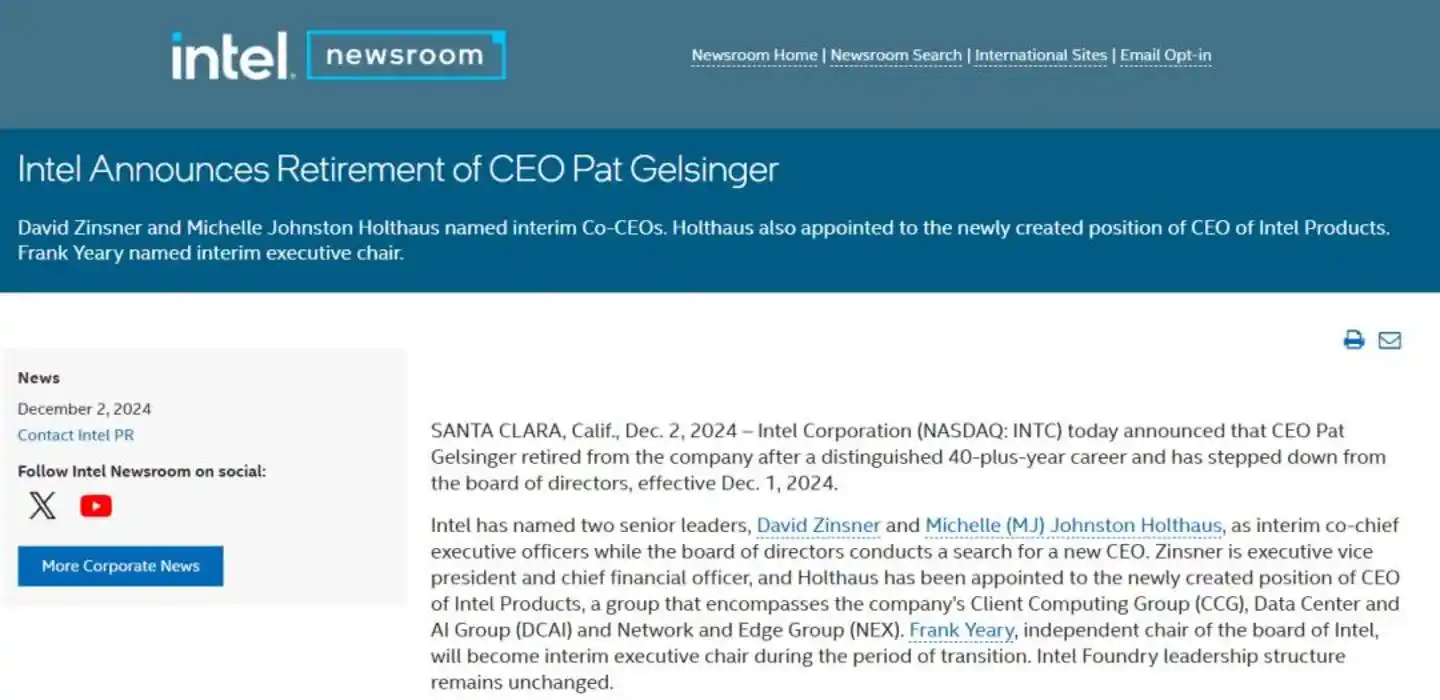
After Intel released its second-quarter 2024 results, the stock fell about 26% in a single day, and the decline for the full year approached 60%, according to the report. Gelsinger’s retirement formally took effect on Dec. 1.
The report said media coverage indicated the board had given him a choice between resigning and being dismissed, and that the board concluded his turnaround plan had not caught up with Nvidia quickly enough.
Months before his retirement, board member Lip-Bu Tan resigned. The report said Tan believed Intel had become bloated, too risk-averse, and too slow in AI, and that his disagreement with Gelsinger over the foundry path could no longer be reconciled.
The 18A process that Gelsinger strongly backed did enter mass production in 2025. But the pace of spending had already moved beyond what the company could comfortably absorb.
Lip-Bu Tan cut costs first
The second executive in the story is Tan himself. The report describes him as a Malaysian-born ethnic Chinese investor with a long history in semiconductor investing and a reputation in the industry as a venture capital godfather. Before taking the job, he had publicly criticized Intel for excess staffing and a slow response to AI. The board wanted someone who could cut deeply enough to stabilize the company.
On March 12, 2025, Intel announced Tan’s appointment as chief executive. The appointment took effect on March 18. He did not bring the same expansion-first zeal. His first move was layoffs, aimed at middle management and bureaucracy, along with cuts to redundant product lines and an effort to rebuild an engineering-centered culture.
He also took a more cautious line on foundry capital spending. The report said Intel was later reported to have paused part of the 14A process development in mid-2025.
For a time, the operating data looked better. Research and administrative expenses as a share of revenue fell from 31.9% to 27.4%. Granite Rapids server chips became a key sales driver and helped gross margin. Production costs for 18A dropped 40% from the first quarter. Products built on 18A rose from less than 5% of revenue at the start of the year to nearly one-third. Wildcat Lake, positioned on value for money, saw shipments jump 70% quarter over quarter and was briefly sold out.
The third-quarter report released on Oct. 29 looked respectable on its face. Revenue was $16.513 billion, up 20.9% year over year. Adjusted EPS was $0.52, above the $0.40 expected by the market. Revenue from the data center and AI business reached $7.3 billion, up 78%.
The problem was the next quarter. Intel guided fourth-quarter revenue to $15 billion to $16 billion, below the third quarter. Gross margin is expected to fall to 38%, down 6 percentage points sequentially. EPS is projected at $0.25, half the third-quarter level.
The report identified an explosion at Intel’s Israel factory as one direct factor. Two workers were killed in the accident. The plant remained offline for an extended period, affecting 10 nm chip shipments and causing about $600 million in losses across two quarters. The PC business also faces a weaker backdrop. Intel expects the global PC market to shrink 12% this year and another 10% next year.
The foundry business still lacks outside demand
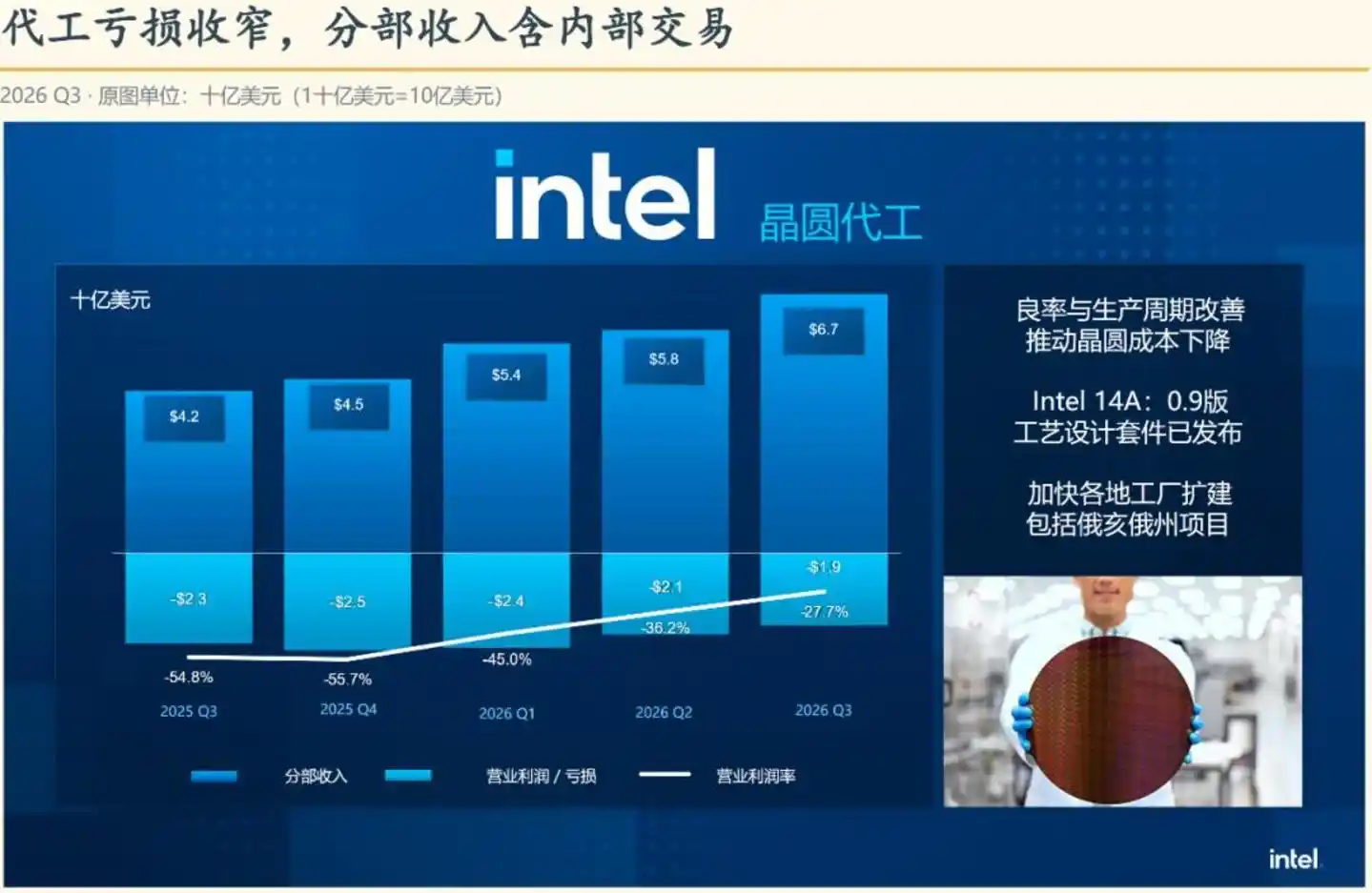
Capacity from 18A and 14A, along with factories under construction across several states, still needs external orders. Yet in the third quarter, Intel’s foundry segment generated $6.7 billion in revenue, of which $6.291 billion came from Intel itself. Outside customers contributed only $411 million. The segment posted an operating loss of $1.9 billion for the quarter.
The report added that Intel completed a $23 billion equity financing in August. If the company were to pull back now, the fabs under construction and the fresh financing would immediately become sunk costs.
Intel remains the only U.S. company capable of manufacturing advanced logic chips, and the subsidies tied to the CHIPS and Science Act, along with the political push for “Made in America,” are attached to that role. The report said neither Intel’s board nor Washington would allow a retreat from foundry at this point.
There are practical obstacles as well. Foundry customers must hand over chip designs, while Nvidia, AMD, and Apple are also Intel competitors. That creates natural concerns over production priority and technology security.
According to the report, yields on 18A will not reach a satisfactory level until 2027, so Intel has shifted its focus back to stabilizing internal processes and slowed the pace of external promotion. Advanced packaging is another bottleneck. A KeyBanc report said some suppliers were still running at yields of only 20% to 30%. Rumored customer lists have circulated repeatedly, but no customer has formally announced a deal.
Two CEOs, one factory bill
The PC market has contracted for two straight years. High memory prices are also squeezing profit. Cash flow is being consumed by heavy investment while the sources of that cash are narrowing.
The report’s conclusion is blunt. Gelsinger moved too fast and spent too aggressively, and he was pushed out. Tan moved more carefully, but found that slowing down carries its own cost: the foundry window may close, and subsidy deadlines will not wait. Both leaders ended up trapped by the same factory bill.
Tan said on the earnings call, “Rebuilding Intel is a multi-year journey, and I have emphasized that consistently. We are only a year and a half into it.”
U.S. stocks reopened on the evening of Nov. 2. After the plunge, Intel was set to face its next market verdict.




