
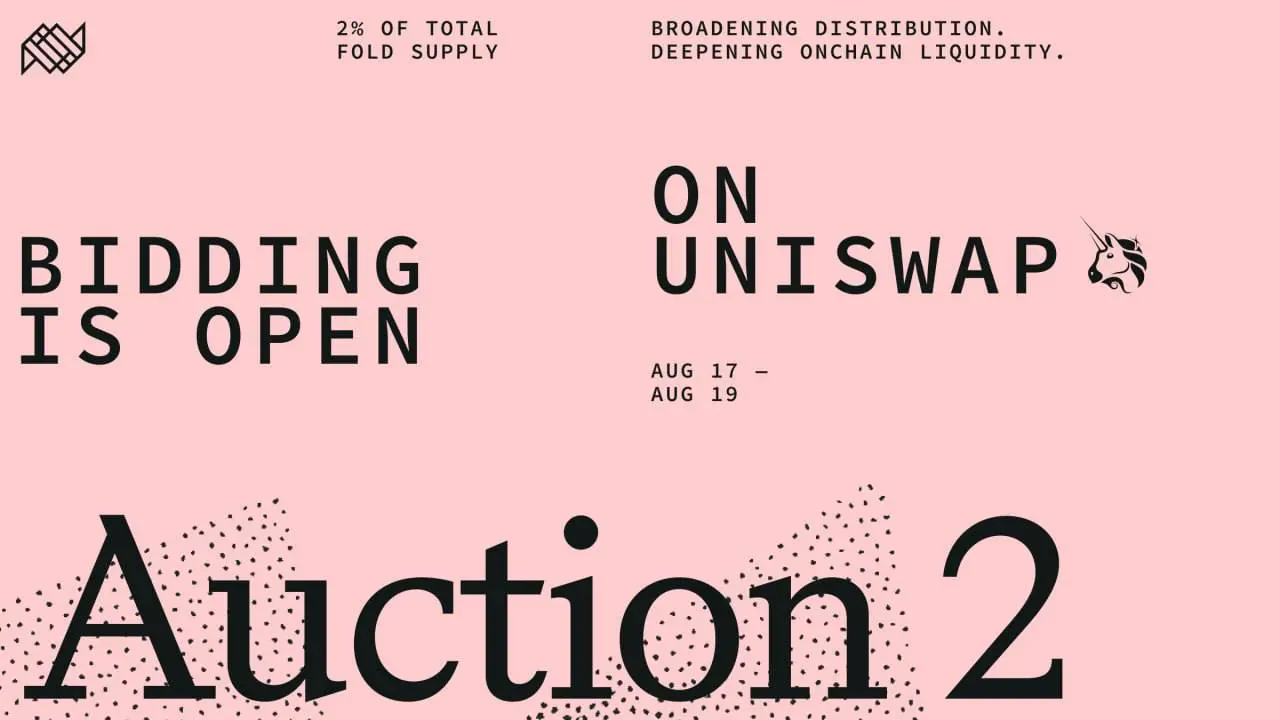
Interfold said the second FOLD auction is now open, Network Alpha is live on mainnet, and general transfers for FOLD have been enabled.
Second auction opens with 2% of total supply
The second auction is being run through Uniswap’s continuous clearing auction mechanism and offers a limited allocation equal to 2% of FOLD’s total supply. The auction started at 14:06 UTC on Aug. 17 and will continue until 13:06 UTC on Aug. 19. The starting price is 0.02154816 USDC per FOLD, the same as the clearing price in the first auction.
Interfold described the sale as the final limited distribution round before FOLD transfers become fully open. The stated goal is to widen access to the token and build out the market infrastructure around the network. Half of the auction proceeds will be earmarked for long-term on-chain liquidity support.
A broader push into confidential coordination
Interfold framed the release of FOLD as part of a larger objective: confidential coordination.
As more coordination moves into digital and computational systems, organizations need ways to work together without exposing sensitive information to counterparties. The announcement pointed to several examples, including markets processing private information, institutions analyzing sensitive data, and communities holding verifiable elections without revealing how individuals intended to vote.
Interfold describes itself as a distributed network for confidential coordination, designed to let independent parties produce shared, verifiable outcomes from information they cannot directly disclose to one another. The stated aim is straightforward: coordination around a shared result without requiring anyone to reveal the underlying data.
Network Alpha reaches mainnet
Network Alpha is the first production release built around that design, according to Interfold. On mainnet, encrypted execution environments, or E3, can now complete the full lifecycle from deployment to runtime. Participants can submit encrypted inputs, computation can be performed over those inputs, and authorized outputs are released through a distributed threshold process.
Interfold said no single cryptographic node holds the full decryption key or can independently control when results are released. Instead, authority is split across multiple independent operators.
Through distributed key generation, or DKG, and threshold decryption, the network collectively sets the conditions under which private computation takes place and determines when authorized results can be made public. Interfold presented this as a model in which inputs remain private, computation is shared, and outputs can be publicly verified without any single machine controlling the process end to end.
FOLD becomes part of the network stack
With general transfers now enabled, FOLD moves beyond being only a transferable asset, Interfold said. Cryptographic node operators can stake FOLD to take on network duties and help secure the distributed cryptographic processes that E3 depends on.
That creates a direct link between the token and the network’s underlying infrastructure. As Interfold expands, it said FOLD will be used across distribution, liquidity, and network participation, tying economic incentives to the operators responsible for confidential coordination.
Already in use for confidential governance
Interfold said Network Alpha is already being used in confidential governance through an integration with Aragon. In that setup, votes remain encrypted throughout the process while the network produces end-to-end verifiable results.
The system also has a receipt-free property, meaning participants cannot prove their vote choice to someone else. Interfold said that reduces the risk of coercive voting and vote buying.
The announcement described this as an early example of the broader class of problems the network is meant to address: allowing multiple parties to contribute private information to a shared process while keeping the underlying data confidential and still producing a verifiable outcome. It added that the same architecture can extend to other coordination settings that need both privacy and verifiability.
Limited scale, defined use of proceeds
Interfold said the second auction was intentionally capped at 2% of total supply. The purpose is not to repeat the first auction or run another large fundraising event, but to act as a transition step between initial token distribution and full network operation.
The auction starts from the first round’s clearing price of 0.02154816 USDC per FOLD. Proceeds will be split three ways: 25% will go directly into a Uniswap liquidity pool, 25% will be used for additional liquidity, and 50% will go to the Interfold Foundation treasury for continued protocol development.
Interfold said that structure reflects the next phase it wants to build toward: broader distribution, easier participation, deeper liquidity, and a live network where FOLD can be used in privacy-focused applications.
From building a protocol to operating a network
Interfold said the significance of this stage goes beyond the auction itself. The project described the shift as a move from building a protocol to operating a network.
In practical terms, that means independent operators are beginning to run infrastructure, developers are building confidential applications, participants are contributing to network processes, and organizations are using encrypted computation to coordinate around information they cannot disclose publicly.
Network Alpha is intended to start at a controlled scale so the node operator set, tooling, system performance, and application use cases can develop gradually under live mainnet conditions. Interfold said a protocol can be deployed at a single point in time, but a network grows through continued participation.
It added that the second FOLD auction is now open, Network Alpha is running on mainnet, and the project is building infrastructure for a setting where information can remain private while coordination stays verifiable.
Official warning and project description
Interfold urged users to use only official channels for auctions, claims, transfers, contract information, and announcements. Any non-official link claiming to offer FOLD tokens, registration, verification, or auction access may be fraudulent, it said.
Interfold describes itself as a distributed network for confidential coordination that allows independent parties to generate shared and verifiable outcomes from private inputs without third-party custody, data exposure, or reliance on trusted hardware.
According to the project, the network can support secret ballots, sealed-bid auctions, and other coordination systems where private inputs must produce verifiable results without relying on trusted operators.