
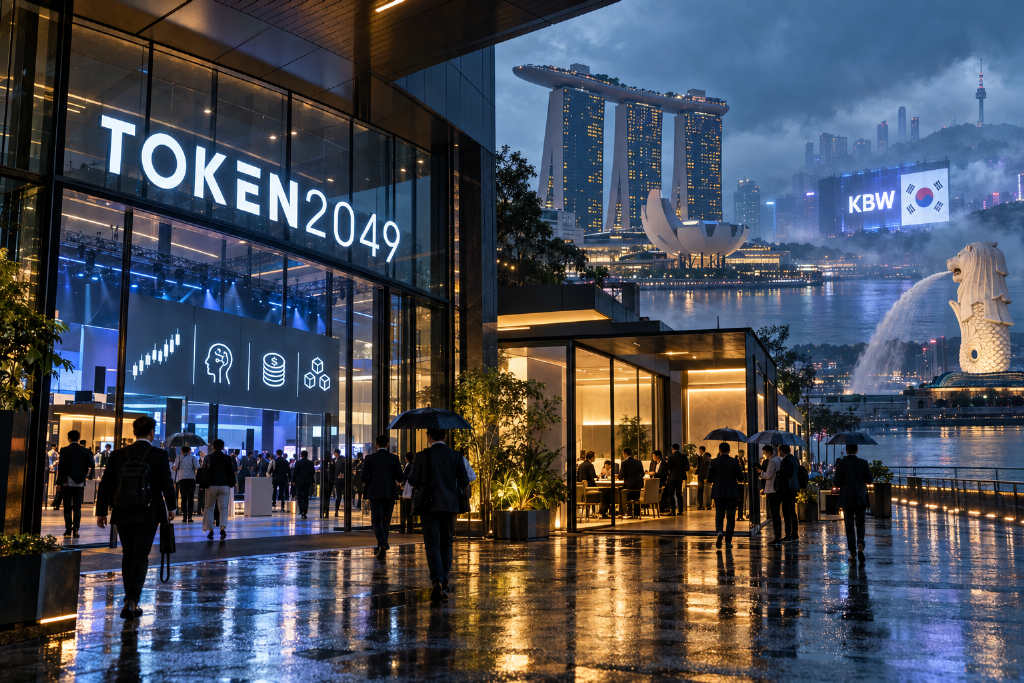
IOSG Ventures said this year’s Korea Blockchain Week in Seoul and TOKEN2049 in Singapore pointed to the same underlying shift: the industry has not cooled in absolute terms, but activity has moved away from the main halls and into side events, meeting rooms and closed-door sessions. The firm said the market is no longer centered on talk of the next 100x token. Instead, the focus has moved to AI agents, stablecoins, institutional rails and products that can show real revenue.
Its core argument was that narrative-driven capital is retreating, while revenue-driven capital is moving in. In IOSG’s view, that migration is showing up most clearly in trading venues, stablecoin and payment infrastructure, institutional access layers and AI products with cash flow or buyback mechanics.
Seoul: the main venue looked quieter, but institutions moved to center stage
According to IOSG, attendance at the KBW main venue did not fall and was slightly above last year, though still below pre-event expectations of more than 14,000. The sense of a colder market came from a change in the crowd rather than a drop in headcount. Local media described it as “hoodies meeting suits.”
Side events were fewer, but more concentrated. Out of roughly 185 side events listed on the official schedule, about 35 were focused on ecosystems and public chains, around 27 on DeFi and trading, including Perp-DEX Day, about 22 on gaming, entertainment and NFTs, around 20 on RWA and institutions, about 16 on AI, and roughly 10 on stablecoins and payments. The remaining 55 or so were broader social gatherings, parties and private dinners.
The speaker lineup also changed. IOSG said 115 of the 290 speakers came from finance, policy and asset-management service providers, close to 40% of the total. Moody’s, S&P Global and Franklin Templeton discussed ratings and data frameworks. Samsung Securities, Korea Investment Securities, Kyobo Life, Hyundai Card and LG CNS appeared as new institutional partners. In IOSG’s reading, the main stage increasingly resembled a financial industry conference.
The report tied that shift to a broader reshuffling of local capital. Naver Financial and Dunamu, the parent company of Upbit, are moving ahead with a share-swap merger. Mirae Asset acquired Korbit. Korea Investment Securities and OKX Ventures each took 20% stakes in Coinone. Hana Bank holds 6.55% of Dunamu. Traditional finance, IOSG wrote, is not showing up just to attend. It is buying access points.
Seoul side events focused on what teams were building, not what they were selling
IOSG described Seoul’s side events as smaller and looser in tone, with conversations centered on actual work rather than token marketing. Ethereum Korea One set its Builder Day theme as “Build Beyond the Narrative” and explicitly wrote “no hype cycles, no price talk.” The opening guest was the CFO of DB Securities.
Citing Tiger Research, IOSG said Korean retail liquidity has been slowing and some foundations have cut budgets aimed at retail users in favor of institutional partnerships. The same shift was visible on the ground, it said. Teams talked more about TAM, compliance and revenue, and less about community airdrops. The conclusion was blunt: the narrative cycle is fading, and the teams that stay in the game are the ones with actual income.
AI led the conversation in Seoul, but real transaction volume remained small
IOSG said AI dominated the side events it attended in Seoul. Yellow discussed agentic trading, and the most common questions from the audience were about trust and where humans remain in the loop. Pharos used its “AI Meets RealFi” event to launch Vault Launchpad, framing agents together with tokenized yield products.
On the main stage, 0G discussed a trust layer for agents. Several speakers cited x402 data saying cumulative transactions could exceed 200 million by mid-2026, with more than 850,000 buyers. IOSG said the market’s working consensus is already clear: agents cannot open bank accounts or use credit cards, which makes stablecoins the most practical settlement method available to them right now.
But the gap between attention and usage remains wide. IOSG said actual agent transaction volume is still small, and average ticket sizes are low. Attention has arrived first. Product maturity has not.
Korean won stablecoins were not a party topic, but they were a meeting-room topic
IOSG said payments barely showed up as a dedicated topic at side events. Only about 10 of the officially listed side events, or roughly 5%, were tied to stablecoins and payments. Yet inside institutional sessions and bank meeting rooms, the subject was one of the hottest on the agenda.
On the regulatory side, South Korea’s digital asset framework law is still in final coordination, and the question of who gets to issue a Korean won stablecoin remains unresolved. The biggest point of contention is whether banks must hold a 51% stake in the issuer. Even so, some players have already started moving. NHN KCP demonstrated Korean won stablecoin payment and settlement on the main stage. The second phase of the Bank of Korea’s Project Hangang already includes nine banks and is positioned as a middle-ground model between a CBDC and a stablecoin.
Distribution is also becoming a battleground. IOSG pointed to Naver × Upbit, Kakao × Kaia, Toss’s offline terminals and bank alliances as competing routes to user scenarios. It also cited a remark from a South Korean lawmaker in October that 54% of Japanese yen stablecoin trading takes place in South Korea. If that figure is accurate, IOSG said, it suggests Korean users are already using stablecoins, just not a domestic one. Once legislation lands, the contest will be about who already controls users and merchants.
South Korea’s tokenization sample: securities plus entertainment IP
IOSG noted that South Korea’s STO law passed in January and will formally take effect on Feb. 4, 2027, with detailed rules expected to roll out this autumn. BCG projects the country’s tokenized securities market could reach about KRW 367 trillion by 2030.
Still, IOSG said the more striking example was entertainment IP. WAVIST Night, hosted by Soneium, DayOneDream and Optimism, put K-Pop and onchain entertainment in the same room. Given South Korea’s strength in exporting IP and the involvement of Japanese-origin public chains, IOSG said “Japan-Korea IP plus onchain issuance and fan economy” could become a market-specific narrative.
Singapore: sold out, but no longer growing
IOSG said attendance at TOKEN2049 Singapore climbed from about 7,500 in 2022 to 25,000 in 2025, but this year marked the first time the event did not grow further. The main reason, it said, was that Marina Bay Sands had reached capacity. Organizers announced at the event that a New York edition will launch in June 2027 with a target of 15,000 attendees, meaning future growth will come from new cities rather than a larger Singapore footprint.
That made Singapore’s version of “cold” similar to Seoul’s. Tickets still sold out. The difference was that the exhibition floor felt less noisy and more institutional. TOKEN2049 again overlapped with Formula 1 week, and hotel prices were three to five times normal levels. At those prices, IOSG said, every meeting became more transactional. Compared with Seoul, Singapore had less room for open-ended discussion and more pressure to get something done in each session.
Day two belonged to Wall Street: the debate shifted from whether to engage to which rails to use
IOSG said the clearest change in Singapore came on the second day. Organizers added an invitation-only TOKEN2049 Institutional gathering, bringing together about 250 executives from traditional finance and digital assets. BlackRock, Morgan Stanley, Goldman Sachs and Franklin Templeton were all on the list. The agenda centered on custody, tokenization, liquidity and trading infrastructure.
On the main stage, Nasdaq CEO Adena Friedman spoke about 24/7 trading. Franklin Templeton CEO Jenny Johnson criticized “digital twin” tokenization that simply ports traditional funds onchain without changing the underlying structure.
Moves around the conference lined up with the same theme. Coinbase said it had completed the Deribit integration. OKX and ICE applied to the SEC to list tokenized trading for 63 U.S. stocks. IOSG contrasted this with Seoul: in South Korea, traditional finance is buying access points such as exchange equity and licenses; in Singapore, it is choosing rails, meaning which chain, which custodian and which settlement layer to use. Institutions are no longer debating whether to touch crypto. They are debating implementation choices.
Payments did not disappear. They moved backstage
IOSG said payment companies were still present in Singapore, but payment itself was no longer a major stage topic. Popular evening events still filled up, including KAST’s gathering and several cocktail sessions. KAST itself is a company focused on stablecoin accounts and cards.
The actual payment developments were happening offstage. IOSG pointed to an Oct. 8 announcement from Nium and RedotPay, which said they would use Nium’s network across 190 countries and 100 currencies to expand stablecoin cash-out services. There was no launch event, only a press release. That, IOSG said, is what the payments track looks like this year.
AI agents were just as prominent in Singapore, but still framed in the future tense
IOSG said AI was also the lead theme at Singapore side events, especially where it intersected with trading and tokens: strategy-running agents, research and execution tools connected to AI, and token launches carrying AI branding.
The main stage reflected the same pattern. “The Agent Economy: Why AI Needs Crypto” featured NEAR’s Illia Polosukhin, Base’s Jesse Pollak and Gauntlet’s Tarun Chitra. Arthur Hayes introduced the AI agent network FLOP, focused on commercial payments between agents, but IOSG noted that no white paper or supply plan had been released by the time of the event. Eric Trump described a scenario in which agents use crypto wallets to book flights.
IOSG said one point was worth recording carefully: not a single speaker claimed that agents are already generating meaningful transaction volume today. The language was consistently about what agents will do, not what they are doing now. That matched what the firm heard in Seoul.
Perp DEXs and prediction markets stayed visible, but the leading players were already moving to the next product
IOSG described Perp DEXs and prediction markets as a continuation of last year’s themes rather than a fresh narrative. The leading names are already extending into adjacent products. Hyperliquid’s Jeff Yan said options are the next focus and will sit on the same order book, though he gave no timeline. Polymarket hinted at launching onchain assets without offering details. Kalshi’s John Wang discussed bringing perpetuals into the U.S. Lighter’s Vladimir Novakovski appeared on a panel about onchain options and derivatives.
The report also highlighted a local regulatory wrinkle. During the same week, the Financial Times reported that Hyperliquid had confirmed Singapore as its registered headquarters, while the Monetary Authority of Singapore said it does not consider the platform to fall within its regulatory perimeter because of its decentralized nature. MAS had already placed Hyperliquid on its investor alert list in June. IOSG said the fact that the world’s largest Perp DEX can sit in Singapore while remaining outside direct oversight says a lot about how far this segment still is from a licensed model.
Regulation: Singapore is writing operating rules, South Korea is still deciding who gets to issue
IOSG said MAS published a consultation paper on Sept. 1 proposing amendments to the Payment Services Act to implement its stablecoin framework. The proposal would ban interest payments to holders, require reserve assets to cover at least 100% of liabilities and remain segregated from issuer assets, mandate monthly independent attestations and annual audits, and add stress testing and orderly wind-down plans. Stablecoins that do not meet the standard would not be banned, but they would be treated as ordinary digital payment tokens. The consultation closed on Oct. 16, and the next step is subsidiary legislation.
That stands in contrast to Seoul, where the debate is still stuck on whether banks must own 51% of a Korean won stablecoin issuer. IOSG summed up the difference this way: one market is still arguing over entry qualifications, while the other is already setting operating rules.
Shared signals across both cities
IOSG reduced the overlap between Seoul and Singapore to several common signals.
- AI has captured attention before product-market fit has arrived. In both cities, AI dominated side events, but no one showed meaningful agent transaction volume or large average transaction sizes. IOSG said the near-term winners are more likely to be infrastructure layers around identity, authorization, settlement and risk control than the “smartest” agent.
- Payments have moved from the stage to the back office. IOSG said stablecoin payments and payment rails were almost standard side-event topics a year ago, but this time there were hardly any dedicated sessions. Volume, however, has not disappeared. The firm cited at least $401 billion in identifiable stablecoin payment volume from January through August this year, up 42% year over year, and said Visa’s annualized stablecoin settlement volume has exceeded $20 billion. Its conclusion was that payments have become a licensed B2B business, better suited to bank meeting rooms than party stages.
- Perp DEXs and prediction markets still draw interest, but they are no longer the new story. KBW had a Perp-DEX Day and around 27 DeFi and trading side events. Singapore showed the same familiar names.
Where the money is moving
For IOSG, the more important question is not whether conference halls feel hot or cold, but where capital is going. Combining conversations from both cities with onchain data, the firm said money is now moving along four broad lines, all tied to the same pattern: narrative-driven capital is fading, and revenue-driven capital is taking its place.
Crypto-native capital: toward Perp DEXs and prediction markets
IOSG said crypto-native money has not left the market. It has shifted from buying new tokens to trading inside venues. Hyperliquid, in its view, is no longer just a Perp DEX but an open trading platform. HIP-3 allows third parties to deploy markets on top of it. One year after launch, cumulative volume reached about $665 billion, with roughly $64.7 billion over the last 30 days, equal to about 27% of Hyperliquid’s total volume as of Oct. 20. The product mix has expanded from crypto assets into commodities, U.S. equities and pre-IPO contracts. By July, single-stock and pre-IPO products accounted for 62% of HIP-3 volume. On Sept. 8, Hyperliquid’s open interest rose to a record $14.3 billion.
In prediction markets, Kalshi and Polymarket posted combined volume of about $45.3 billion in August. IOSG said that was the first month-on-month decline since the World Cup, down about 15%, though September’s football season lifted activity again. The leading platforms are also moving into adjacent categories: Hyperliquid into options, Kalshi into perpetuals and Polymarket into onchain assets.
Compliant capital: toward fintech and stablecoin rails
Traditional finance is not entering crypto to buy tokens, IOSG said. It is buying access points and rails. In South Korea, that means exchange equity and licenses. In Singapore, it means custody, tokenization and settlement layers. The return profile for this capital looks more like fintech than token speculation, with attention on licenses, distribution and take rate rather than token premiums.
The altcoin line: toward AI products with revenue
IOSG argued that while AI agents on stage are still framed in future tense, the secondary market has already started pricing AI products that generate revenue now. Venice.ai posted annualized revenue above $100 million in August. Since late 2025, it has used part of monthly revenue to buy back and burn VVV, and since July it has also directed 5% of API revenue to buybacks and burns.
Grass, meanwhile, reported $17 million in revenue for 2025 and another $17 million in the first half of 2026, with a full-year target of $75 million. IOSG noted that those figures are company-reported and unaudited. Its conclusion was that AI tokens that remain relevant will do so because they have paying users and mechanisms that route revenue back to the token, not because of the agent narrative alone.
Meme and speculative capital: toward revenue-generating trading gateways
IOSG said meme speculation has not disappeared, but value capture has shifted into the tool layer. Citing DeFiLlama, it said Fomo overtook GMGN in July on seven-day revenue to become the highest-grossing trading app across chains, with weekly revenue peaking at $1.57 million. The company completed a $75 million Series B in June at a $550 million valuation.
Rabby Wallet generates roughly $4 million to $5 million in annualized swap fees and also routes perpetual trading through Hyperliquid’s builder code, bringing in about $740 million in volume over the last 30 days. IOSG’s takeaway was that individual meme lifecycles are getting shorter, while the durable money is being made by gateways that control traffic and can direct it into Perp DEXs.
Risks IOSG flagged
IOSG also listed several areas that warrant caution.
- Trading activity is highly concentrated while regulation remains incomplete. About 97% of HIP-3 volume sits on trade.xyz alone, and MAS does not consider Hyperliquid to be within its regulatory scope.
- Prediction market volume is tied closely to sports calendars, and August already showed the first pullback.
- Revenue figures for AI products and trading apps are often self-reported or heavily dependent on meme activity. Whether buybacks can continue depends on whether revenue keeps growing.
What IOSG is watching next
IOSG closed by saying conference venues may feel colder, but business has not disappeared. Attention has shifted toward AI, while money continues to move through the back end of payments. South Korea, in its view, is changing from “the world’s most active retail market” into “the most instructive institutionalization case study.” Regulation is still catching up, but capital, licenses and distribution pipes are already being put in place. Singapore offers a different case: venue growth has topped out, institutions now dominate the second day, and regulators are filling in the operating details for stablecoins.
The firm said the next few months are worth watching for several specific milestones: South Korea’s STO implementation rules expected in autumn, the Naver-Dunamu shareholder meeting in November, the Nov. 20 deadline for VASP re-registration, and the final version of the Korean won stablecoin bill. In Singapore, the key items are subsidiary legislation for the MAS stablecoin framework and whether MAS will issue a formal position on decentralized platforms such as Hyperliquid.
IOSG said the piece reflects its industry observations only and does not constitute investment advice.


