
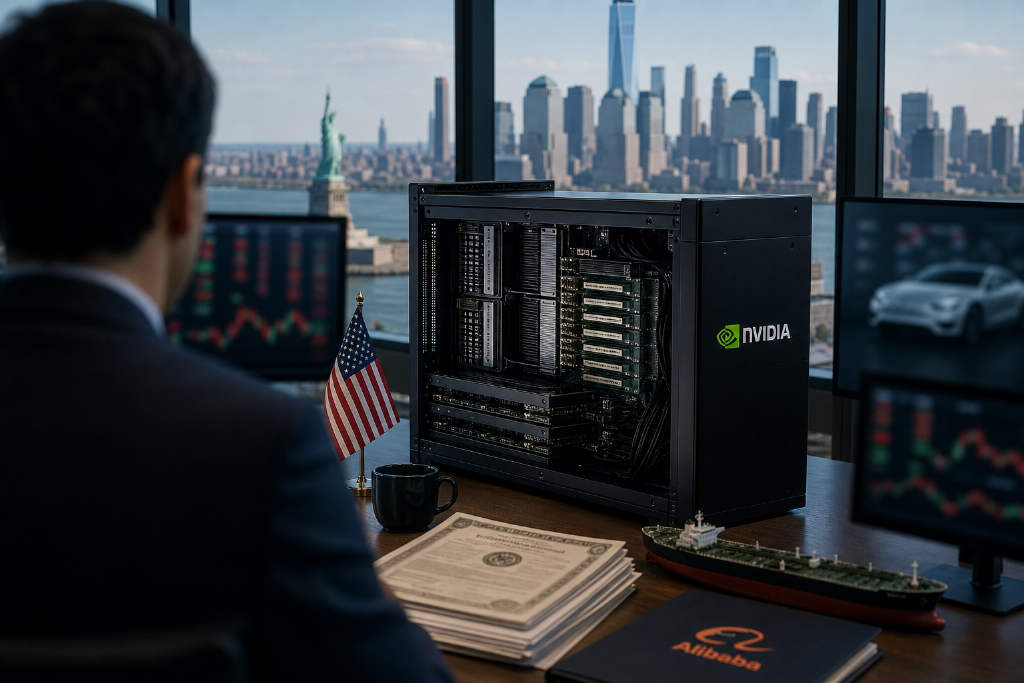
PANews said several market themes are tightening at the same time, with macro data, Treasury yields, Iran sanctions, AI spending and large-cap tech all in focus going into the new week.
On Friday, the preliminary U.S. August composite PMI beat expectations and climbed to its highest level in more than four years. Strength in services offset weakness in manufacturing and helped the three major U.S. stock indexes finish higher. The Dow Jones Industrial Average gained 0.98%, its biggest one-day rise since May. The S&P 500 added 0.43%, and the Nasdaq Composite rose 0.44%.
The weekly picture was weaker. The S&P 500 fell 1.43% for the week, the Nasdaq lost 2.05%, and the Dow slipped 0.85%. The Nasdaq also ended a three-week winning streak.
Bond market pressure remains in place
PANews highlighted the Treasury market as the area that deserves the closest attention. In early Asia trading on Aug. 24, the 10-year U.S. Treasury yield was around 4.71%, while the 30-year yield stood near 5.245%, both near the upper end of their one-year ranges. Last Tuesday, the 30-year yield briefly touched 5.338%, the highest level since 2007.
The report said wider fiscal deficits, energy-driven inflation, AI-related corporate debt issuance and uncertainty over Federal Reserve policy are all pushing up the term premium. Treasury Secretary Bessent has expanded long-dated bond buybacks, but that has not fundamentally changed the direction of long-end yields.
Goldman Sachs said keeping yields from rising further may require fiscal tightening or more favorable inflation data. Otherwise, long-term yields could test the 5.2% to 6% range until investors are willing to absorb more duration.
Dollar softens while gold and silver extend gains
The U.S. dollar index was hovering near 98.72, close to a three-month low. Gold Predict technical analyst AG Thorson said the dollar may have formed an important top in June. After breaking below its 200-day moving average, he said, the technical picture now confirms a weaker cycle, and the index could even fall below 90 next year.
Precious metals stayed strong. Gold futures rose more than 5% for the week and broke above $4,700 early Monday in Asia, extending gains to a new high since May. Silver futures gained more than 6% for the week and briefly moved above $70. Spot gold traded above $4,650 intraday before giving back part of the move.
Thorson said gold and silver may already have completed a midyear bottom. In his view, gold could break above $7,000 next year, while silver may consolidate in the $90 to $100 area before moving higher again.
Bridgewater founder Ray Dalio also warned that the U.S. fiscal path has reached a turning point. If deficits and debt continue to deteriorate, he said, a debt crisis could break out within one to five years, roughly three years as a central estimate. He suggested reducing bond exposure and allocating 10% to 15% to gold plus a small amount of Bitcoin.
Bessent says Iran sanctions will amount to an “economic D-Day”
Iran is another key market driver this week. Bessent said the U.S. will launch what he described as an “economic D-Day” against Iran, calling it the largest financial offensive in history. The package is set to focus on secondary sanctions tied to buying Iranian oil, money transfers and ship-to-ship transfers, with details expected during Monday trading hours.
Bessent also said “large-scale military action” is no longer expected to be necessary. On the other side, Iran’s parliament is advancing a Strait of Hormuz toll proposal, and its top security official warned that if the economic war continues, “not a drop of oil” will be allowed to leave. PANews said shipping activity has already declined and oil prices have come under pressure.
In early Asia trading on Aug. 24, Brent crude was around $91.4 a barrel and WTI crude was near $85.6. Both were down from earlier highs. PANews described the pullback as profit-taking ahead of the release of the sanctions details.
U.S.-Canada trade friction escalates
Trade tensions also moved higher. A 50% U.S. tariff on roughly $20 billion of Canadian goods took effect on Aug. 22. Canada then said it will impose equivalent retaliatory tariffs on U.S. goods starting Sept. 8, covering dairy products, steel, home appliances, pulp and electronic products.
The report said Ottawa sees little chance of reopening negotiations before the midterm elections and is preparing a long-term support package. On the same day, Trump granted a 90-day exemption on import tariffs for ground beef, allowing up to 300,000 tons of imports in an effort to lower consumer prices.
AI infrastructure costs rise as Nvidia server prices may climb more than 15%
Even with Friday’s broader equity rebound, AI semiconductors did not keep pace. The Philadelphia Semiconductor Index fell 0.51%, Nvidia lost 0.97%, Arm dropped 2.95%, Marvell Technology fell 5.57%, and Intel lost 2.24%. The market is showing more concern about the return on AI capital spending.
PANews said hedge fund Citadel has disclosed that it cut semiconductor exposure by more than 80% through over 100 block trades involving more than $4 billion. The positions mentioned in the report include Micron, Nvidia, Broadcom, Taiwan Semiconductor Manufacturing Co., CoreWeave and Nebius.
At the same time, some of Nvidia’s biggest customers were told that server prices for systems using Nvidia AI chips may rise by more than 15% next year because memory chip costs have surged. For Nvidia, the increase points to strong pricing power. For customers such as Microsoft, Google and Oracle, it means higher AI spending and a longer payback period.
Alibaba became another focal point after announcing the completion of an HK$80 billion placement to expand its full-stack AI capabilities. Its U.S.-listed shares fell more than 8% on Friday, and the Hong Kong-listed stock came under more pressure at Monday’s open. Michael Burry said publicly that he has exited Alibaba and switched into JD.com, adding that new share placements at Alibaba have become routine and that he would not reconsider the stock unless it fell by half.
PANews said analysts now see the AI trade moving from a phase driven by belief to one driven by verification, with investors paying more attention to cash flow, gross margin and electricity costs. Nvidia is due to report second-quarter earnings after the U.S. market closes on Wednesday. The market expects July-quarter revenue of $95 billion and guidance for the October quarter of about $108 billion.
Investors will focus on four items: Blackwell shipment progress, Rubin’s ability to take over as the next platform, the AI supply-demand balance, and Nvidia’s financing responsibility when locking in large customer orders.
At the same time, price competition in AI models has intensified as OpenAI and Google cut prices, while AI startup Anthropic has reportedly been linked to a fundraising plan of more than $100 billion. PANews said those developments show the industry entering a capital-heavy race defined by computing power, electricity and financing.
Tesla leads the Magnificent Seven, crypto-linked shares jump
Tesla rose 5.14%, hit a one-month high and is now up more than 16% this month. Nevada approved Robotaxi operations in Las Vegas for Tesla, Waymo and Uber, with Tesla allowed to deploy as many as 5,000 vehicles. The company also announced a Cybercab event in Austin on Sept. 3, where a model without a steering wheel or pedals may be added to the fleet.
Nvidia fell 0.97%. PANews said caution ahead of earnings was a major factor, with investors watching server price increases, higher costs, pressure on gross margin and financing obligations tied to AI orders. Within semiconductors, the Philadelphia Semiconductor Index lost 0.51%, Arm dropped 2.95%, Intel fell 2.24%, TSMC’s ADR rose 0.71%, and Broadcom gained 1.21%.
Marvell dropped 5.57%. PANews said investors are proactively cutting high-beta exposure to the AI networking and custom-chip chain ahead of earnings season. The sensitivity has increased after reports that Broadcom is discussing $70 billion to $80 billion in debt financing for AI infrastructure.
Among Chinese ADRs, Alibaba fell 8.58%, while its Hong Kong shares were down nearly 10% at one point in early trading. The company said the roughly HK$80 billion raised through the placement will be used entirely for AI. The market’s near-term concern is dilution. Burry said he sold Alibaba and rotated into JD.com, adding that he would not be interested again unless Alibaba’s share price was cut in half.
Elsewhere in Chinese stocks, NetEase rose 6.98%, Xiaomi gained 4.48%, Tencent added 1.57%, Meituan fell 1.42% and PDD Holdings lost 1.27%.
Palantir rose 3.44% and remained one of the better-liked AI software names, which PANews tied to clearer demand from government and enterprise customers. Cybersecurity stocks also advanced, with Cloudflare up more than 5%, Zscaler up nearly 4% and Palo Alto Networks up more than 2%.
Crypto-related shares rallied sharply, driven by Bitcoin nearing $80,000, improving liquidity expectations and crypto-friendly policy from the Trump administration. Robinhood gained nearly 14%, Coinbase rose more than 8%, Strategy added more than 6%, Circle and Bitmine climbed more than 5%, while IREN fell nearly 2%.
Gold mining shares also moved higher after gold crossed $4,600, expanding profit leverage across the sector. Eldorado Gold rose more than 7%, Harmony Gold gained nearly 7%, AngloGold rose nearly 6%, Gold Fields added more than 5%, Kinross Gold gained more than 4% and Barrick Gold rose nearly 3%.
Southern Copper climbed 8.7% to a record closing high. PANews said a weaker dollar and stronger commodity trading boosted resource shares. Rare-earth names were also strong, with Critical Metals up more than 22%, TMC the metals up nearly 21%, USA Rare Earth up more than 12% and MP Materials up more than 9%.
In financials, Goldman Sachs rose 3.74% and Morgan Stanley gained more than 2%, helped by elevated long-end rates and a rebound in value stocks. Goldman also picked Boeing, Capital One, Mastercard, SpaceX, Thermo Fisher Scientific and Visa as stocks favored by both hedge funds and mutual funds.
Apple slipped 0.63% after cutting more than 200 jobs tied to Siri and Vision Pro teams. The market read the move as a shift in resources toward AI and new devices, but also as a sign that Vision Pro’s near-term commercialization remains difficult. Among other megacaps, Google rose 1.05%, Meta gained 0.75%, Microsoft was up about 1% and Amazon edged down about 0.3%.
What markets are watching this week
Monday, Aug. 24
SK Hynix’s labor union is set to vote on wages and labor agreements on Aug. 24 and 25. If labor talks are disrupted, the market will watch for any effect on HBM and the memory supply chain. As a core AI memory supplier, developments around SK Hynix could influence sentiment around Micron, Samsung and Nvidia-linked supply chains.
PDD Holdings will hold a 19:30 conference call, and Leapmotor and XPeng are also due to report earnings. For PDD, the focus is Temu growth and margins. For XPeng and Leapmotor, the focus is deliveries, gross margin and autonomous-driving spending.
Tuesday, Aug. 25
At 02:00, Bessent is scheduled to release details of the Iran sanctions package. A key question is whether the U.S. will sanction third countries that buy Iranian oil. PANews said stricter measures could support oil, gold and energy shares, while exemptions could lead oil prices lower.
Jefferies will host its semiconductor, IT hardware and communications technology conference on Aug. 25 and 26. Participants include TSMC, FormFactor, Aehr Test Systems and Arbe Robotics. Discussion is expected to center on AI accelerators, high-bandwidth memory, advanced packaging, data-center demand and automotive semiconductors.
Wednesday, Aug. 26
Gamescom in Cologne runs from Aug. 26 to 30, with the opening at 02:00. Microsoft, Nintendo, Tencent, NetEase and CDPR are among the companies expected to appear. The market will watch for new game releases, AI game tools, cloud gaming and hardware ecosystem updates.
At 20:30, the U.S. will release July core PCE and the revised second-quarter GDP figure. PANews noted that PCE is the inflation measure watched most closely by the Federal Reserve. If inflation comes in above expectations, Treasury yields may rise and the Nasdaq could face pressure. A softer reading could support gold and tech stocks.
Deutsche Bank’s California Technology Conference will run on Aug. 26 and 27 in Dana Point, California. In China, the Shenzhen AGIC General Artificial Intelligence Expo runs from Aug. 26 to 28, alongside the upcoming Digital Expo schedule, with attention on embodied AI and progress in real-world AI applications.
Thursday, Aug. 27
At 04:00, Nvidia will report earnings. The market is focused on data-center revenue, Blackwell shipments, Rubin progress, gross margin and guidance. Strong guidance could revive the AI trade. Weak order quality or margin pressure could extend the semiconductor pullback.
The Jackson Hole global central banking symposium runs from Aug. 27 to 29. Central bank officials are set to discuss financial innovation, inflation and policy paths. PANews said markets will prepare in advance for remarks from Waller, with the potential for larger swings in bonds and the dollar.
Bilibili, Vanke, China Life and Aluminum Corp. of China are also due to report. Investors are watching advertising, gaming and margins at Bilibili; property pressure at Vanke; the effect of capital-market volatility on investment income at China Life; and commodity-price exposure at Chalco.
Friday, Aug. 28
At 04:45, Marvell Technology will release earnings, a key checkpoint for the AI chip group. Weak guidance could pressure semiconductor sentiment again, while strong orders could help repair the AI hardware trade.
Zhipu’s GLM-5.3 weights are expected to be open-sourced on Aug. 28. The market is watching whether the model is linked to the anonymous Ox Alpha “Niulai” model. If open-source capabilities approach the frontier of closed-source models, PANews said the move could lift sentiment around China’s large-model developers, AI applications, cloud computing and domestic compute supply chains.
At 22:00, Federal Reserve Chair Waller is scheduled to speak at Jackson Hole. PANews called this the biggest macro event of the week. If he stresses inflation risks, the dollar and Treasury yields may strengthen and tech shares may come under pressure. A softer tone could support a rebound in risk assets.
At the same time, the U.S. will publish benchmark revisions to nonfarm payrolls and the University of Michigan consumer sentiment index. A large downward revision to jobs data could raise concern that the U.S. economy is weaker than it looks, while higher inflation expectations could narrow the Fed’s room to cut rates.
Meituan, BYD and PetroChina are also due to report, with investors watching food-delivery competition and margins, overseas expansion and EV margins, and the effect of oil prices and natural-gas demand.