
ITjuzi has released a new report, Portrait of China’s Embodied Intelligence Entrepreneur Ecosystem, which reviewed 1,155 entrepreneurs in the embodied AI sector and identified one central pattern: a big-tech background has become a powerful funding amplifier for startups in the field.
According to the report, more than 300 entrepreneurs previously worked at major technology companies including Huawei, Microsoft, Baidu, Google, DJI, Alibaba, Tencent, ByteDance and Xiaomi. The 232 embodied AI companies they helped found account for only 20% of the industry by company count, but they have taken in about half of all sector funding.
How the nine big-tech camps compare
The report compares the nine camps across three measures: number of companies in the embodied AI industry chain, total funding and average funding per company. It notes that some founders worked at more than one major tech company, so there is limited overlap in funding totals across camps. Even so, the data still shows the relative funding strength and industry weight of each group.
Huawei stands at the top in both company count and total funding. Its 26 companies raised a combined RMB 38.85 billion, far ahead of the Alibaba and Tencent camps that have stronger internet pedigrees. In the report’s framing, capital in embodied AI is moving toward teams that can actually build robots.
Microsoft ranks first by average funding at RMB 1.542 billion per company, while Google follows closely at RMB 1.509 billion per company. The report ties those figures to founders with elite AI research backgrounds who are able to raise large rounds on highly technical, frontier-facing narratives.
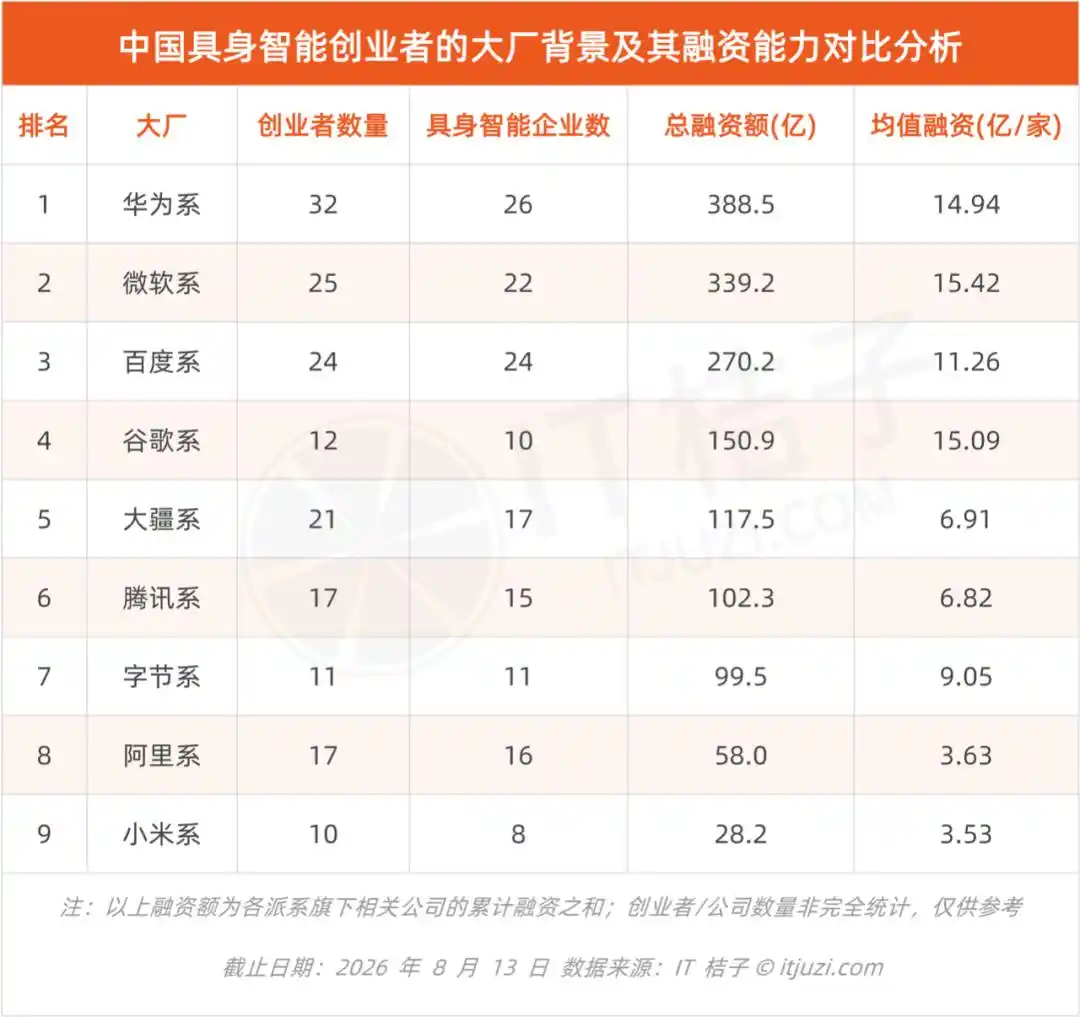
Alibaba’s camp has 16 embodied AI companies, a respectable count, but funding is concentrated in Yuyong Technology, founded by Lin Junyang. Funding at the rest of the group is relatively modest, leaving Alibaba with an average of only RMB 363 million per company, near the bottom among the nine camps and ahead of only Xiaomi.
Huawei: strongest in hardware and industrial execution
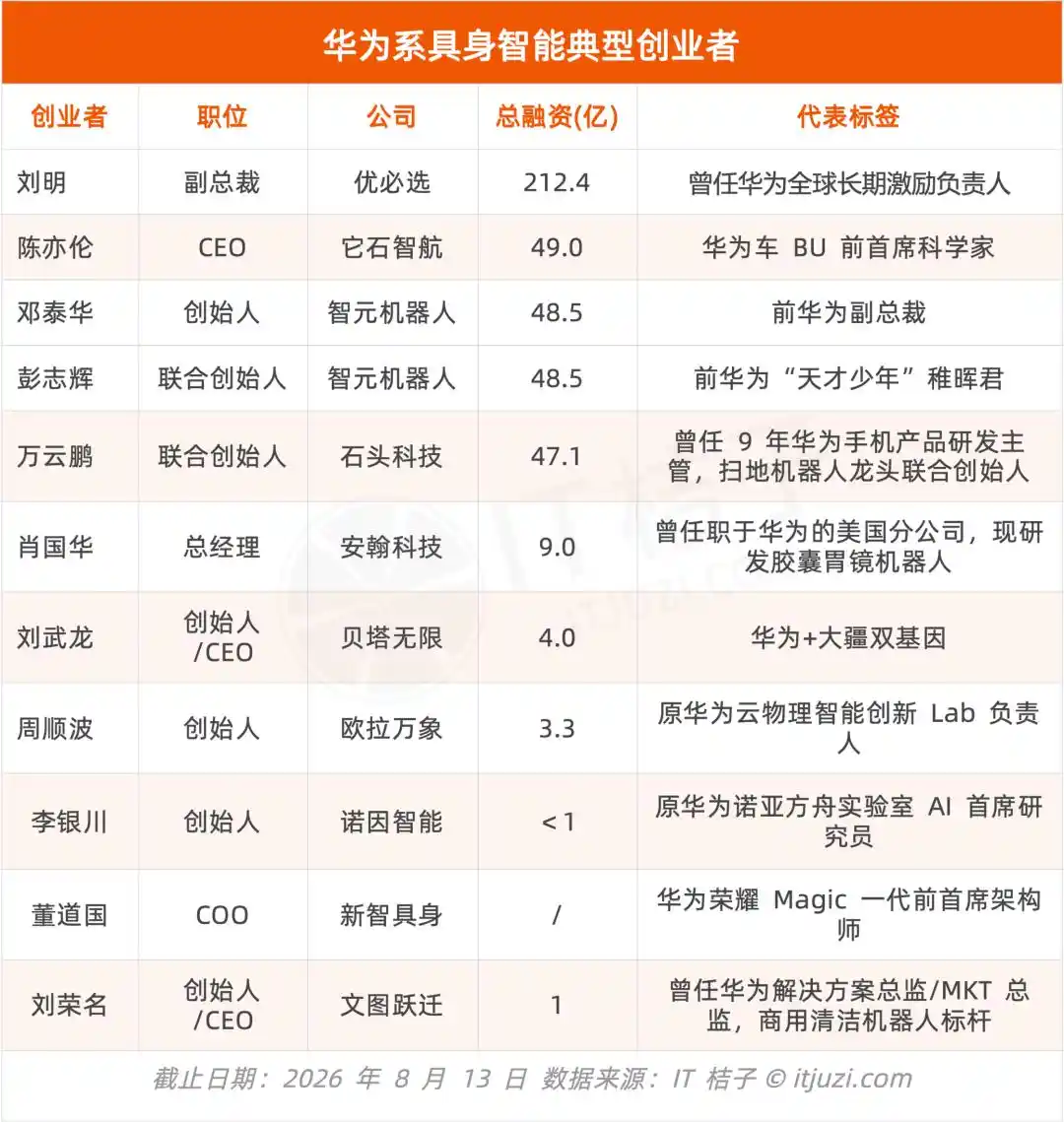
Huawei’s camp posted the highest total funding in the report, with 26 companies raising RMB 38.85 billion in aggregate. ITjuzi says the group’s edge comes from a combination of systems thinking and engineering execution. Engineers from Huawei are described as people who can think from top-level architecture all the way through mass production, connecting hardware, software and supply chains in one line of sight. That is exactly the mix embodied AI startups often lack.
The report highlights AgiBot founder Deng Taihua and co-founder Peng Zhihui, also known to many as “Zhihui Jun,” along with Tashi Zhihang CEO Chen Yilun, UBTECH vice president Liu Ming and Wan Yunpeng, who left Roborock and later founded the new energy company Endless Watt. Huawei-linked embodied AI companies are heavily concentrated in complete robot systems and industrial use cases.
Microsoft: research-driven, AI-native founders
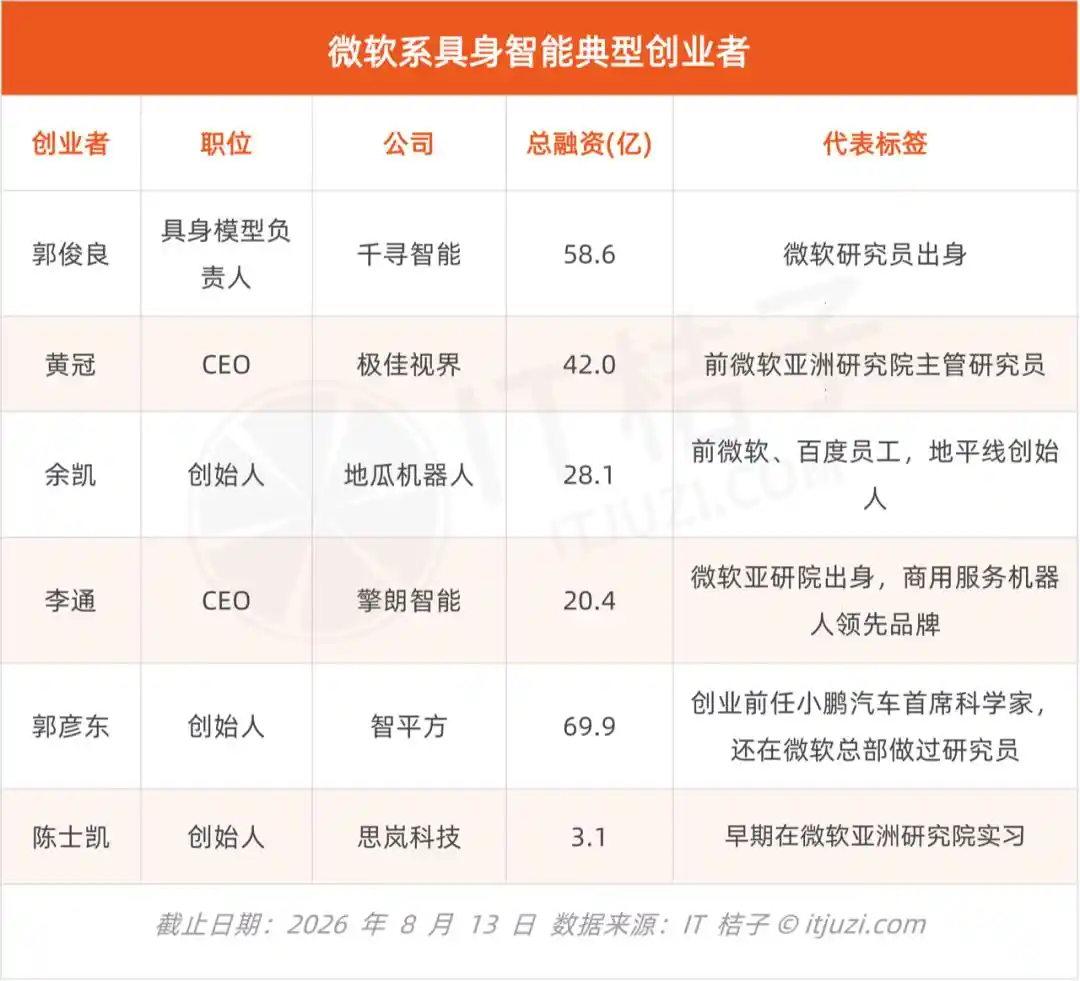
Microsoft ranks second by total funding at RMB 33.92 billion. The report says this founder group is defined by AI research, with many entrepreneurs coming from research roles. Microsoft Research Asia helped train a generation of algorithm talent in China, and some of that talent has now shifted from pure AI work into embodied AI and robotics.
Examples listed in the report include Yugua Robotics founder Yu Kai, Best Vision CEO Huang Guan, Qianxun Intelligence embodied-model lead Guo Junliang, Zhifang founder Guo Yandong and Keenon Smart CEO Li Tong. ITjuzi also notes that founders with Microsoft backgrounds are not uncommon in listed robotics-adjacent companies such as Horizon Robotics and Roborock.
Baidu: autonomous driving talent moves into robotics
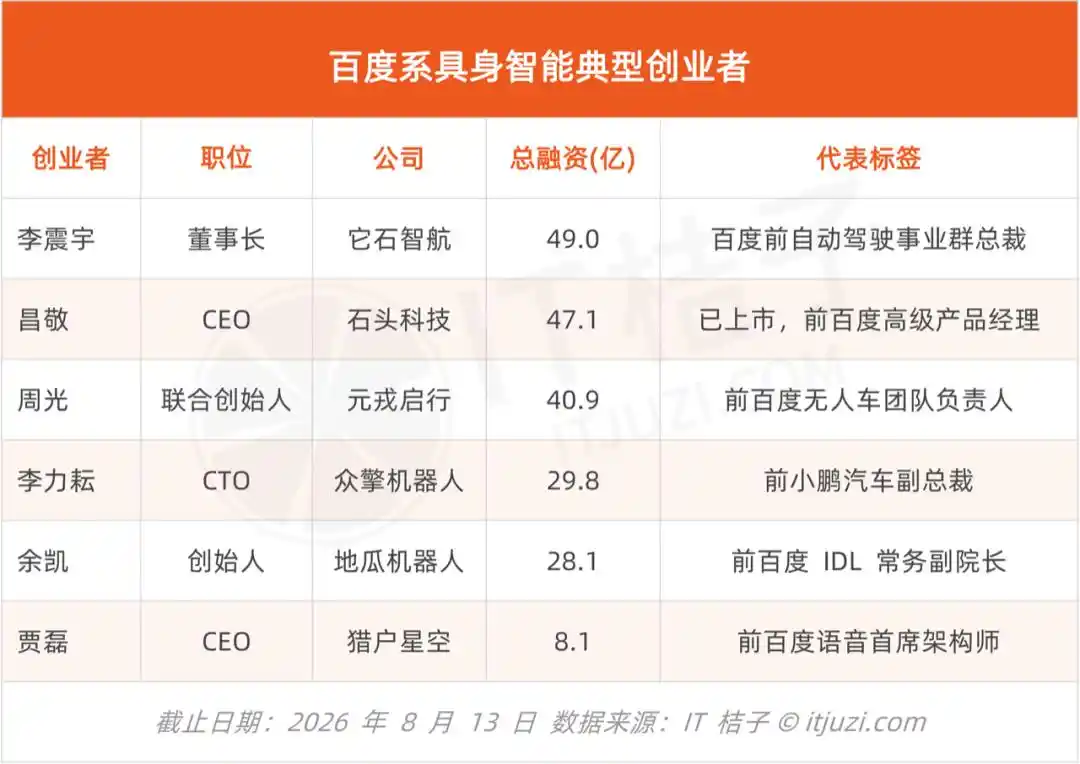
Baidu’s camp includes 24 embodied AI companies with combined funding of RMB 27.02 billion. Its defining feature, according to the report, is the concentration of autonomous driving talent. Baidu Apollo trained one of China’s earliest groups of autonomous driving engineers, and the stack they built in perception, planning and control can be transferred into embodied AI with relatively little friction.
The report names Tashi Zhihang chairman Li Zhenyu, DeepRoute.ai co-founder Zhou Guang, Zhongqing Robotics CTO Li Liyun and Roborock CEO Chang Jing. It characterizes the Baidu path as a natural move from cars to robots, while adding that some companies remain positioned in the middle of the industry chain.
Google: fewer companies, larger rounds
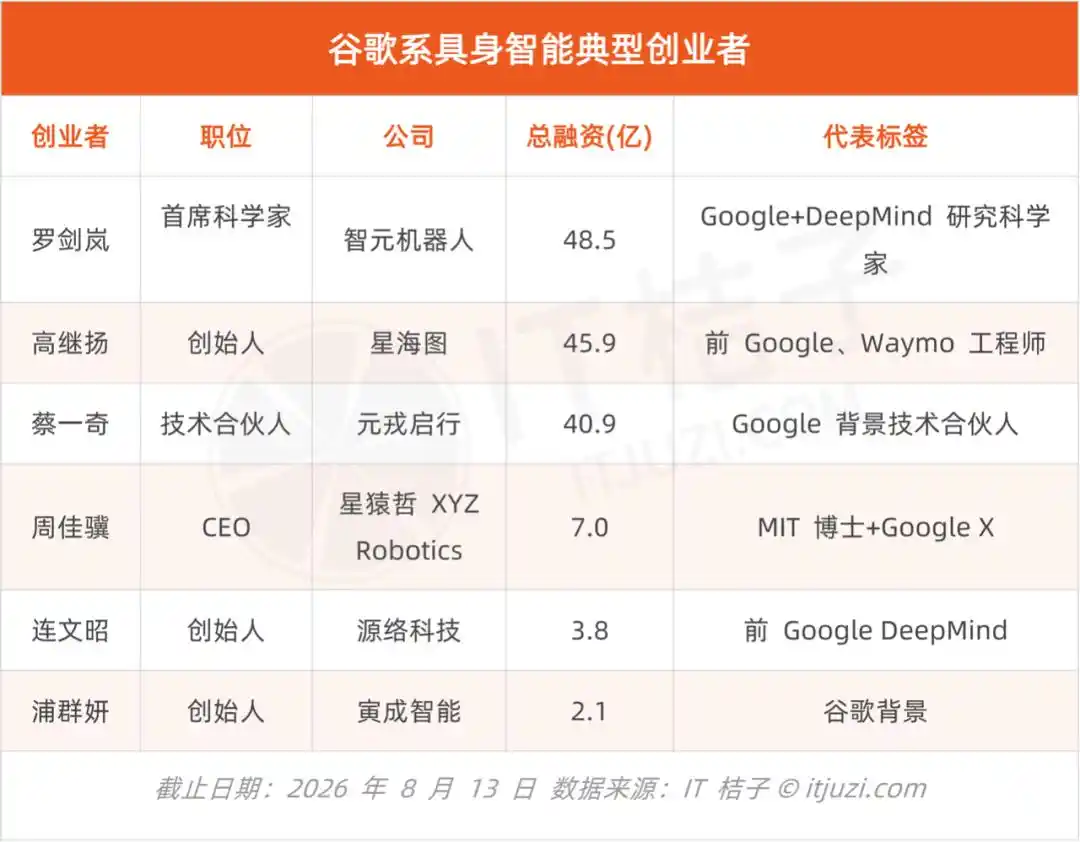
Google’s camp contains only 10 embodied AI companies, but average funding reaches RMB 1.509 billion per company, second only to Microsoft. The report says these founders often have strong academic profiles, global exposure and AI research credentials, which supports higher valuations and a stronger tilt toward frontier directions.
Representatives include AgiBot chief scientist Luo Jianlan, Xinghaitu founder Gao Jiyang and DeepRoute.ai technical partner Cai Yiqi. ITjuzi says Google-backed founders are known for being small in number but highly selective, with most of their companies based in Beijing and Shanghai and less closely connected to the Greater Bay Area supply-chain ecosystem.
DJI: full-stack hardware depth
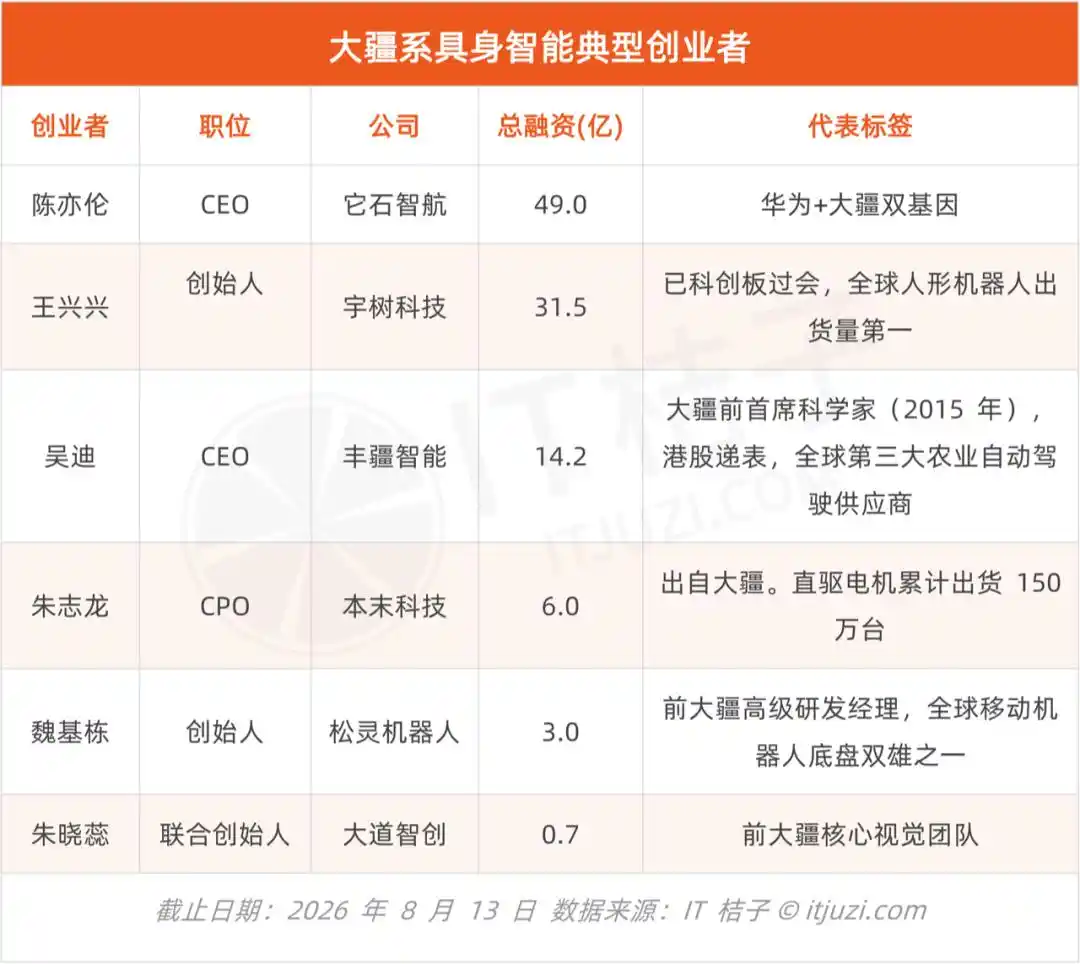
DJI’s camp includes 17 companies with total funding of RMB 11.75 billion. The report says its strength lies in full-stack hardware thinking. As the world’s leading consumer drone company, DJI has produced talent across the full robotics chain, from complete machines to core components, giving it a major place in China’s robotics industry.
The report points to Unitree founder Wang Xingxing, Tashi Zhihang CEO Chen Yilun and FJ Dynamics CEO Wu Di. It also highlights DJI’s RoboMaster competition system, which has run for 10 years and has continuously trained and identified young engineering talent for the country’s robotics sector.
ByteDance: AI-native, but hardware still a question
ByteDance’s camp has 11 companies with RMB 9.95 billion in funding, or RMB 905 million on average per company, placing it in the upper middle among the nine groups. The report says the camp’s clearest trait is a combination of AI-native capability and consumer product thinking. Methods formed inside ByteDance, such as algorithm-driven growth and intense focus on user experience, are now being applied to embodied AI startups.
Named figures include Qianxun Intelligence vice president Xie Junyuan, Accelerated Evolution CEO Cheng Hao and Shenpu Intelligence chief scientist Wang Jiawei. The report also draws a clear limit: ByteDance-linked startups are relatively weak in hardware accumulation, and for many of them, mass-production capability and supply-chain experience still have to be proven.
Tencent, Alibaba and Xiaomi show three different paths
Tencent’s camp includes 15 companies with total funding of RMB 10.23 billion, ranking sixth. ITjuzi describes the style of Tencent-linked founders as relatively dispersed. It includes veteran entrepreneurs such as Roborock’s Chang Jing and RoboTerra chairman Xiong Minghua, as well as newer founders from Tencent Robotics X, including Stardust Intelligence founder Lai Jie and AGILINK founder Xiong Kun. The latter two both chose dexterous manipulation for humanoid robots as their focus.
The report adds that Tencent has played more of an investor role in embodied AI than Huawei or Baidu, with direct investments in companies such as UBTECH, Unitree and FJ Dynamics, while producing fewer startup founders directly.
Alibaba’s camp has 16 companies, RMB 5.8 billion in total funding and an average of RMB 363 million per company, putting it near the bottom among the nine groups. ITjuzi says Alibaba Cloud and DAMO Academy have been the main talent pipelines, but most of the projects are still pre-Series A and lack mature flagship companies.
Lin Junyang is identified as one of the group’s most representative figures. The report says he joined Alibaba in 2019 as a senior algorithm engineer at DAMO Academy, later became the technical lead for the Tongyi Qianwen series of large models after 2022, and founded Yuyong Technology in 2026. The company has already secured $220 million in funding. Other representatives named are Yuanli Lingji vice president Chen Xuesong and Crossing Minds CTO Li Ping.
ITjuzi also notes that the scaling back of innovation lines such as DAMO Academy indirectly pushed some entrepreneurs into embodied AI. Those teams may have research support from the lab side, but the gap to real commercialization remains sizeable.
Xiaomi’s camp has eight companies with total funding of RMB 2.82 billion, making it one of the smaller and newer groups in the report. Its defining feature is the ecosystem-chain playbook. Many founders come from Xiaomi’s ecosystem companies and are familiar with product definition, supply-chain integration and cost-performance optimization. The report says this also creates a natural link with Xiaomi’s auto and robotics businesses.
Representative names include Xiaoyu Zhizao founder Qiao Zhongliang, Magic Atom founder Wu Changzheng and Amio Robotics founder Liu Fang. Most Xiaomi-linked companies are still in early angel stages, but the report says their background in ecosystem-chain manufacturing gives them leverage for future commercialization.
What kind of big-tech background matters most
The report says brand-name employers do lower investors’ trust costs, but the divergence across camps points to something more specific. The most rewarded background is not just prestige. It is a combined hardware-and-AI profile.
Huawei, Microsoft and Baidu, the three camps in the top funding tier, share that feature. Huawei is strongest in hardware design, supply-chain management and mass production. Microsoft and Baidu are stronger in AI algorithms and large models. Put together, those capabilities look much closer to the full stack embodied AI startups need.
By contrast, the Alibaba and Tencent camps, which come more directly from internet-company backgrounds, trail on funding scale. Xiaomi entered later, but even there, the core funding support goes to ecosystem veterans with hardware production genes. In the report’s reading, money is already giving a clear answer: teams that are strong in algorithms and have actually built hardware raise capital more easily, while teams with only model-building credentials are seeing their valuation room narrow.
Mass production is the dividing line
ITjuzi uses the contrast between DJI and ByteDance to make that point. ByteDance’s camp posts a higher average funding figure, RMB 905 million per company, than DJI’s RMB 691 million. But on the ability to ship products at scale, DJI is well ahead.
The report gives two examples. FJ Dynamics products are already present in 110 countries, and Benmo Technology has delivered more than 1.5 million direct-drive motors cumulatively. Pure ByteDance-linked embodied AI startups, by comparison, are mostly still at the product-validation stage.
That leaves the market with a clear split in the report’s analysis. AI-native founders may win higher starting valuations in the near term, but the ability to scale manufacturing and deliver products is what determines whether a company can move from funding support to self-sustaining operations.
This article was sourced from the WeChat official account ITjuzi (ID: itjuzi521). The author is Wu Meimei.